
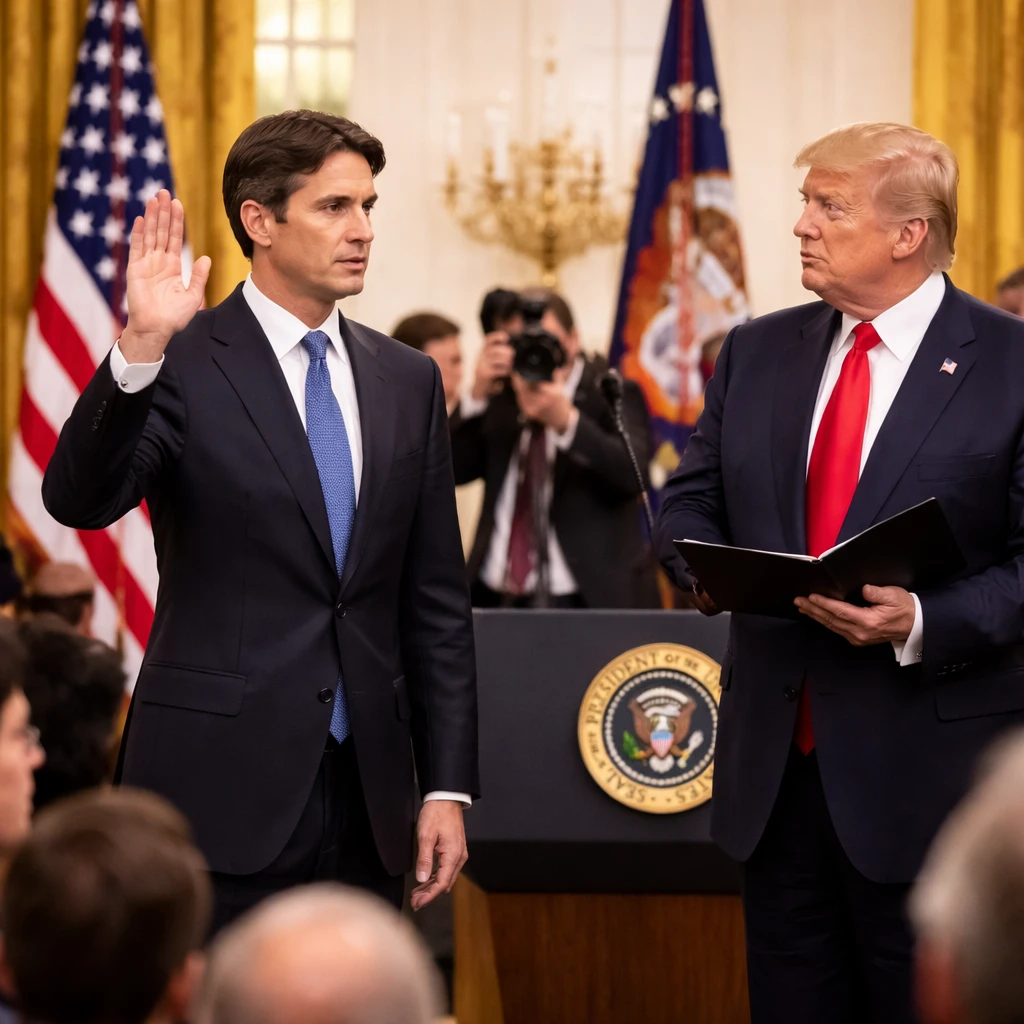
President Donald Trump is scheduled to swear in Kevin Warsh as chair of the Federal Reserve during a White House ceremony on Friday, according to an administration official who requested anonymity. The event will mark Warsh's formal assumption of the central bank’s top leadership role.
Warsh takes over as the Fed's 17th leader, replacing Jerome Powell, who had continued in a caretaker capacity after his official leadership term concluded last week. The Senate approved Warsh's nomination earlier this month by a 54-45 tally - the slimmest confirmation margin ever for an individual named to lead the Federal Reserve.
The transition occurs against a challenging backdrop. The ongoing conflict involving the US and Israel and Iran is noted in public commentary as generating inflationary pressures that complicate the outlook for Fed policy. Those pressures add a layer of difficulty to the central bank's task of charting a path for interest rates and inflation control.
The degree of Warsh's independence from the White House has been a focal point for critics. President Trump has expressed his expectation that Warsh will pursue near-term reductions in borrowing costs. That expectation follows a period during which Mr. Trump publicly pressed the Fed under Jerome Powell for not cutting rates fast enough.
During his Senate confirmation hearing, Warsh pledged to act independently while also offering critique of the Fed's recent performance. His stated balance of independence and criticism was a central theme of his public testimony to lawmakers.
Key context and implications
- Senate confirmation: Warsh was confirmed 54-45 earlier this month, the narrowest margin for a Fed chair confirmation in history.
- Leadership succession: He succeeds Jerome Powell, who had remained in charge in a temporary role after his term ended last week.
- Policy backdrop: The conflict involving the US and Israel and Iran is cited as creating inflationary pressures that complicate the Fed's policy outlook.
What remains uncertain
- Independence questions - Critics have raised concerns about whether Warsh will maintain sufficient independence from the White House, which could affect perceptions of central bank decision-making.
- Policy direction - President Trump has said he expects near-term rate cuts, but the article does not provide a detailed roadmap for how Warsh will act beyond his confirmation hearing commitment to independence and his critique of the Fed's recent performance.
The White House ceremony on Friday will formalize Warsh's transition into the role. Beyond the event itself, attention will remain on how the new chair navigates the interplay between geopolitical developments, inflationary trends, and expectations from the executive branch.