
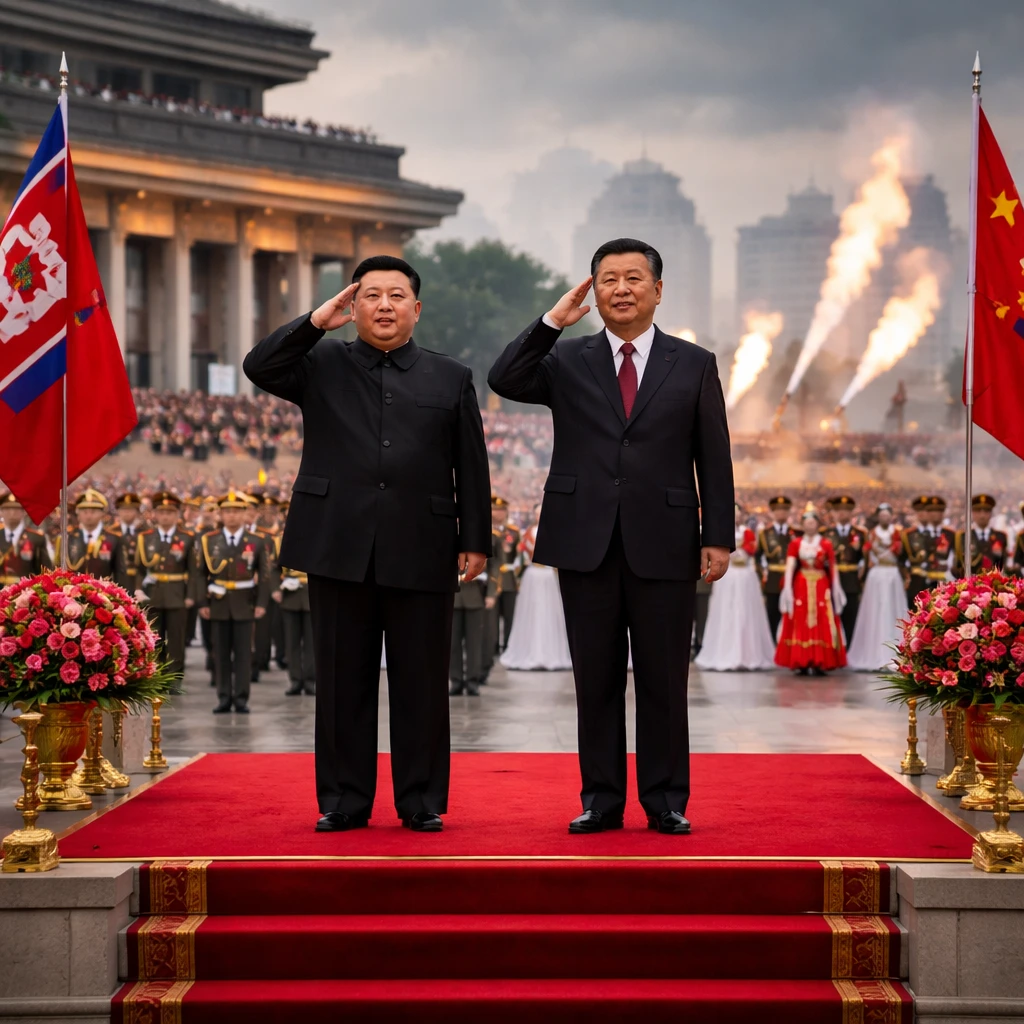
Chinese President Xi Jinping’s trip to Pyongyang this week concluded with both Beijing and Pyongyang portraying the visit as a success, even as differences in emphasis and remaining limits to cooperation were evident.
During the two-day visit, North Korean leader Kim Jong Un welcomed Xi with a 21-gun salute and a public cultural program that included performances of Chinese and North Korean songs. State-controlled accounts from both countries conveyed warm language: each side lavished praise on the other and spoke publicly of deeper cooperation going forward. Yet, conspicuously absent from the official accounts and public reporting was any detailed discussion of denuclearisation or of relations with the United States.
Analysts cited the omission of denuclearisation from the visit’s public agenda as significant given its prior role in shaping tensions between China and North Korea. On the eve of Xi’s arrival, Kim Yo Jong, the sister of the North Korean leader, publicly blamed the United States for spreading false information after Washington said in May that Xi and U.S. President Donald Trump had affirmed a shared objective of denuclearising the Korean peninsula during talks in Beijing.
Jenny Town, director of the Korea program at the Washington-based Stimson Center, framed Xi’s decision to make his first foreign trip of the year to Pyongyang - and to do so without placing denuclearisation front and center - as a clear diplomatic win for Kim Jong Un. "Having Xi now take his first trip out of country this year to visit Pyongyang on an agenda that didn’t include North Korea’s nuclear programme, was a big win for Kim," she said.
Observers also noted commentary from analysts who see China’s posture as having shifted. Jeremy Chan, a China and Northeast Asia analyst at Eurasia Group, said: "Beijing has very clearly moved on from that issue and now tacitly accepts North Korea as a nuclear state, which likely puts China on an equal footing with Russia in Pyongyang’s eyes." He added that drawing North Korea closer to Beijing and counterbalancing Russia’s influence appeared to be China’s primary objective for the trip.
Chinese foreign ministry spokespeople told a regular briefing that China’s position and policy on the peninsula remained consistent and stable when asked whether denuclearisation had been discussed during the meeting between Xi and Kim. They did not respond immediately to requests for clarification on whether the absence of public mention amounted to implicit acceptance of North Korea’s nuclear status.
Public theater and divergent emphases
Despite shared public warmth, there were distinct differences in how the two governments described the visit and its outcomes. North Korean reporting featured the ceremony, the symbolism of equality with Beijing and the public trappings of state-to-state friendship. Chinese accounts, by contrast, emphasized practical expectations for cooperation in areas such as trade, tourism and law enforcement, and even referenced military cooperation.
Analysts said these differences reflect the limits of how far Pyongyang is currently willing to go to deepen ties with Beijing. Town noted that while North Korea has moved closer to Russia in recent years - including through military support to Russia and in exchange for economic assistance - the personal chemistry between Kim and Xi does not appear comparable to Kim’s reported rapport with Vladimir Putin. "It is clear that Kim and Xi do not have the kind of rapport Kim has with Putin; there seems to be little personal affinity between them. But both understand the strategic value of the relationship to push through," she said.
That said, commentators highlighted two elements of the visit that could have particular significance. First, Kim's explicit support for Beijing’s One China principle - which for Beijing means that both sides of the Taiwan Strait belong to one country - was noted in official messaging. Second, China’s public mention of military cooperation during or around discussions stood out to observers as a sign that security elements were being acknowledged, even if not discussed in a way that would settle longstanding concerns about nuclear weapons.
Chad O’Carroll, founder of the North Korea-focused website NK News, stressed that Pyongyang’s prior support for Russia had demonstrated North Korea’s ability to deliver material assistance to a major power during wartime. He said there is not yet comparable evidence of an equivalent military commitment to China, though he observed that messaging from North Korea on Taiwan now has increased significance.
Signals and absences
Observers also examined the trip for symbolic signals beyond the formal communiqués. One such point of attention was whether Kim’s daughter, believed to be around 13 and known by the name Ju Ae, would appear publicly during the visit. Her presence on previous trips, including an accompanying role during a visit to Beijing last year and frequent appearances in photographs with her father, had led some agencies and commentators to suggest she might be being groomed for succession.
Images released by Chinese and North Korean state media from this visit did not include the girl. Benjamin Ho, a China programme associate professor at the S. Rajaratnam School of International Studies in Singapore, said her absence aligns with Beijing’s protocol-focused approach. "Given Beijing’s penchant for protocol, it would be awkward if a young girl appears among all the senior officials present," he said.
In sum, the trip accomplished visible diplomatic goals for both sides: Kim gained international visibility and public reaffirmation of ties with China, while Beijing secured public commitments around trade, tourism, law enforcement and a measure of security cooperation. Still, the visit laid bare the limits of the relationship and left key strategic questions - notably the nuclear issue and the precise nature and depth of military assistance or cooperation - publicly unresolved.
Implications for markets and sectors
- Trade and tourism sectors could be affected by the stated Chinese expectations of increased cooperation in those areas.
- Law enforcement and security-related industries may see heightened attention if bilateral cooperation expands.
- Defense and geopolitical risk considerations remain relevant for markets observing any shift in state-level commitments or alignments.