
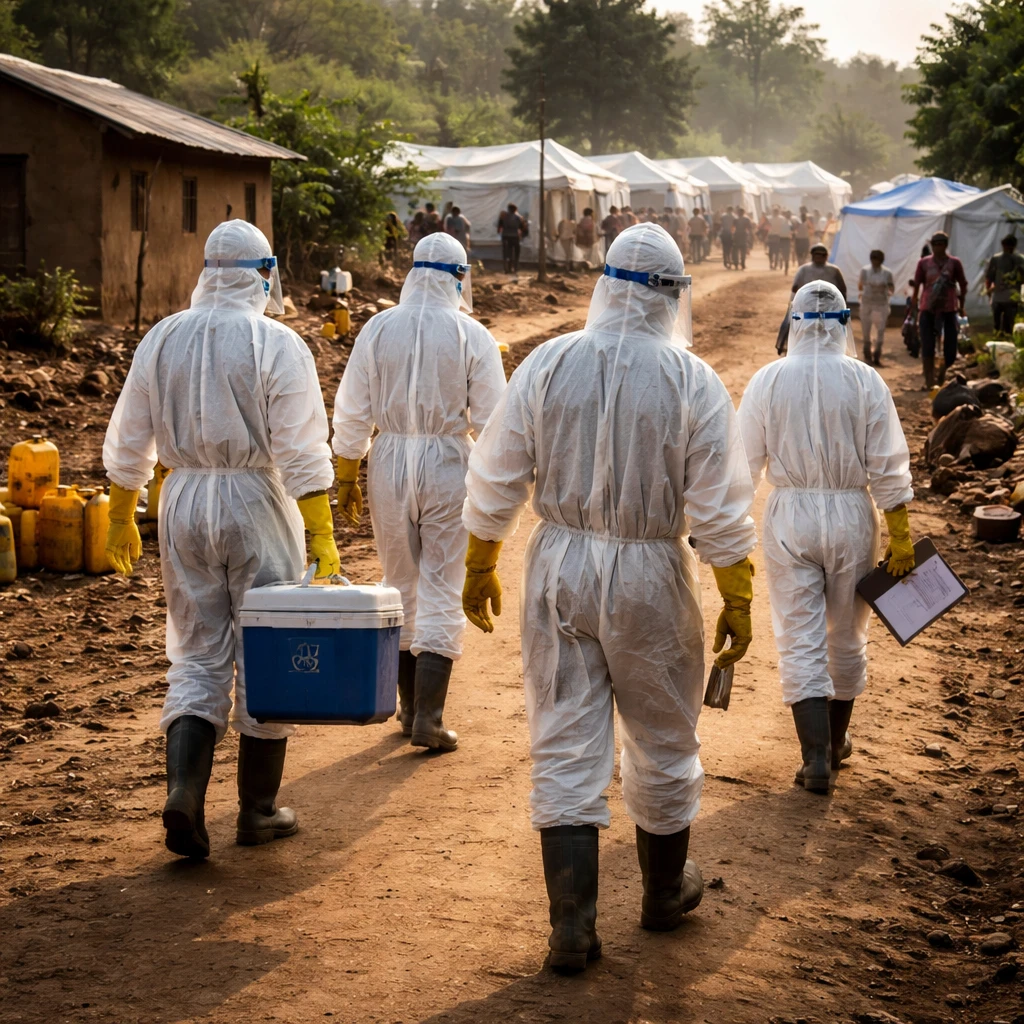
The Ebola epidemic in the Democratic Republic of Congo is moving faster than any previously recorded outbreak in the country. With authorities projecting the total number of reported cases to exceed 4,000 this week, the current wave has already become the nation’s largest Ebola epidemic in modern times and the world’s second-largest since the 2014-2016 West Africa crisis, when the World Health Organization documented over 28,000 infections and around 11,000 deaths.
Officials and published analyses attribute the rapid spread to a combination of late detection, surveillance systems pushed beyond capacity, local insecurity and a notable lack of vaccines and validated treatments targeted at the virus species driving this epidemic.
Pace of transmission
Health authorities report that this outbreak is expanding at roughly five times the pace of comparable epidemics at the same stage. For context, a 2018-2020 Ebola episode in eastern Congo ended with 3,481 cases and 2,299 deaths over a two-year span; at that time it took more than 10 months to exceed 2,000 confirmed infections. By contrast, the present outbreak reached the 2,000-case milestone in about two months and, by late July, had become the largest Ebola epidemic recorded in the country less than three months after it was officially declared in May.
How the virus gained a headstart
The epidemic has been driven by the Bundibugyo species of Ebola virus, a strain that circulated undetected for months before the outbreak was formally recognized in May. Early cases were missed in the community, with some patients initially diagnosed with conditions such as peritonitis, and customary funeral practices helped spread the disease before public health alarms were raised. Missteps in testing and sample handling further obscured early transmission - health workers at times relied on assays aimed at the wrong Ebola species, and samples sent to Kinshasa were mishandled, allowing the pathogen to spread without detection for months. A July study published in the peer-reviewed journal Science concluded the outbreak had likely begun at least as early as January in communities on the outskirts of the mining town of Mongbwalu.
Surveillance and contact tracing under strain
By July, World Health Organization officials estimated that about 80% of new infections were occurring outside of known transmission chains, indicating that most cases were being identified only after the virus had already moved rapidly through communities. Field reporting from Ituri Province described surveillance teams as overstretched: contact tracers lack sufficient resources, face heavy caseloads and are struggling to keep up with both investigating alerts and monitoring contacts. Health authorities say this creates a self-reinforcing problem - undetected transmission produces more cases, which in turn further overwhelms surveillance capacity.
Funding, aid cuts and workforce pressures
Financial and staffing shortfalls have undermined both early detection and ongoing containment operations. One USAID official said the agency had been in the process of awarding a five-year contract in 2025 to carry out health surveillance in Congo when the agency was abruptly shuttered last year. Reporting in June noted that essential components of the Ebola response were facing gaps in funding and personnel. By mid-July, the WHO had received less than half of the resources it identified as necessary to respond to the eastern Congo outbreak. At the same time, health workers have staged protests over unpaid salaries.
Broader reductions in humanitarian assistance have compounded these problems. Programs that provide water and sanitation services - interventions that can limit disease spread and support outbreak response - have been cut back, and those programs had previously counted the United States as their leading donor. The interplay between resource constraints and operational shortfalls has weakened efforts to detect and interrupt chains of transmission.
No licensed vaccine or proven treatment for this strain
Unlike the more common Zaire species of Ebola, for which vaccines and therapeutic options have been developed in recent years, the Bundibugyo species driving this epidemic has no licensed vaccine or proven treatment. Infectious disease specialists note that many vaccine development efforts in the past decade concentrated on the Zaire strain, leaving responders with fewer validated medical countermeasures for this outbreak.
Conflict, mistrust and attacks on health services
The epicenter of the outbreak is eastern Congo, a region affected by long-standing violence. Conflict has delayed access to communities, disrupted the flow of personnel and supplies and complicated routine public health work such as contact tracing. Attacks on hospitals and health teams continue to hinder response operations and further frustrate efforts to contain transmission.
Population movement and hard-to-monitor populations
Containment is also challenged by population movement across trade and migration routes that run through eastern Congo. People travel regularly between towns, displacement camps and neighboring countries, creating pathways for the virus to move across jurisdictions. Reporting in June highlighted dozens of suspected Ebola-linked deaths at a displacement camp, raising concerns about transmission among mobile and hard-to-monitor groups.
What this means for response efforts
The combination of late detection, overwhelmed surveillance, constrained financing, absent species-specific medical countermeasures and insecurity has allowed the Bundibugyo-driven outbreak to outpace containment efforts. Each of these factors is identified in field reporting and peer-reviewed research as contributing to the unusually rapid spread the region is now experiencing.
Addressing the epidemic’s trajectory depends on improving early detection and surveillance capacity, securing sufficient and timely funding, protecting health workers and health infrastructure from attacks, and developing or deploying effective species-specific vaccines and treatments - challenges that responders and donors must confront if transmission is to be controlled.