
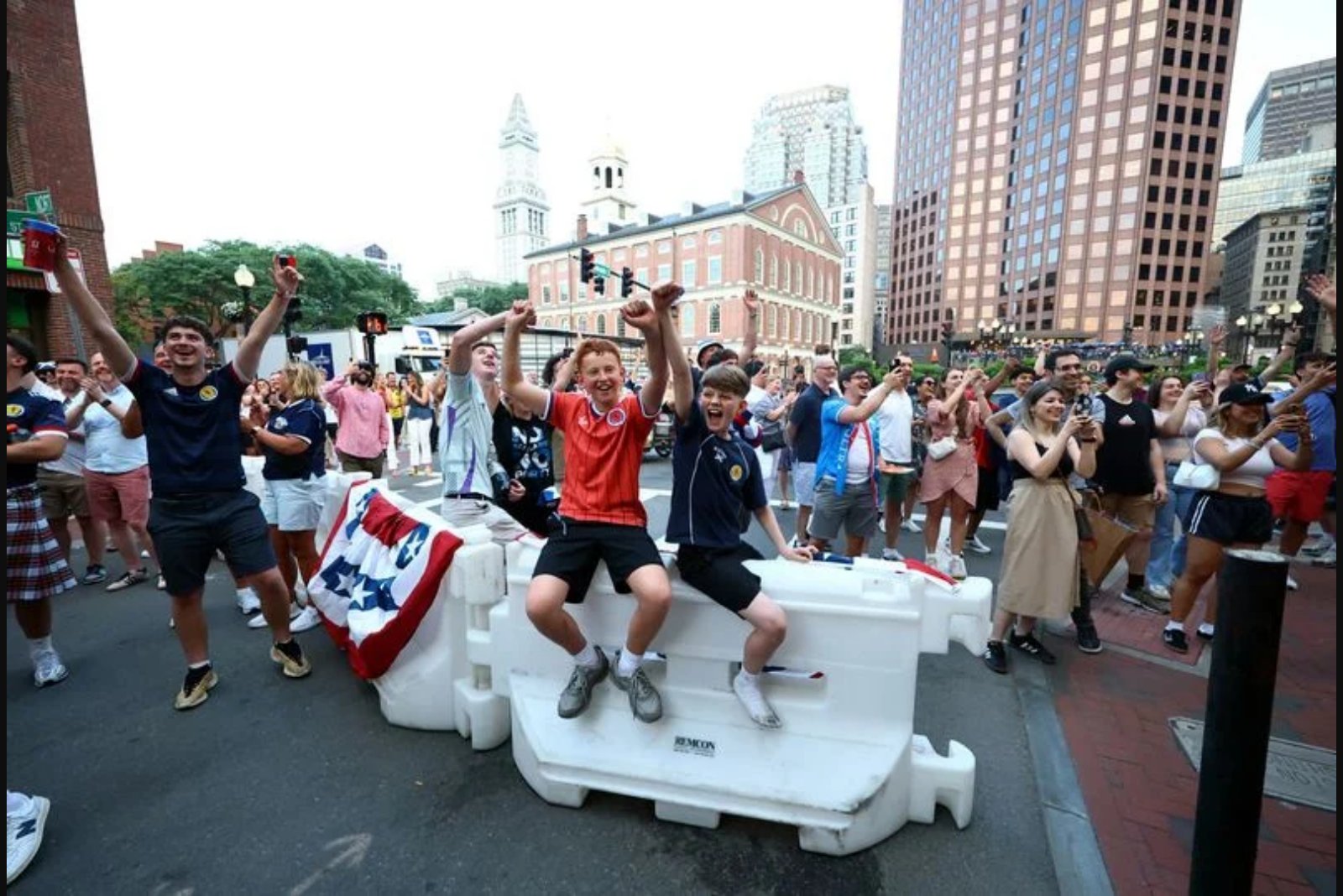
Before the tournament kicked off, many international fans questioned whether the United States was the right setting to co-host soccer’s marquee competition. Concerns ranged from visa access and high costs to gun violence and an apparent lack of local enthusiasm for the sport. Those doubts have not disappeared entirely - but as matches get under way a stream of social media posts and firsthand accounts from visitors point to a markedly different experience: Americans offering warm welcomes, 24-hour retail culture, free soda refills, and a fondness for chicken wings served with ranch dressing.
In a Boston pub ahead of Scotland’s opening game with Haiti, Scottish supporter Gail Nicholl of the "Tartan Army" described a brisk but pleasant encounter. "I met these two gorgeous girls from Boston. It was her birthday, she was having cocktails. I bought her another one and they kept saying 'welcome to Boston, Massachusetts!'" Nicholl said. "They loved us, we loved them ... Everyone is so friendly, so nice."
Online forums have echoed that sentiment. "Something new for me is how friendly and outgoing everyone is," wrote a Swiss fan from Zurich on a Reddit thread filled with praise from visiting tourists.
Observers with experience in sports and place-branding say these sorts of encounters can have lasting effects. "The front porch of your house is the first thing a visitor experiences before they ever step inside," said Darin White, founder of Samford University’s Sports Industry Program in Alabama and a former soccer coach. "Sports serves that same function for cities, states, and countries. It is often the first meaningful, emotionally charged encounter someone has with a place they might otherwise never have thought much about." White pointed out that research has repeatedly shown hosting a major sporting event can alter entrenched stereotypes.
What is notable about this edition of the World Cup is that it is drawing international visitors into U.S. cities that are not the usual tourist magnets. Fans are venturing beyond New York, Los Angeles and Orlando to places such as Kansas City, Atlanta and Houston, and finding experiences that do not match preconceived expectations.
In Kansas City, groups of Argentine supporters - whose own culture places high value on "asado" barbecue - gathered to sample the local dry-rub style of grilled meat. Visiting Argentina supporter Cristian Gastes said: "The Argentinean barbecue is my favourite. But this one is really good." In Dallas, German fan Maximilian Kirch from Duesseldorf tried barbecue and purchased a Texan cowboy hat. "Of course I’m wanting to experience more of it," he said.
White noted that small acts of kindness between strangers - a Moroccan fan helped to find their gate in Dallas, or a German family given directions in Seattle - rarely make headlines but can be powerful contributors to "Brand USA." He said such moments are influential beyond the immediate interaction.
Despite the positive anecdotes, several practical issues identified before the tournament remain. Heat in southern venues like Miami presents a challenge for fans and players alike, and the competition’s schedule pushes the final further into summer when temperatures are at their peak. FIFA has said attendance at matches has been strong, but elevated ticket and travel prices have already deterred some supporters from making the trip.
Visa restrictions and denials have also prevented many fans from entering the United States. Citizens of four participating nations - Iran, Haiti, Ivory Coast and Senegal - have faced partial or total bans on entry. That has complicated support for teams whose diasporas in the U.S. vary in size; Iran and Haiti have significant American diasporas who might otherwise attend, while Ivory Coast and Senegal have smaller U.S. communities.
Even when travel is possible, many fans say they have found American crowds willing to back teams without large traveling contingents. At the France v Senegal match in New Jersey, Brooklyn resident Jessica Ambres, wearing a Senegal shirt, said: "I’m in the bloodiest of the nosebleeds but I hope they can hear me down there on the pitch." Ambres said she felt a connection to the African diaspora as a Black American.
Across stadiums in the United States, a noticeable number of local attendees have cheered for underdog sides or for countries with small or no fan contingents present, amplifying the sense of an inclusive welcome.
City leaders and business owners are hoping the favorable impressions will translate into longer-term relationships. "I hope that the Tartan Army will keep coming back to Boston," said Boston Mayor Michelle Wu. "Of course, have a wonderful time during the games now, but we’d love to see you any season, any year. This is your home." Whether these gestures of hospitality will reshape international views of the United States more broadly - in light of earlier political tensions and the 'America First' posture that has at times strained relations with allies - is an open question. Analysts say the emotional resonance of sporting events can matter, but they do not suggest that such impressions erase other diplomatic or policy-driven concerns.
For now, many overseas visitors appear to be focusing on the immediate experience: a mix of American consumer customs, friendly interactions and regional discoveries that differ from their expectations of the country. As the tournament continues, those encounters - both the publicized and the small, private ones - will continue to play a role in how traveling fans remember this moment in U.S. sporting and civic life.