
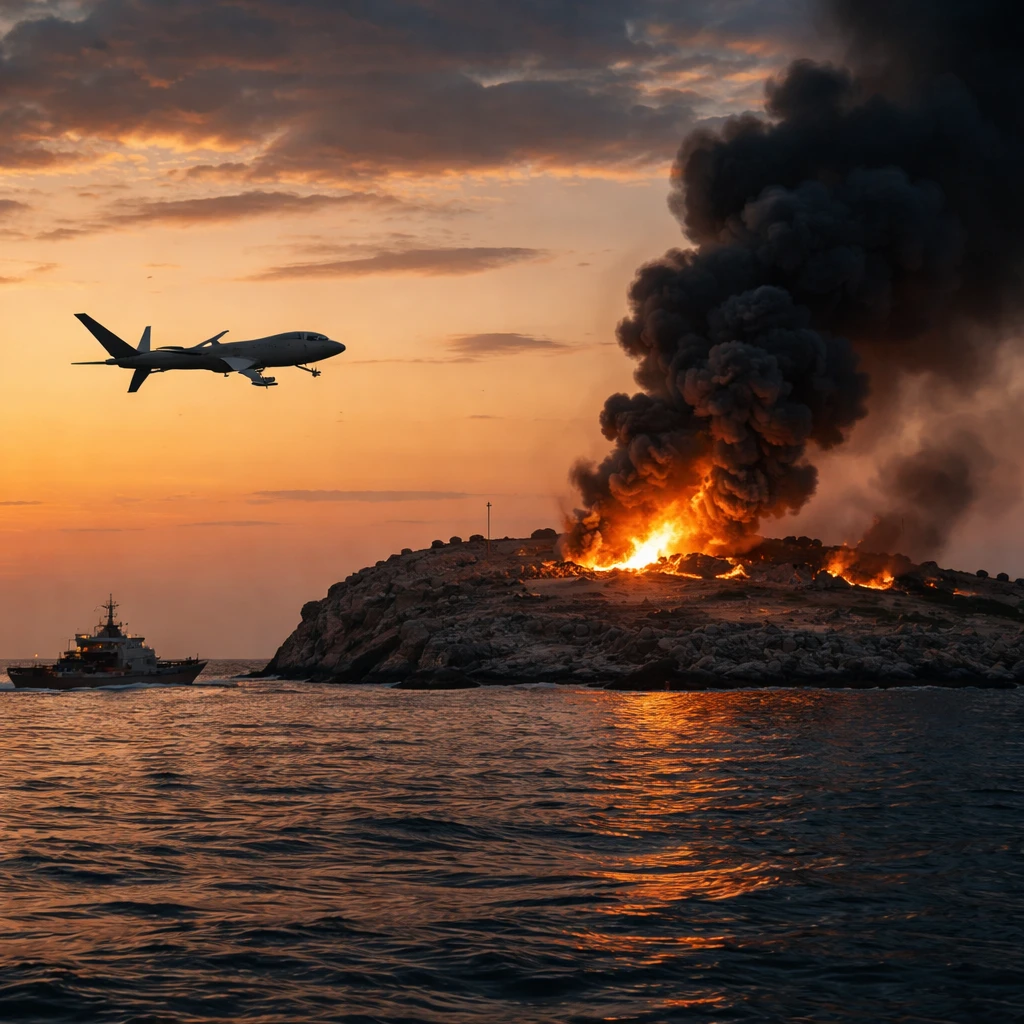
U.S. forces struck two Iranian launchers on Larak Island, a U.S. official confirmed, after personnel from Iran's Islamic Revolutionary Guard Corps were seen preparing rockets with sea mines for possible use in the Strait of Hormuz.
The U.S. official said that the strikes, carried out earlier on Sunday, targeted the two launchers where the Revolutionary Guard units had been observed making preparations to launch rocket-delivered sea mines into international waters. Iran's own Revolutionary Guards reported that the attack caused deaths and injuries among soldiers and civilians, and vowed a "response and punishment," according to state media accounts.
Iranian semi-official media reported that the U.S. used a drone strike for the operation on Larak Island. The U.S. president has said that last week all mines in the international waters of the Strait of Hormuz had been detonated or removed and that Tehran has been warned any ship or boat placing new mines would be destroyed.
Sunday's action is the first publicly acknowledged U.S. strike against Iranian positions since late July. Officials in Washington have, in recent weeks, described a conflict reaching a relative stalemate while warning of punitive economic measures for states that support Iran. The broader conflict entered its sixth month this week.
The fighting has involved multiple actors. The United States and Israel carried out attacks on Iran on February 28, and Iran responded with strikes against Israel and Gulf states that host U.S. military bases. The series of strikes and counterstrikes, as well as Israeli operations in Lebanon, have produced heavy casualties and large population displacement, according to reports citing casualty figures in the thousands and displacement in the millions. Eighteen U.S. service members have been killed in the conflict.
The confrontation has also produced a blockade of the Strait of Hormuz, a key global shipping lane that, before the conflict, handled roughly one-fifth of the world’s oil shipments. The disruption to transit through the strait has had wide implications for energy markets and maritime commerce.
Details about operational specifics, such as weapon types used in the strikes beyond the reported use of a drone, and the precise extent of damage on Larak Island, were not disclosed in the accounts relayed by officials and Iranian state outlets.
Context and immediate reactions:
- U.S. confirmation of the strikes followed observations of Revolutionary Guard forces preparing rocket-launched sea mines aimed at the Strait of Hormuz.
- Iran's Revolutionary Guards reported casualties and pledged to respond, escalating tensions between Tehran and Washington.
- Media in Iran characterized the U.S. action as a drone strike; U.S. leadership has reiterated prior statements about removing or detonating mines in the strait and warning against new mine deployments.