
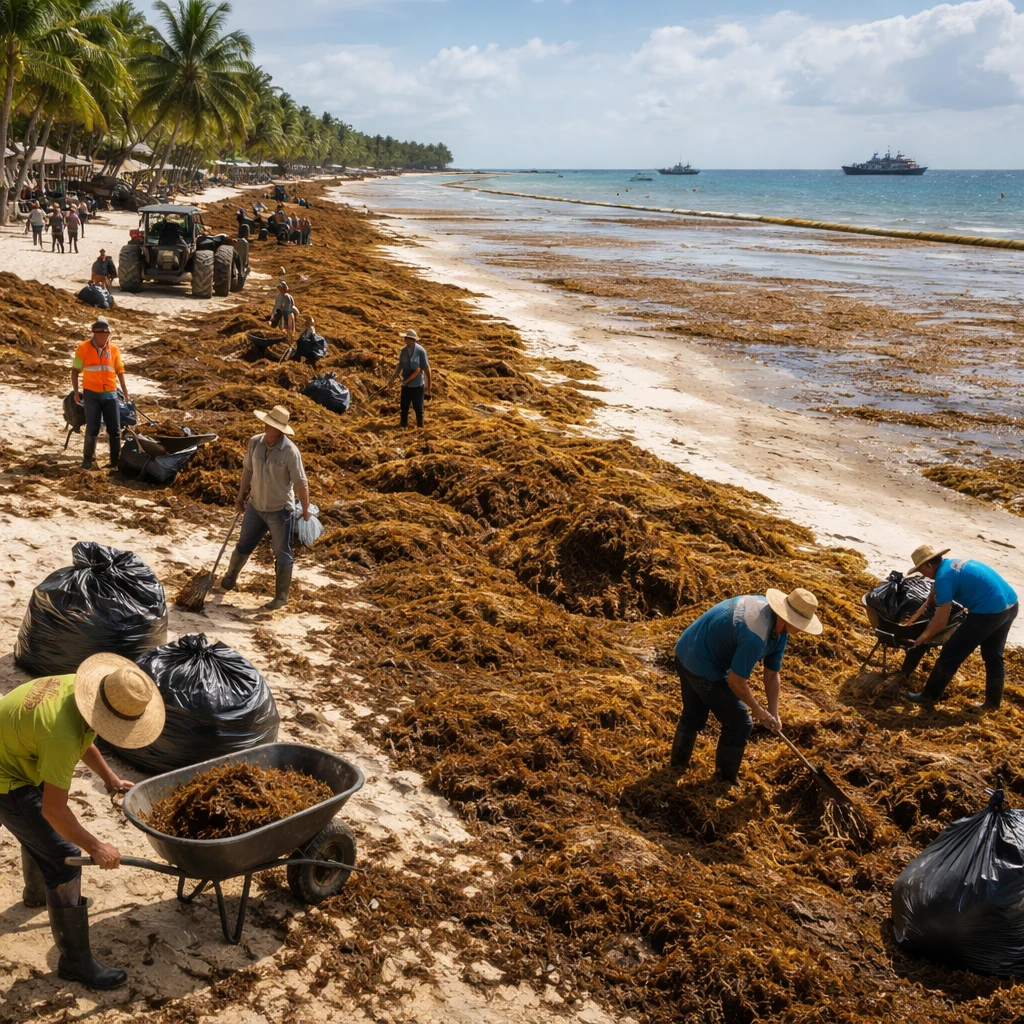
A massive influx of sargassum - a brown seaweed that travels across the Atlantic in sprawling mats - is washing ashore across Mexico’s Caribbean coast in volumes described by local officials as unprecedented. The arrival of the algae has led to beach closures in major tourist destinations and a mounting economic toll on hospitality and retail businesses that depend on pristine shores.
In the eastern state of Quintana Roo, home to resort areas such as Cancun, Playa del Carmen and Tulum, environmental authorities project that 119,000 tons of sargassum will reach the coast by the end of the year, topping last year’s record influx of 96,000 tons. Workers along the Riviera Maya are spending long hours removing seaweed from beaches, a task that local leaders and hoteliers warn may be both costly and only partially effective if peak months are still ahead.
"Warmer temperatures are going to give you more sargassum," said Brian Barnes, a research assistant professor at the College of Marine Science at the University of South Florida who studies the phenomenon. He added that a combination of available nutrients and extended sunlight also contributes to the blooms.
Once deposited onshore, sargassum decomposes rapidly, emitting a foul odor frequently likened to rotten eggs. The stench and the unsightly mats have discouraged visitors in what is traditionally a key period for tourism. "The drop in tourism is extremely serious," said Tulum Councilman Eugenio Barbachano, attributing the downturn to the sargassum epidemic. "The low season is not just low, it is critical."
Economic burden and local impacts
Quintana Roo’s governor, Mara Lezama, has quantified the cost of managing sargassum at roughly 11% of the state’s GDP, which she equates to about $2 billion annually. Industry groups provide complementary estimates: the Riviera Maya hotel association places the annual cost of combating the seaweed at roughly $150 million.
In late June, local monitoring networks reported that 92.5% of the state’s beaches had reached an "excessive" level of sargassum, prompting some closures and red alerts for dozens of beaches. "Quintana Roo is a state that sells beaches, blue sea and water activities," said Carlos Solis, a local tourism service provider. "It affects everything."
Environmental and health concerns
Marine scientists warn that decomposing sargassum can block sunlight from reaching underwater vegetation, suppressing biodiversity in affected areas. The decay process may also release heavy metals, including arsenic, into beach sands, according to environmental assessments cited by researchers.
Concerns extend to workers who handle the seaweed. A study published in 2025 in a scientific journal documented reports from beach-cleaning workers who experienced itchy and burning skin, headaches, fatigue and nausea after shoveling sargassum. These health complaints have added pressure on communities tasked with ongoing clean-up operations.
Government response and resources deployed
To confront the problem, the Mexican Navy has mobilized a dedicated sargassum-fighting contingent. The deployment includes 11 specialized coastal ships, an amphibious sargassum collector, 18 support boats, two barges and four drones. Authorities have also placed over 9,000 meters - about 29,500 feet - of containment barriers in the water to protect shorelines from incoming seaweed.
The federal government is preparing an emergency plan and is scheduled to present a revised response plan on July 30, with aims to enhance coordination and effectiveness in tackling the blooms.
Scientific recommendations and perspectives
Brian Lapointe, research professor at Florida Atlantic University’s Harbor Branch Oceanographic Institute, recommended establishing a system that links satellite monitoring and predictive modeling with targeted interventions before sargassum reaches beaches. Advocates of this approach say it could enable preemptive measures rather than reactive clean-ups.
Tourist experience
Despite the pervasive mats, some visitors continue to use the water. "I went swimming today," said Wendy, a Swedish tourist. "I expected worse." Yet the presence of sargassum is clearly altering visitor behavior and perceptions, contributing to the economic strain described by local officials.
As cleanup crews and government agencies work to remove and contain the seaweed, the immediate challenge remains twofold: limit the environmental damage below the waterline and restore conditions that sustain tourism-driven revenues for communities along the Caribbean coast.