
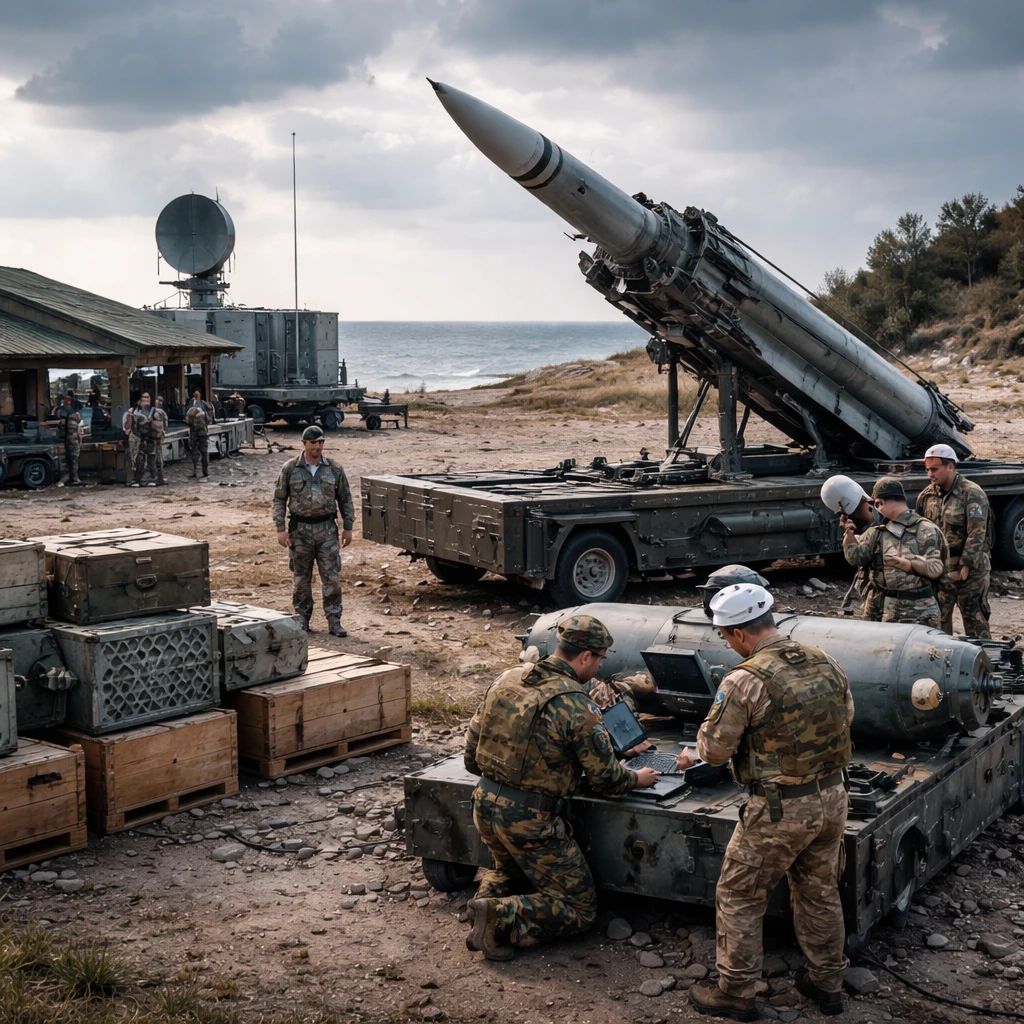
KYIV, July 27 - Ukraine is targeting delivery of a prototype for Freyja, a new European anti-ballistic missile system, within the first half of next year, a senior Ukrainian official said, underscoring Kyiv's drive to reduce its reliance on U.S.-sourced interceptors.
Davyd Aloian, deputy secretary of Ukraine's National Security and Defence Council and the official responsible for the Freyja programme, said an international steering committee charged with estimating research and development costs is due to meet for the first time soon. The timetable is tight, he acknowledged, but Kyiv and its partners are aiming to move rapidly from concept to a demonstrable prototype.
"Since we’re working within such a tight timeframe, we have an ambitious goal: to have an MVP (minimum viable product) ready by the first half of next year," Aloian said. "That is a prototype that can already demonstrate its first practical results."
The anti-ballistic coalition was formally launched at a summit in Paris two weeks ago, where leaders from 10 European countries, Ukrainian President Volodymyr Zelenskiy and about a dozen defence manufacturers gathered to begin coordinating the effort. Kyiv has proposed that the project will rely on contributions from allies in the form of modern radars, sensors and technical know-how in missile guidance and control electronics.
Ukraine itself has offered to provide a launcher and an interceptor missile for Freyja. President Zelenskiy has described that contribution as a "matter of testing" and has said he hopes the system can be operational within a year.
The urgency behind Freyja's push stems in part from Kyiv's heavy dependence on U.S.-made Patriot air defence systems, which the country says are the only currently reliable option for downing Russian ballistic missiles that travel at several times the speed of sound. Patriot supplies have been constrained by political volatility, limited inventories and long production cycles, according to Ukrainian officials. In the meantime, Russia has intensified ballistic strikes this month on Kyiv and the southern port city of Odesa, launching dozens of missiles that Ukraine says it was often unable to intercept due to a shortage of interceptors.
Industry participants already signed up include Eurosam - maker of the SAMP-T interceptor system - as well as Leonardo, Thales and Saab. Ukraine's missile and drone manufacturer Fire Point, which developed the Flamingo cruise missile, has been named lead industrial partner for Freyja and last month announced a deal with German defence firm Hensoldt to supply radar for the programme.
Freyja is designed to be a lower-cost alternative to the Patriot, which many European nations also operate. Other European air defence platforms, such as the Franco-Italian SAMP/T and Germany's IRIS-T, have not yet been demonstrated to be capable of reliably defeating ballistic missile threats at scale, officials say.
Central to Freyja's concept is an open systems architecture that allows modular integration of components from different suppliers. Aloian used a practical image offered by President Zelenskiy - likening the coalition to Lego pieces that can be slotted together - to describe how countries could choose national components within a unified framework. "The overall logic of this system is that it's an open architecture," Aloian said. "So if Denmark says 'I want the Freyja system with a Danish-made Weibel radar,' that's fine. If Sweden says they want the Saab system, that's no problem either."
To support the coalition's work and provide stable financing, officials are considering establishing a dedicated body, potentially a fund, to pool contributions. Aloian also expressed the view that direct involvement by private businesses alongside governments could streamline processes and cut bureaucratic delays. "The coalition should be practical rather than political," he said.
Setting up the steering committee to formalise research and development cost estimates is the next immediate step in moving from political agreement toward technical development. Given the compressed timeline for an MVP, the programme will rely heavily on coordination among national procurement authorities, defence manufacturers, radar and sensor suppliers, and the supplier of the Ukrainian interceptor and launcher components.
For industrial participants, the challenge will be to align production capabilities, integration work on guidance and control electronics, and the delivery of radar and sensor hardware within tight schedule constraints while ensuring interoperability across national choices of components. For governments, the tasks include committing finance, smoothing regulatory processes where possible, and balancing national preferences for domestic suppliers with the coalition's open architecture approach.
Sector impacts: defence manufacturing, aerospace systems, electronics and radar supply chains; procurement and government financing for military capabilities.