
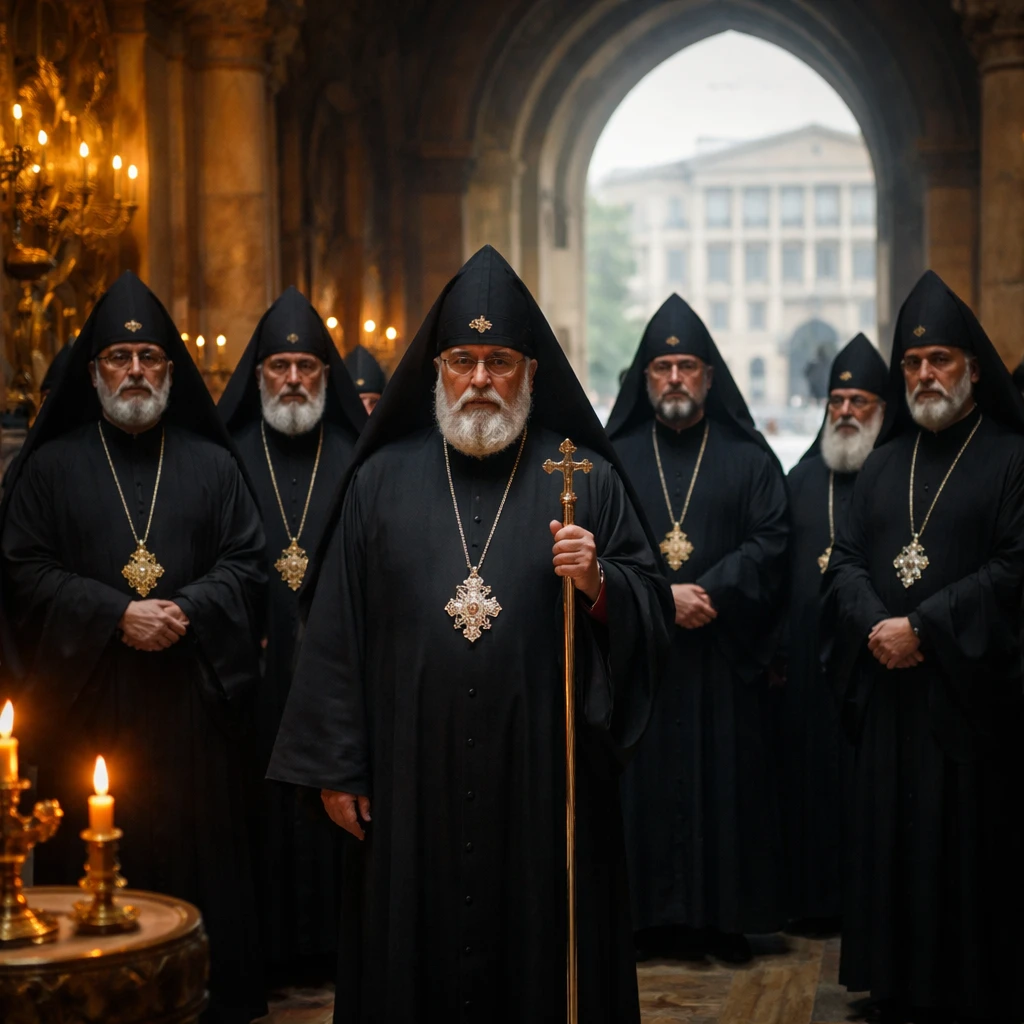
The leader of Armenia's Apostolic Church, Catholicos Karekin II, along with six other senior clerics, is scheduled to go on trial on Friday in a case that has escalated an already tense dispute between the church and the government of Prime Minister Nikol Pashinyan. The defendants are accused of failing to comply with a civil court order that temporarily reinstated a bishop the Church had earlier defrocked. If convicted, each faces up to two years in prison.
The trial is being framed as the most serious legal confrontation to date involving the Apostolic Church, an influential institution in Armenia which traces the nation's adoption of Christianity to 301 AD. The legal action comes amid intensifying disagreements between church leadership and the government over Pashinyan's tenure and his handling of peace talks with Azerbaijan following a succession of conflicts dating back to the 1980s.
Pashinyan, re-elected in June, has received strong backing from the European Union as he pursues policies aimed at aligning Armenia more closely with Western institutions and reducing Russian influence. Yet opposition figures, church officials, and civil society organizations have criticized the prosecution of the Catholicos as politically motivated, arguing it forms part of a broader campaign against government critics.
Anna Melikyan, a lawyer with the Armenian non-profit Protection of Rights Without Borders, said the case amounts to executive interference in church matters and raised concerns about the independence of the judiciary. "This is a clear interference of the executive power in church affairs," she said, adding that worries about judicial independence in politically sensitive matters - including cases involving the church or clergy - are particularly strong. Representatives of the prime minister's office and the prosecutor's office did not reply to requests for comment.
Pashinyan has repeatedly demanded Karekin's resignation and has accused the Apostolic Church - without presenting evidence - of acting as a proxy for foreign powers, specifically Russia. Church officials have denied those allegations. Several senior clergy members have called for the prime minister to step down.
The Apostolic Church, which is distinct from both Orthodox and Catholic denominations, counts millions of adherents in Armenia and among the diaspora. Church leaders say that arrests of multiple clergymen in recent years have had a political character. The current trial traces back to the case of Gevorg Saroyan, a bishop who was defrocked after the Church accused him of abusing his authority and neglecting his duties. Saroyan had publicly demanded Karekin's resignation and aligned himself with Pashinyan.
Another prominent cleric, Bagrat Galstanyan, who helped lead street protests against Pashinyan over territorial concessions to Azerbaijan two years ago, is currently under house arrest pending trial. The Catholicos has also voiced demands for the prime minister's resignation. Those developments illustrate the extent to which church leadership has moved into the political fray.
Tigran Grigoryan, director of the Regional Centre for Democracy and Security in Yerevan, described the case as part of a wider pattern of selective justice pursued by Pashinyan's government. Grigoryan pointed to a string of actions against opposition figures, including detentions and state seizures of assets, as evidence of that pattern. He noted that one high-profile archbishop received a two-year prison sentence in October after publicly calling for regime change in a media interview, and that several other priests are awaiting trial on related charges.
Legal and political analysts say the trial will be watched closely within Armenia and by international observers, as it could influence perceptions of the government's approach to dissent, the autonomy of religious institutions, and the state of judicial independence. The outcome is also likely to affect relations between political actors and civic institutions that have increasingly become entwined in the country's post-election dynamics.
Context and implications
The proceedings against Karekin II and the other clerics underscore a deepening rift between state authorities and the Apostolic Church. That rift touches on questions of institutional independence, the role of religion in public life, and the use of the legal system in politically sensitive disputes. With Pashinyan pursuing a westward policy trajectory supported by the EU and facing vocal domestic opposition - including from clergy - the case highlights the interplay of domestic politics and broader geopolitical alignments.
How the judiciary handles this high-profile case may shape public confidence in legal institutions and reverberate through Armenia's political landscape in the months ahead.