
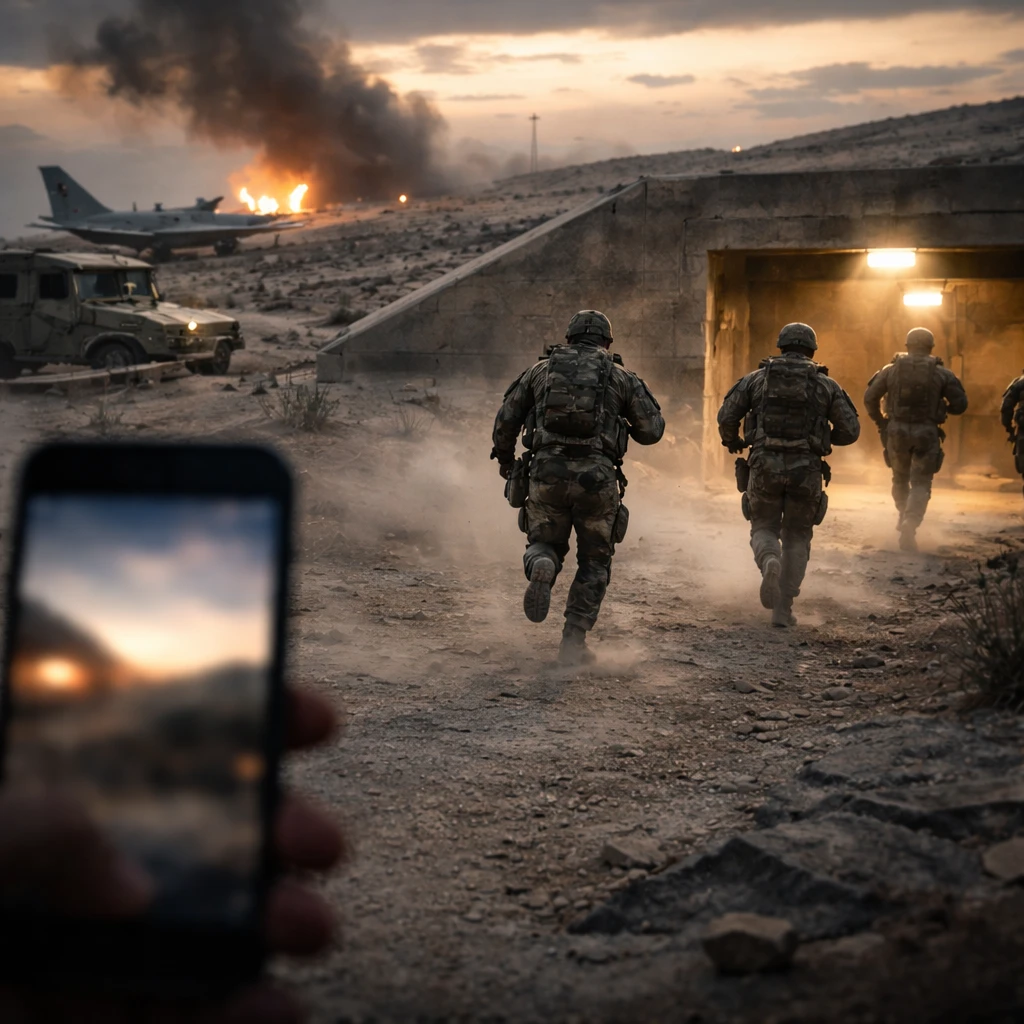
Admiral Brad Cooper, who leads U.S. Central Command, has sent a pointed warning to service members deployed in the Middle East: images and videos shared online - including content originating from the personal devices of U.S. troops - are giving Iran actionable information about the effectiveness of its strikes.
In a July 28 letter to forces, Cooper said Iran was able to assess the outcomes of its attacks in near real-time by scanning media coverage and online posts that referenced "reactions, photos, and footage from the cellphones of our troops." He added that this kind of open-source information could have lethal consequences. "The direct, unavoidable cost of this open-source intelligence could be measured in the lives of American service members and civilian residents in targeted Gulf countries," Cooper wrote.
While the letter urged personnel to "redouble our focus on operational security," it did not list specific new measures to be taken. The message underscores a growing tension for U.S. forces operating in the region - between the ubiquity of immediate reporting and first-person material, and the military's need to limit information that might aid an adversary attempting to kill or wound American troops.
Potential phone seizures in Jordan
Sources familiar with operations in the region report that some troops stationed in Jordan have been told their cellphones will be confiscated in the coming days. Two sources described such directives for personnel, while a third source said the option of taking phones from deployed troops was under consideration because of operational security concerns, but did not present confiscation as certain.
U.S. Central Command emphasized that Cooper's communication was intended as a general reminder about operational security priorities. A Central Command spokesperson, Captain Timothy Hawkins, said: "The message is a general reminder to our service members on the importance of maintaining operational security. This is one of many opportunities Admiral Cooper has used to convey operational priorities."
First-person footage and the Muwaffaq Salti attack
Cooper's letter appeared to reference recent first-person footage circulated online from an attack on Muwaffaq Salti Air Base in Jordan on July 17, in which service members were seen running for shelter. The admiral noted a specific instance in which video recorded on a pair of Meta smart glasses was posted on Instagram and showed where and how a service member evacuated to a bunker during a missile and drone strike.
He argued that without such public accounts, Iran would have a much harder time determining whether its munitions had achieved their intended effects. The U.S. military employs electronic jamming and other battlefield measures that can obscure whether a weapon struck its mark - information adversaries normally could not easily obtain. Cooper wrote that, absent these first-person and media disclosures, Iran "does not know if they missed by 50 meters, hit an empty tarmac, or successfully struck a crowded facility."
Cooper warned further that detailed descriptions and analyses published openly by news outlets and online content creators were effectively doing Iran's battle damage assessment for them. "Detailed lists, descriptions, and analyses of what was hit, openly published by news outlets are essentially performing Iran's Battle Damage Assessment (BDA) for them, free of charge," he wrote.
Casualties, inquiries, and information controls
The conflict between the United States and Iran that began on Feb. 28 has resulted in casualties among U.S. forces. Some 18 U.S. troops have died in the campaign, and more than 600 have been wounded. Those figures have fed domestic concern about the course of the conflict and prompted requests by some lawmakers for more detail on the extent of damage to U.S. infrastructure at bases across the region.
Democratic lawmakers have sought information about damage to facilities such as radar towers, barracks and aircraft hangars. They have also called for disclosure of the results of a U.S. military investigation into a likely U.S. strike on a girls' school in Iran on Feb. 28, the opening day of the conflict.
At the same time, Pentagon officials have periodically limited public comment on incidents in the region, citing operational security concerns. Military leaders have often declined to verify or elaborate on Iranian accounts of strikes or to provide granular details about individual incidents that produced injuries among U.S. troops.
Phone policies, location data and family concern
Rules governing the use of personal cellphones by deployed troops vary widely across services and missions. In many circumstances service members are required to lock their phones away, and on particularly sensitive missions - such as those conducted by special operations forces - phones can be banned outright.
The prospect of more systematic phone seizures has alarmed some family members of deployed troops who have already been distressed by claims of strikes across U.S. bases in the Middle East. For many deployed personnel, cellphones remain a crucial link to loved ones, used periodically to send messages and reassure family that they are safe.
U.S. officials have also warned for years that certain smartphone applications - including fitness trackers - can leak precise location information that adversaries could exploit for targeting. Commercially available location data harvested from smartphones or other devices has been used to target or surveil U.S. forces, according to previous reporting.
Operational trade-offs
Cooper emphasized that publicly available details about the effects of strikes can enable follow-up attacks. "Detailed public disclosures can become an immediate green light for Iranian forces to launch a secondary, much more devastating wave of attacks," he wrote. His letter frames a core operational dilemma for commanders: how to preserve transparency and the information flow that families and the public expect, while denying adversaries the immediate, granular intelligence that can be gleaned from unfiltered reporting and personal posts.
As commanders weigh whether to implement stricter controls on personal devices, the broader tug-of-war between protecting personnel and maintaining channels for reassurance to loved ones will shape on-the-ground life for thousands of U.S. service members stationed across the Middle East.