
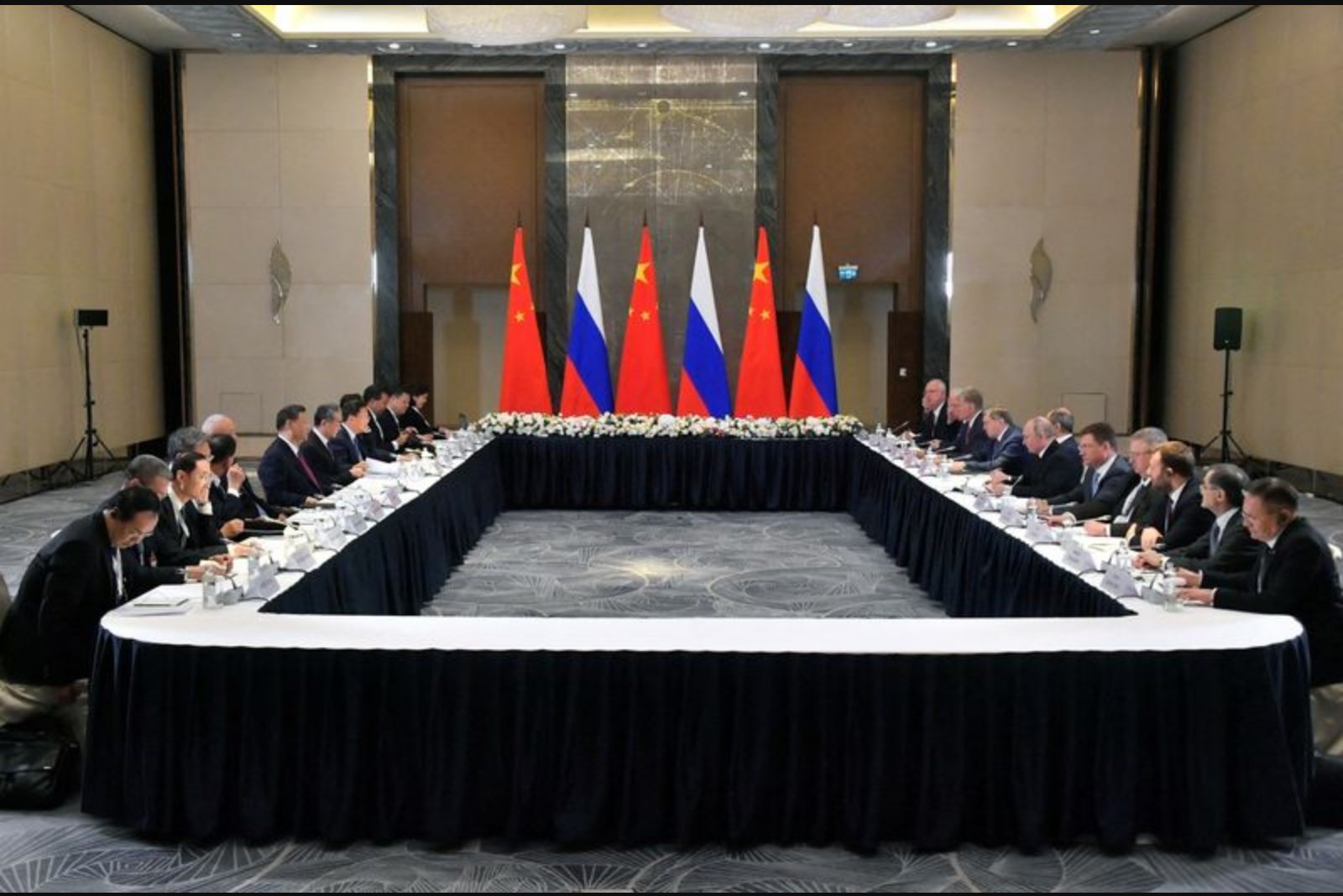
Classified Russian records and European sources indicate that covert military training of Russian forces in China last year received approval at the highest levels of Russia's defence establishment and involved senior officers from both countries, according to two European officials and classified documents reviewed by the reporter.
The papers include a direct reference to an internal decree issued by Russian Defence Minister Andrei Belousov in August, 2025. That decree, the documents say, authorized a delegation from the Russian armed forces to travel to People’s Liberation Army facilities in China to participate in a series of training courses.
One of the reported courses was a three-week programme held in Beijing in November focused on radiological, chemical and biological protection. Documents and images associated with the training show Russian soldiers receiving lectures from a Chinese instructor, examining a model of a nuclear reactor, and receiving instruction on "chemical reconnaissance," "radiation reconnaissance" and measures to protect ventilation systems from contamination.
Officials and the documents stressed that the inclusion of radiological, biological and chemical defence topics underscores the strategic significance of these exchanges to both militaries. One of the European officials said the CBRN component was especially sensitive given how militaries view such training.
Requests for comment to the defence ministries of Russia and China were not answered. China’s foreign ministry issued a public statement repeating its long-standing position on the Ukraine crisis and calling the specific allegations "entirely unfounded," according to the statement. Beijing continues to portray itself as neutral in Russia’s war with Ukraine and positions itself as a mediator.
Last month, a separate intelligence account cited by European agencies and internal military documents reported that approximately 200 Russian military personnel underwent training in China in November, with some subsequently joining operations in Ukraine. The Kremlin did not provide comment on that account but criticized what it described as false information being published in the West.
European Union foreign policy chief Kaja Kallas said on June 15 that Brussels had confirmed the training occurred through its own channels and is now assessing the implications. Beijing responded to Kallas’s remarks by calling them "nothing but smears."
Within European capitals, officials are deliberating how to respond to the reported training while balancing the bloc’s substantial trade ties with China. The 27-member EU has considered whether additional measures are warranted in light of defence concerns, even as trade priorities remain central to the relationship with Beijing.
The EU has already issued sanctions on Chinese companies it says support Russia’s war effort. A Brussels-based official told contacts that the bloc needs to reassess viewing China primarily through an economic lens and pay more attention to what Kallas described as China’s role as a "decisive enabler of Russia’s war."
Two European officials, speaking on condition of anonymity because of the sensitivity of the information, identified the signatories of a July 2 agreement underpinning the exchanges as Russian Major General Rustam Khusainov and Chinese Senior Colonel Sun Dayun.
Domestically, some Russian figures dismissed the reports. Andrei Kartapolov, a senior lawmaker who chairs the Russian parliament’s defence committee, told Russia’s RTVI outlet that the account of the training was "complete nonsense" and asserted that Russia’s military had nothing to learn from China.
The documents reviewed by the reporter include internal Russian assessments that both praised and critiqued elements of the instruction provided in China. A report on a training session in Nanjing commended the equipment quality, the use of simulators and the instructors’ high theoretical knowledge, while also noting China’s lack of combat experience.
Other files named participating senior officers. One internal Russian military roster detailed every participant across the courses, listing rank, date of birth, affiliation and security clearance level for senior officers as well as other attendees. That list shows Colonel General Rustam Muradov, deputy commander-in-chief of Russia’s land forces, as the leader of the Russian delegation.
Additional documents indicate that Chinese Major General Li Jinsun, head of the PLA’s Military Academy of Radiological, Chemical and Biological Defence, participated in the opening of one of the courses. The list also records that Russian Major General Vitaly Gerasimov was a participant in a course in Bengbu.
The reported training and the high level of signatories involved emphasize the political and military weight attached to these exchanges by both capitals, according to the European officials familiar with the material. At the same time, internal Russian comments highlighting China’s strong equipment and theoretical teaching but limited combat experience reflect an uneven complementarity between the two armed forces.
Summary
- Classified Russian documents and two European officials say Defence Minister Andrei Belousov approved delegations to PLA facilities in August, 2025.
- One disclosed course was a three-week programme in Beijing in November on radiological, chemical and biological protection, with images and reports showing classroom instruction and practical demonstrations.
- European institutions, including the EU foreign policy chief, have confirmed through their channels that training took place and are evaluating diplomatic and policy responses; China has denied the allegations.
Key points
- High-level approval - Documents reference an internal decree by Defence Minister Andrei Belousov authorizing Russian delegations to PLA training sites, indicating official endorsement at the ministerial level.
- CBRN focus - The reported courses included radiological, chemical and biological defence instruction, which officials described as strategically sensitive and noteworthy for military cooperation.
- European policy implications - Brussels has confirmed the training through its channels and is assessing possible responses while weighing trade and security priorities.
Impacted sectors and markets
- Defence - The reported transfers of training and equipment familiarization relate directly to military capabilities and procurement discussions.
- Trade and industry - Diplomatic friction could influence trade policy, sanctions targeting companies linked to military support, and supply chains that intersect with sanctioned entities.
- Technology and dual-use goods - The assessment of equipment quality and simulator use points to potential relevance for suppliers of advanced simulation and protective technologies.
Risks and uncertainties
- Political response uncertainty - EU deliberations are ongoing, and it is unclear what additional measures, if any, will be taken in response to the training; this creates policy risk for companies linked to cross-border trade.
- Information and denial dynamics - Official denials from Moscow and Beijing, and differing public statements, generate uncertainty over the full scope and future transparency of such military exchanges.
- Operational relevance - Internal Russian reports noted China’s limited combat experience despite strong equipment and theoretical instruction, leaving questions about the practical battlefield value of the training.