
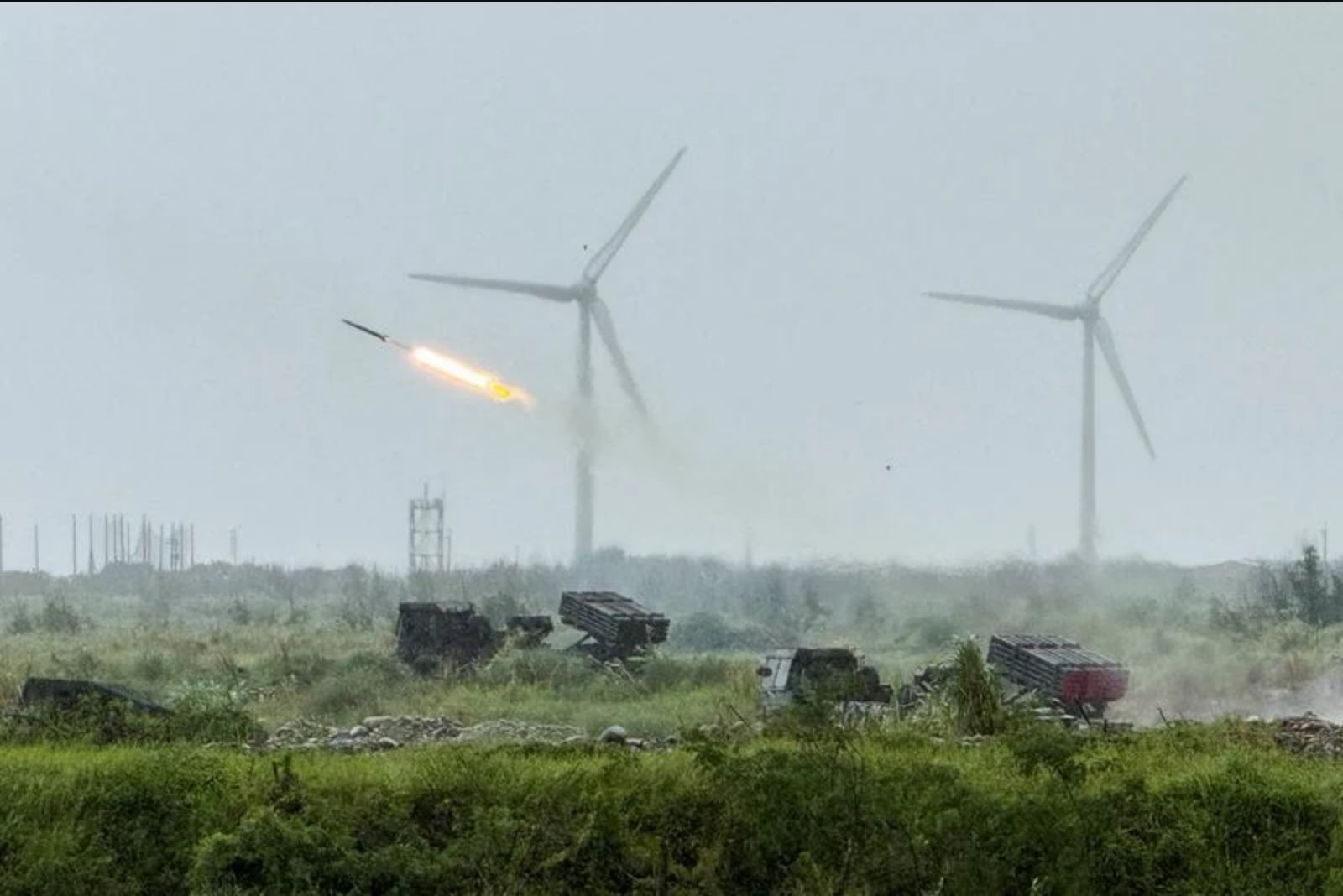
TAICHUNG, Taiwan, June 9 - Taiwan's armed forces conducted a coastal live-fire exercise on Tuesday designed to simulate stopping an amphibious invasion, officials said. The operation combined rockets, artillery, anti-tank missiles and mortars fired from multiple positions to create a defensive "kill zone" intended to halt landing forces.
The drill took place along a roughly 20 km (12 mile) stretch of coastline around Taichung in central Taiwan. It was executed simultaneously from eight distinct positions facing the Taiwan Strait - an area of west coast beaches and mud flats that Taiwan regards as the most likely locus for any attempted landing across from China.
Military commanders described the exercise as a shift toward more realistic, less predictable training by compressing preparation timelines and increasing mobility. Artillery commander Ong Yih-ming told reporters: "What is different about this training compared with the past is that we are no longer conducting heavy artillery firing in a fixed, routine formation as before." He added: "The timing for entering positions this time was based on realistic combat conditions. So I believe this training posed a considerable level of difficulty for our troops."
The forces employed a mix of weaponry, including the locally produced, truck-mounted Thunderbolt-2000 rocket systems and U.S.-made Paladin howitzers alongside anti-tank guided missiles, conventional artillery and mortars. The military noted this marked the first time in seven years that the Thunderbolt-2000 had been used for live-fire shooting in an operational area, underscoring its role in long-range suppression and high mobility.
Rocket commander Liao Neng-cheng described the condensed timetable for position preparation: "What was different this time compared with the past is that previously, we would usually enter the position one week in advance and complete firing preparations," he said. "This time, however, we arrived at the position only one day before and carried out the relevant position preparations. So our preparation time was relatively tight."
Officials framed the exercise within a broader effort to modernise Taiwan's military posture. The government is investing in more mobile systems and altering training doctrines to better mirror the pressures and uncertainties troops might face under combat conditions. The moves aim to reduce predictability in deployments and to leverage weapons with greater mobility and suppression range.
The drills come against the backdrop of cross-strait tensions. China regards democratically governed Taiwan as its own territory and has not renounced the use of force to pursue reunification. Chinese warplanes and warships operate near the island on an almost daily basis, according to the military context cited by Taiwan. Taiwan rejects Beijing's sovereignty claims, maintaining that only the island's people can decide their future.
Implications
The exercise highlighted Taiwan's focus on rapid-deployment coastal defence and on integrating mobile rocket systems with conventional artillery to counter an amphibious threat. By staging live-fire drills with shorter preparation windows, Taipei intends to better replicate the time pressures of real combat and to increase the difficulty of enemy targeting.