
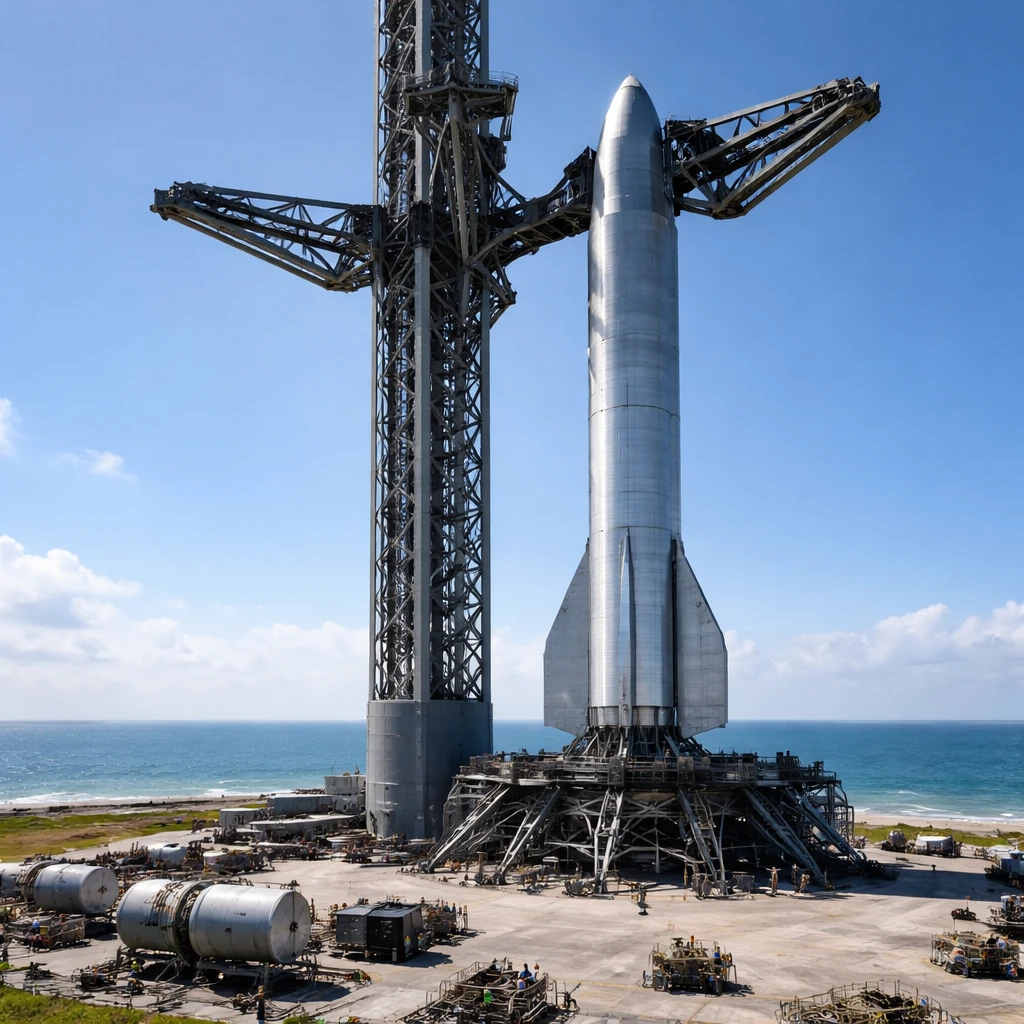
SpaceX is preparing for what it describes as a significant step in Starship development: the company says it aims to launch its next test flight as soon as this month and to attempt the first land recovery of the rocket’s upper stage, according to statements made by CEO Elon Musk on the company’s most recent earnings call.
The planned mission, which would be the 14th flight test of Starship, is intended to carry the first tranche of V3 Starlink satellites into orbit. Musk said those satellites are "expected to deliver 10 times the amount of broadband capacity and data density from our current generations." The company has said in its IPO prospectus that it ultimately expects to place 60 of these V3 satellites on each Starship launch and to conduct dozens of Starship missions carrying them.
SpaceX’s stated objective to return the upper stage - the core "ship" of Starship - to land represents a marked escalation from the previous test in July, when the upper stage appeared to show improved landing behavior during a descent over the Indian Ocean. Musk had earlier indicated that a land recovery attempt for the upper stage could take place sometime this year and might occur on the 14th flight depending on the outcome of the 13th mission.
The company is currently in the process of recovering the 13th test’s rocket stage from the ocean for inspection, based on satellite imagery captured by Vantor. That recovery will feed into evaluations of the vehicle’s condition and inform decisions about whether to proceed with a land-capture attempt on the next flight.
Musk emphasized that the timing of the next launch and the decision to pursue a land recovery remain contingent on regulatory approval. "Assuming we receive regulatory approval to do so, we’ll attempt to catch the ship with the tower on the next flight, which is tentatively scheduled for the end of this month," he said on the call, and added that he expects the Starship launch cadence to "increase rapidly."
A return to land would require the tower at SpaceX’s Texas launch site to catch the upper stage using large mechanical arms attached to the tower. Those same arms have been used successfully to recover the Super Heavy booster three times, most recently in March 2025. In prior tests, when the arms catch the upper stage the Super Heavy booster has landed in the Gulf of Mexico, a pattern that SpaceX has repeated across its last five tests.
Musk described a longer-term operational sequence in which the tower would catch both stages: first the Super Heavy booster, which would be moved aside quickly, and then roughly 90 minutes later the tower would catch the ship after it completes a full orbit of Earth. He projected an eventual increase in flight frequency, forecasting that "probably a year from now, we will be doing at least one flight a day, possibly more."
Beyond the technical milestones of landing and reuse, the company’s own launches to place Starlink satellites have made up an increasingly large share of SpaceX’s manifest. The firm’s Starlink business has grown to outpace revenue from its other units, a trend that has resulted in a rising proportion of launches dedicated to deploying the company’s own broadband satellites and has contributed to tighter availability of U.S. launch capacity as demand to access space grows.
Key points
- SpaceX aims to attempt the 14th Starship flight as soon as this month, with plans to place the first V3 Starlink satellites into orbit and to attempt a land recovery of the upper stage.
- The land-capture attempt depends on receiving regulatory approval; the company is recovering the 13th flight’s stage from the ocean for inspection to inform that decision.
- Successful land recovery of the ship is central to SpaceX’s goal of building a fully reusable orbital launch system and to the company’s plans to increase Starlink deployment cadence and overall launch frequency.
Risks and uncertainties
- Regulatory approval - The timing of the next flight and whether the company can attempt a land-capture depends explicitly on obtaining regulatory clearance.
- Recovery success - The feasibility of returning the upper stage to land and safely catching it with the tower arms remains unproven at scale; the company is still inspecting the 13th-stage recovery from the ocean.
- Launch cadence and operational scale-up - Musk’s projection of a rapid increase in flight frequency, including the possibility of daily flights within a year, is contingent on successful technical and regulatory outcomes.
Sector impacts
- Communications infrastructure - The deployment of V3 Starlink satellites is positioned to materially increase broadband capacity and data density for the Starlink network.
- Aerospace and launch services - Progress toward reusable land recoveries could alter economics in the commercial launch market and affect availability of launch slots for external customers.