
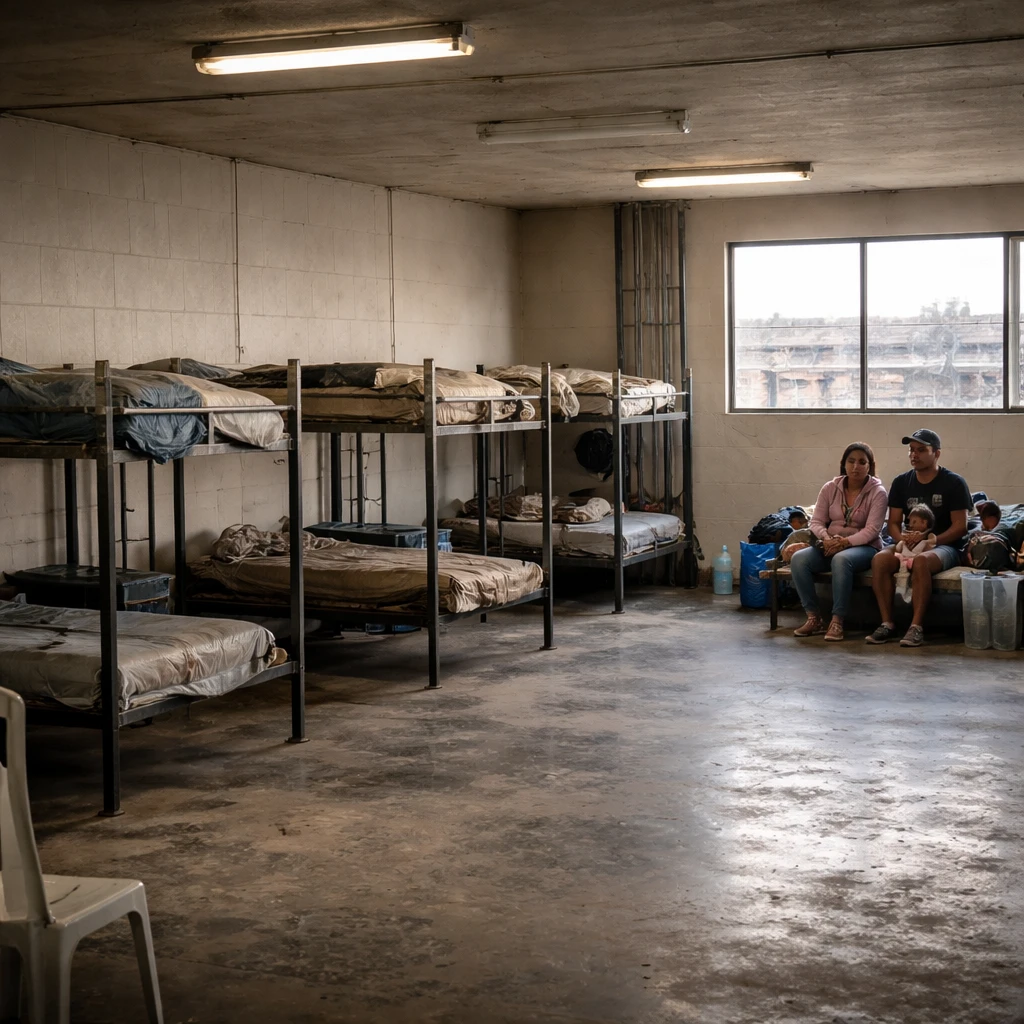
Ciudad Juarez - Shelters that once received thousands of people seeking entry to the United States are now mostly quiet as fewer migrants travel north amid a tightened U.S. immigration posture and an active deportation program. The change is visible in the city’s shelter network where occupancy has fallen sharply and the composition of residents has shifted.
Salome Villena, an Ecuadorean mother who had planned to make the journey with her husband and two young children, ages 4 and 6, said the altered U.S. immigration landscape reshaped her family’s plans. "Our intention was to cross into the United States, but because of what Trump did, we couldn’t," Villena said, referencing policies that the family said made legal migration routes harder to access.
The family considered hiring a smuggler to take them across the border, Villena said, but abandoned that option after they alleged the man began stealing their money. Instead, they remain in Ciudad Juarez and are among the relatively small number of people still staying at a local shelter.
The return to U.S. leadership under President Donald Trump abruptly ended the CBP One app, a tool that previously let asylum seekers schedule appointments at ports of entry. The removal of that legal pathway left thousands of migrants stranded in northern Mexican cities and prompted Mexican authorities to open emergency shelters in anticipation of higher numbers of deportees.
Despite the preparations, many of those facilities have stayed largely empty. Local officials report that migrant arrivals have dropped and that deportations are frequently carried out by air to southern Mexico or to other countries, reducing the expected inflow into border cities such as Ciudad Juarez.
Juan Fierro, who runs the Good Samaritan shelter in the city, described a sharp fall in new arrivals since the U.S. measures took effect. "It’s becoming increasingly complicated and difficult for people to reach Mexico’s northern border and cross into the United States," he said, pointing to the logistical and policy obstacles now facing would-be migrants.
The reduced flow has also changed who is staying in the city’s shelters. Dirvan Garcia of the state population council, Coespo, said the jurisdiction is experiencing a markedly different situation than before. "We are living something completely different," Garcia said. "There are a large number of people who initially intended to cross the border but are now putting down roots in the city."
Garcia added that steep budget cuts, combined with the decline in arrivals, have led Coespo to shrink its network of shelters by nearly half, bringing the total down to 18 facilities. Even so, overall occupancy in the network is around 15 percent.
Most of the residents occupying those spaces are Mexican nationals displaced by violence. The non-Mexican population that remains in the shelters is principally made up of migrants from Venezuela, Colombia and countries in Central America, Garcia said.
For families like Villena’s, the closure of established legal avenues and the perceived risks of irregular migration have altered migration calculus. Some have chosen to stay and attempt to rebuild locally rather than continue toward the U.S. border, even as municipal services and shelter capacity adjust to lower demand.
Context and local response
Municipal shelters and state agencies had prepared for larger numbers of returnees and deportees by opening emergency housing. The anticipated surge, however, did not materialize in many cases because of the drop in arrivals and the use of air deportations to move people to other parts of Mexico or abroad. As a result, local authorities are now managing reduced occupancy while contending with budgetary constraints and a changing profile of shelter residents.
On-the-ground reality
The visible result in Ciudad Juarez is a smaller, more settled migrant community in which some people who initially planned to cross the border are opting to remain and integrate locally. Shelter operators report fewer newcomers and an increased share of Mexican residents displaced by internal violence, altering the services and resources required at many facilities.
Local officials and shelter managers continue to monitor the situation, balancing limited budgets with the need to provide for the population that remains, even as broader migration flows and enforcement policies shape the immediate future of border shelter operations.