
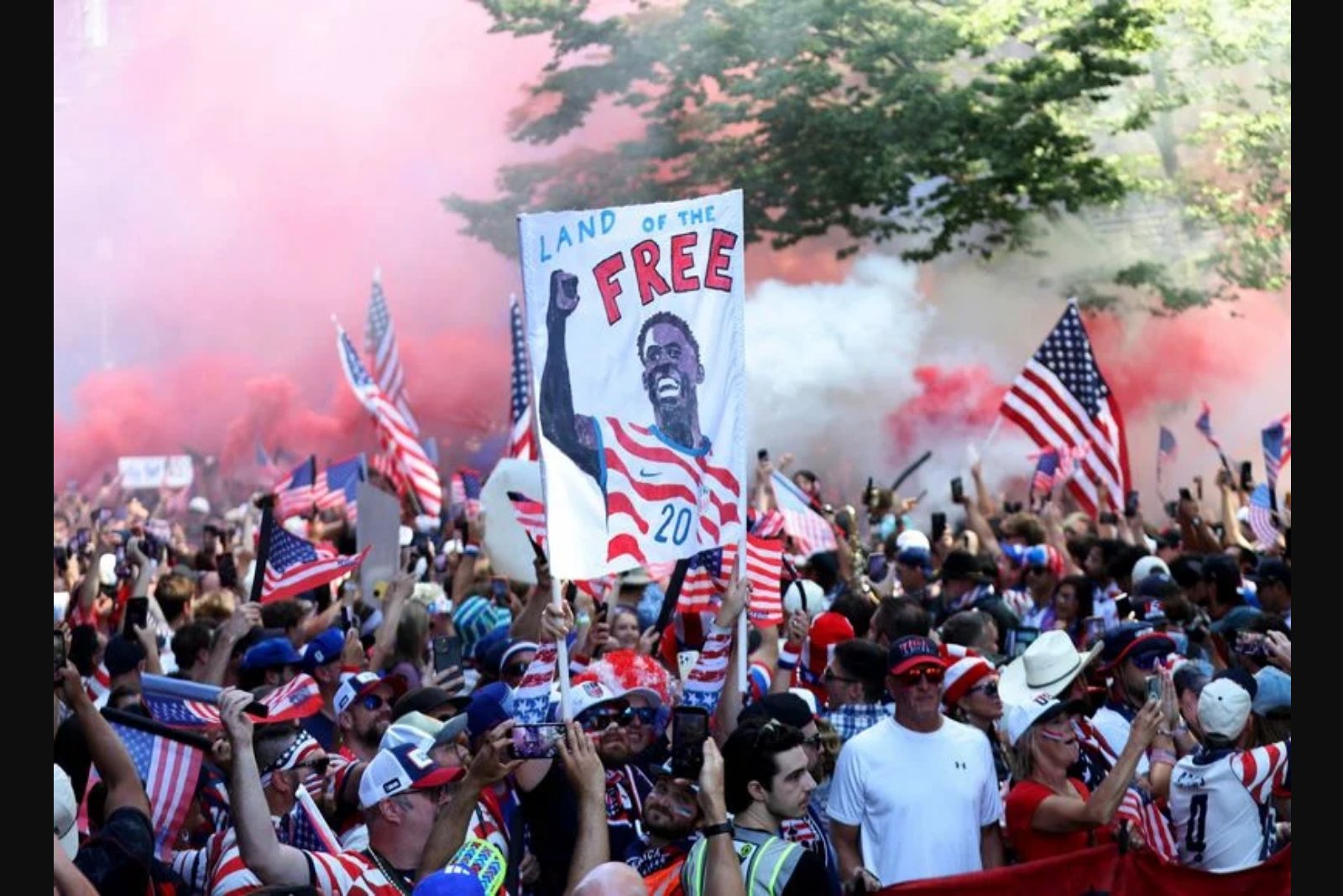
Seattle’s streets, often associated with protest marches, grunge music and black-clad residents, were dominated on Monday by a different spectacle: a widespread outpouring of red, white and blue as fans gathered ahead of the United States’ World Cup last-16 match against Belgium.
Despite the city’s reputation as a blue voting enclave with a socialist mayor, supporters here set aside local political differences to back the national team. The debate over the reinstatement of United States striker Folarin Balogun - whose red card suspension became the subject of public attention after President Donald J. Trump asked FIFA President Gianni Infantino to reverse the decision - did not fracture fan support on the ground, spectators said.
“I don’t think soccer is blue or red. I think it’s a national sport," said Brad Lawliss, 57, from Portland, Oregon. "Actually, there’s more soccer players in this country than there are of any other sport. It’s actually a united soccer nation.”
Game day customs in the host city have come to include celebratory marches toward the stadium and expansive fan zones along the waterfront. Local authorities and event organizers have reworked large parts of a previously run-down waterfront into gathering areas with screens and hospitality outlets that have swelled as the U.S. progressed through the tournament.
Thousands of supporters filled blocks on Washington Street, singing and chanting "U-S-A" as they made their way toward the venue. Ticket holders continued the march directly to the stadium, while others found space in secured pens with large screens on the waterfront or packed bars and restaurants to watch the match.
Among the fans arriving from the suburbs were Michael Scott, 54, and Eric Cutts, 47, who rode the ferry into the city. Like about a dozen other supporters interviewed, they said Balogun’s reinstatement was appropriate and that the initial red card should not have been issued.
"I didn’t like the fact that we had to have a political twist to this decision," Scott said. "I thought it was enough that FIFA should just review it without a political push, but I understand that Trump is gonna be a fan of the USA, and he’s gonna want to do what he’s gonna do."
Cutts echoed a view shared by several local supporters that the city’s left-leaning politics did not supersede enthusiasm for the national team. “Seattle’s a lot more patriotic than people think. I think we’re obviously all here to support the team first,” he said. "And that we have the best players on the field and on the pitch, that’s the best thing for the fans."
Belgium supporters staged their own procession toward the stadium, arrayed in red, yellow and black, accompanied by drums and singing. Most appeared in high spirits, though one marcher carried a plain cardboard sign calling attention to the controversy around the Balogun decision.
Brad Petts, 34, who purchased tickets for himself and his father - who was celebrating his 70th birthday - said he felt the reversal was justified. "It wasn’t a red card, so I think it is the right result," he said. "But it happened in a pretty sketchy way, so I think they should have gotten the same result differently. We’ll go no matter what."
Scenes across the city underscored how sporting events can temporarily recast civic spaces and bring together diverse groups. Waterfront fan zones, bars, restaurants and public transport systems absorbed the influx of supporters, while the broader debate over the role of political intervention in sporting governance continued to circulate among fans and commentators.