
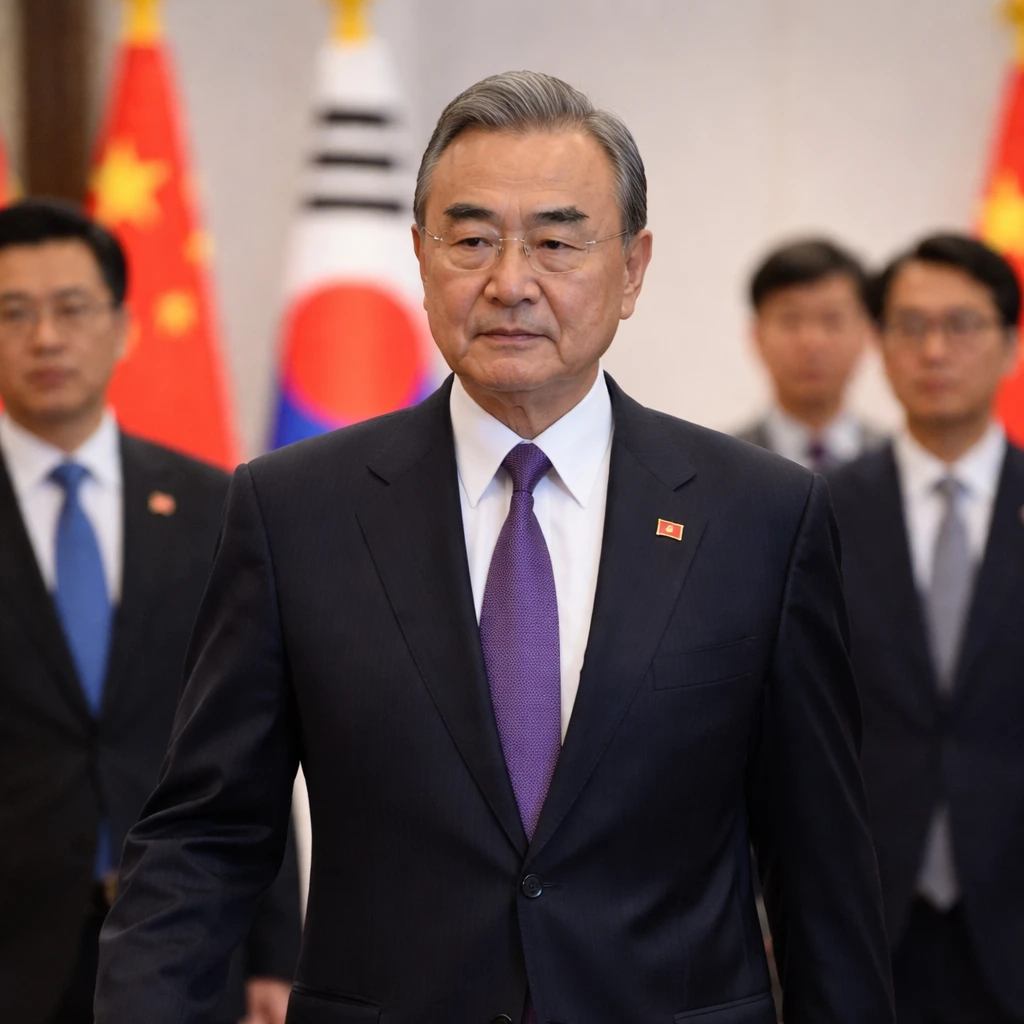
BEIJING, Aug 20 - China’s Foreign Minister Wang Yi urged South Korea to refrain from aligning solely with either China or the United States, and blamed U.S. policy toward North Korea as a driver of tensions on the Korean Peninsula, Chinese state news agency Xinhua reported.
Wang conveyed his views during separate meetings in Seoul, where he met South Korea’s National Security Adviser Wi Sung-lac and later held talks with President Lee Jae Myung. Xinhua reported Wang as saying that "the fundamental solution to the tensions on the Korean Peninsula lies in addressing the root causes of the problem and urging the United States to abandon its hostile policy toward North Korea."
In his discussion with Wi, Wang said China hoped South Korea would "achieve genuine strategic autonomy, refrain from bloc confrontation and taking sides, and develop relations with major powers including China and the United States in parallel and without contradiction." He framed that posture as conducive to easing regional strain.
The remarks follow recent statements by U.S. President Donald Trump that he intends to meet North Korean leader Kim Jong Un later this year and his comment that the Asian country possesses 57 "very powerful" nuclear weapons. Trump has also directed Pentagon officials to curtail joint military exercises with South Korea, citing his "very good relationship" with Kim, according to the reporting.
Washington continues to publicly demand North Korea’s denuclearisation, a stance Pyongyang has consistently rejected. Meanwhile, Japan’s government and coastguard reported that North Korea fired a suspected ballistic missile toward the sea on Thursday.
Wang told Wi that "China would be glad to see the peninsula move toward peaceful coexistence between South Korea and North Korea," and called for a restart of bilateral dialogue and a restoration of mutual trust between the two Koreas.
During separate talks with President Lee, Wang urged Seoul to maintain a friendly policy toward China, stating that bilateral ties had "fully recovered" and had made positive progress this year. He urged South Korea to pursue a "rational, pragmatic, and positive policy towards China," adding that such an approach "is entirely in line with South Korea’s interests and the trend of the times," Xinhua reported.
Wang also pressed for the early completion of second-stage negotiations on a free trade agreement between China and South Korea. He argued that the two countries should work to promote regional economic integration in the face of "intensifying fragmentation in the global economy and rising trade protectionism," according to Xinhua.
Contextual points contained in the reporting:
- Wang held meetings in Seoul with National Security Adviser Wi Sung-lac and President Lee Jae Myung.
- He attributed the root of peninsula tensions to U.S. policy toward North Korea and urged Washington to abandon that policy.
- Wang advocated for South Korea to avoid taking sides and to pursue balanced relations with both China and the United States.