
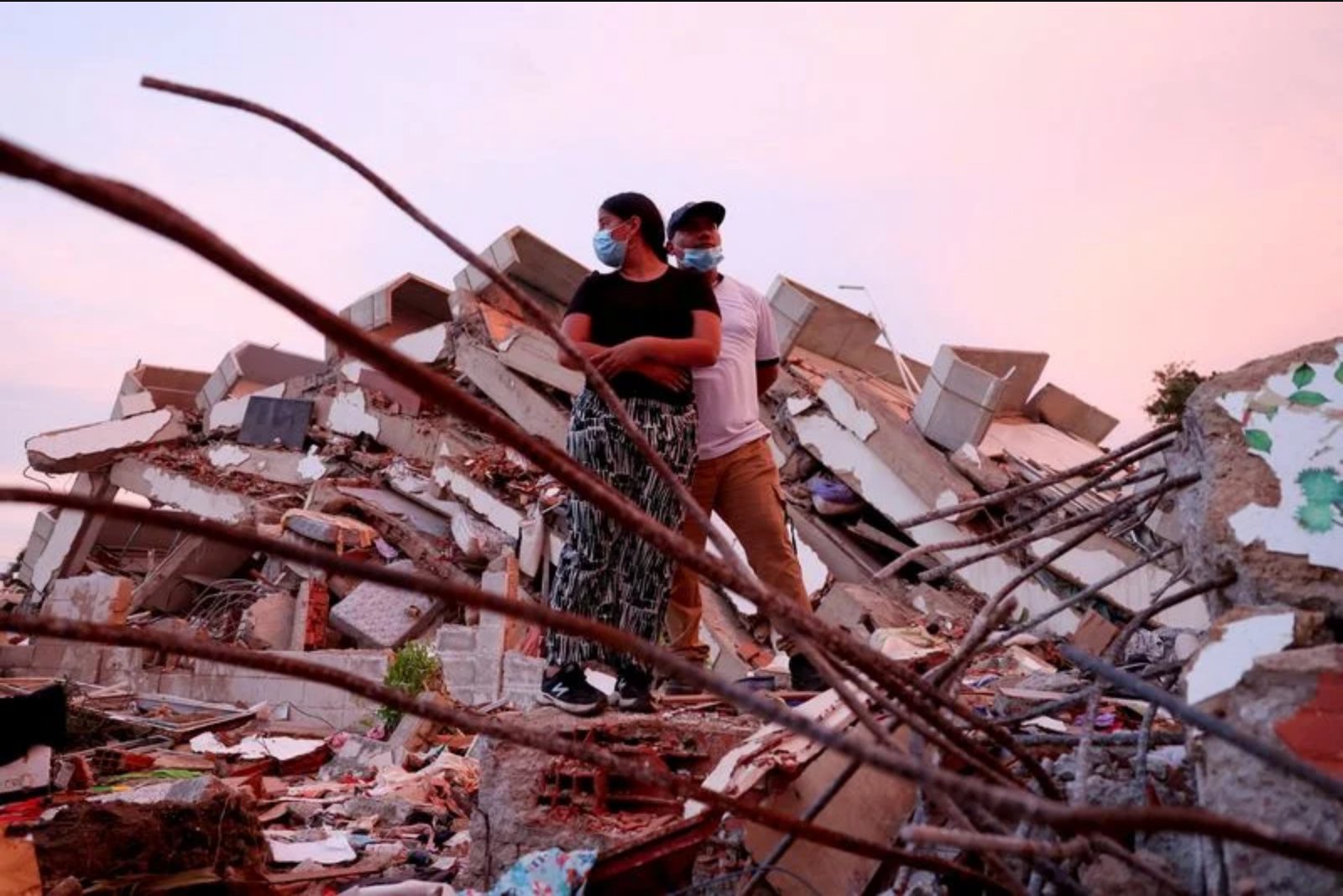
More than 100 people gathered quietly along the roadway that borders what once was the Los Cocos public housing complex in La Guaira state, listening intently for any sign of life beneath the ruins. For long stretches, silence held, broken only by the occasional cellphone ring or a rescuer's shout. Then a horn sounded and the rhythm of the search resumed - pickaxes, shouted directions and the slow removal of concrete and rebar as teams sought survivors and the dead from towers that collapsed during last week's twin earthquakes.
Six of the eight towers that composed the Hugo Chavez complex were destroyed, leaving rubble where ground floors and stairwells once stood. At one location, national police and a paramedic pried a charred woman's body free from the debris, extracting her legs as dark hair hung into the wreckage below. A relative stood nearby, attempting by phone to locate someone who could accompany the remains to the morgue.
At the site of what used to be Building 27, rescuers - among them members of Mexico's Topos team - worked through tunnels of broken concrete and twisted metal to reach lower floors. They were assisted by young cadets in olive-green army uniforms. A voice from a nearby shaft ordered silence, and rescuers raised fists to signal quiet. Minutes later a man shouted from a mound of rubble that he heard people, and digging picked up again.
Halted operations and fading hopes
At a separate location in Macuto, rescue teams from Ecuador and the United States stopped efforts in the early hours of Tuesday after more than 40 hours attempting to reach a mother and her three children trapped beneath a nine-story building. Major Jorge Montanero, leader of the EQ11 team from Guayaquil, said his team believes the critical survival window has passed and that what remains is likely to be death. "In the end, we believe the days have already passed and that what we will find now is death," he said while standing amid rubble after cutting through four concrete slabs in search of the four missing people. "Unfortunately, things haven't developed favorably."
The International Rescue Committee said tens of thousands of people remain missing two days after the crucial 72-hour survival period, noting that the chances of survival decline sharply after that time. The IRC also said the scale of the response does not match the scale of humanitarian need.
Morgues and the human toll
At a temporary morgue in La Guaira's port area, relatives waited to identify bodies. Andrea Montilla sat in a plastic chair while family members inside completed the formal identification of the remains of her cousin and his grandmother. Her 14-year-old cousin had been recovered overnight from a collapsed apartment building, she said. Montilla added that the cousin's mother was still missing.
Empty coffins were stacked throughout the port, and many bodies were laid along a concrete stretch in body bags. An official at the site, speaking on condition of anonymity, told officials that those present were from La Guaira and had lost multiple family members; he said there was no immediate estimate of the number of bodies already returned to families or still awaiting identification.
Jordanian emergency workers reported rescuing a child early on Tuesday - the only recorded survivor recovered during the sixth day of search efforts, according to Venezuelan authorities.
Damage assessment and urban impact
NASA estimates indicate some 59,000 buildings were damaged or destroyed by the twin earthquakes, which struck seconds apart with magnitudes of 7.2 and 7.5. The physical devastation is visible from satellite imagery. In many areas, collapsed structures have been first tended to by relatives and neighbors rather than professional teams, with locals removing debris to recover people or bodies.
Gianluca Rampolla, the U.N. resident coordinator in Venezuela, said on Monday from Caracas that he expects the death toll to exceed official tallies and that authorities were procuring 10,000 body bags. The acting government has reported at least 1,943 deaths, thousands injured and roughly 16,000 people left homeless. A website promoted by political opposition groups estimated about 43,000 people missing.
Critical infrastructure checks and energy concerns
Venezuela's state-run oil company PDVSA and private gas distributor Domegas said they were inspecting gas lines serving some 600,000 consumers in Caracas to identify and repair leaks. Both companies reported that specialized equipment to detect leaks had arrived in the country.
International relief, funding needs and health warnings
U.N. agencies warned of mounting food insecurity and public health risks among the displaced population. The World Food Programme appealed for $50 million to deliver emergency food assistance to as many as 500,000 people over the next three months, while noting it could feed up to 1 million people if enough funding became available. The WFP reported that it had delivered a month's supply of cereals, dry beans, lentils and vegetable oil to 1,200 people in La Guaira and established temporary feeding centers.
The World Health Organization said Venezuela's health system was under strain, reporting at least three health centers critically damaged and six others damaged or only partially functional. WHO spokesperson Christian Lindmeier warned that displaced populations face higher risks of diseases such as yellow fever and dengue, particularly given low vaccination coverage.
Separately, the top U.S. general for Latin America told officials that the U.S. military had built a substantial presence in and around Venezuela to support relief efforts, with more than 900 personnel inside the country and an additional roughly 800 stationed in nearby Caribbean hubs including Puerto Rico and Curacao.
Scale and implications
Rescuers continue work under difficult conditions, balancing the search for survivors with retrieval of the dead. Local volunteers have often led initial recovery efforts where professional teams have not yet arrived. Humanitarian agencies emphasize that the response so far has fallen short of the needs on the ground, and warn that without significant additional resources and rapid repairs to damaged health and sanitation infrastructure, displaced communities will confront escalating hunger and disease risks.
The scenes in La Guaira - from makeshift morgues to laborious tunneling into concrete rubble - illustrate both the immediate human toll and the scale of the recovery challenge ahead. Authorities, international teams and local volunteers remain engaged in an urgent effort to locate survivors, attend to the injured and address basic needs for tens of thousands of displaced people.