
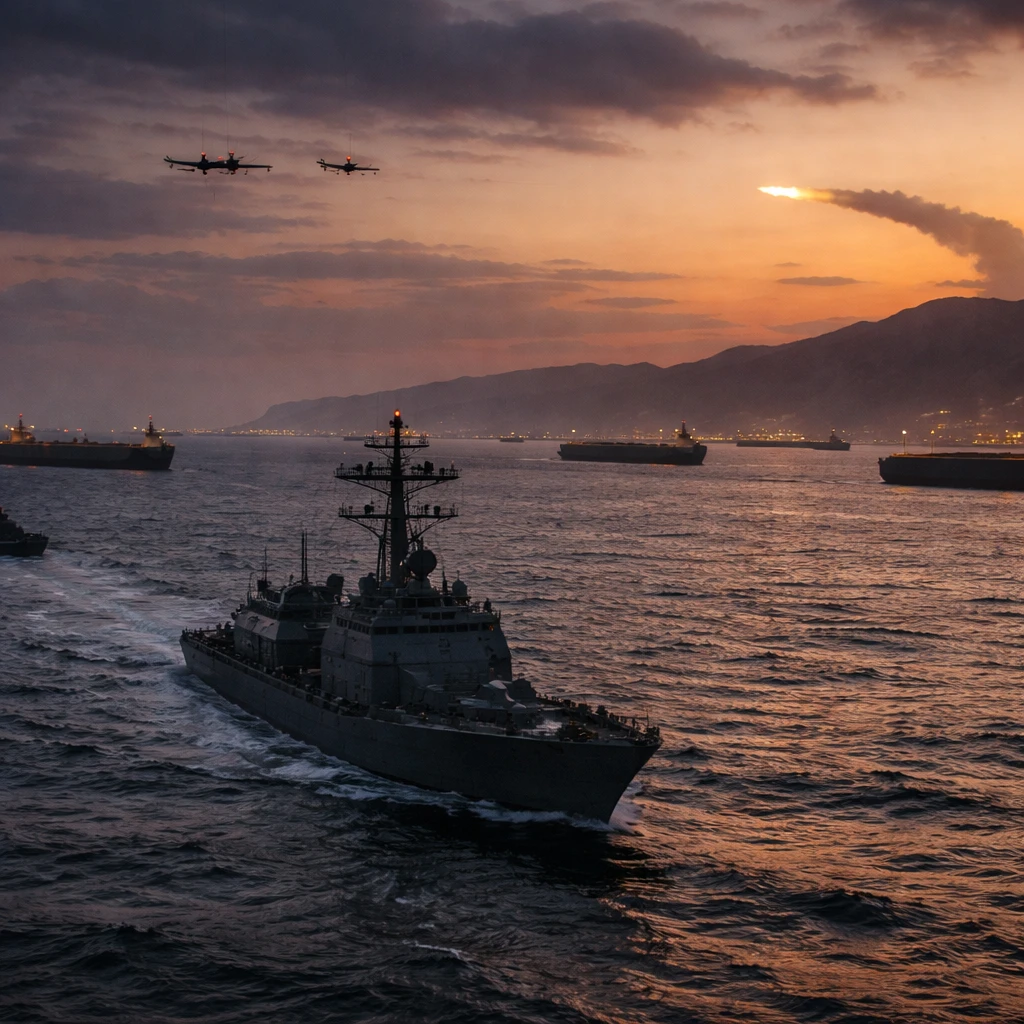
The Houthi movement’s pledge to prevent ships from loading or unloading at Saudi ports in the Red Sea raises the prospect of a new front in a region where U.S. forces are already heavily engaged, according to current and former U.S. officials. If carried out, the action could choke off roughly 7% of global oil supply by impacting Saudi exports and could expand a conflict that Washington has been focused on containing.
Saudi Arabia, which hosts U.S. personnel, has not made a formal request to Washington for military help. Still, political leaders in the United States have signaled a willingness to respond if the Houthis obstruct shipping in the Red Sea, a crucial corridor for global trade. "If something like that happens, we’ll take care of it. We’ve done that with the Houthis before," President Trump told reporters, indicating a readiness to act.
Military planners caution that responding to a Houthi blockade would not be straightforward. The Houthis have shown resilience in the face of air campaigns by the Saudi-led coalition and later U.S. strikes. Their record has created a reputation for being hardened, adaptive fighters who can survive and continue to mount threats to maritime traffic in the Red Sea and the Bab el-Mandeb strait.
Jason Campbell, a former senior Pentagon official now at the Middle East Institute, said the United States would be forced to divide its regional resources between confronting Iran and addressing operations off Yemen - effectively opening two simultaneous theaters. "You’re bifurcating your admittedly fairly robust resources in the region between two active fronts," he said.
Practically, confronting the Red Sea threat could require redeploying U.S. warships from positions in the Gulf closer to Yemen to conduct strikes and to defend shipping from Houthi missiles and drones. That shift would also demand a reallocation of intelligence resources to closely track Houthi capabilities, which U.S. officials say may have evolved since prior campaigns.
The possibility that U.S. Navy vessels and aircraft could again be called on to shoot down Houthi missiles and drones raises further concerns about the attrition of key munitions and air defense interceptors. Experts have previously warned about dwindling stockpiles of such materiel as U.S. forces conduct operations across multiple theaters.
Responding to such questions, Pentagon spokesman Sean Parnell said the U.S. military "has everything it needs to 'execute at the time and place of the president’s choosing.'" He added, "We have executed multiple successful operations across combatant commands while ensuring the U.S. military possesses a deep arsenal of capabilities to protect our people and our interests."
The Houthis have maintained their ability to threaten maritime traffic despite years of bombing by a Saudi-led Arab coalition aimed at dislodging the group from its strongholds in Yemen, and despite recent U.S. strikes. Michael Mulroy, who served as deputy assistant secretary of defense for the Middle East, said: "The Houthis have proven many times in the past that they have the ability and willingness to obstruct maritime traffic in the Red Sea and the Bab el-Mandeb strait."
Under President Biden, the U.S. carried out strikes against Houthi targets to keep the Red Sea trade route open, and the previous administration intensified those efforts as attacks on U.S. warships and commercial vessels increased. Last year, a concentrated U.S. response that lasted roughly two months required significant firepower - including two aircraft carriers, additional warships, fighter jets and strategic platforms such as B-2 bombers - yet officials and analysts say it did not eliminate the group’s capacity to menace shipping.
Despite the U.S. military’s scale and resources, officials acknowledge constraints because many of the systems and assets likely needed for operations off Yemen are currently committed elsewhere in the Middle East, notably to efforts directed at Iran. "We’re pretty busy already," one U.S. official said, noting that warships have been at sea longer than usual because of the high tempo of operations - first in the Caribbean and now in the Middle East.
Long deployments take a toll on personnel and ships alike; vessels require periodic returns to port for maintenance and crews need rest. At present, more than 20 U.S. Navy warships and hundreds of U.S. military aircraft are operating in the region, and additional forces are en route to support operations tied to the Iran conflict, a second U.S. official said. That inflow could limit what is available to counter a separate campaign near Yemen, where a response would demand substantial naval and air assets as well as dedicated intelligence focus.
Retired U.S. Marine officer Mark Cancian, now with the Center for Strategic and International Studies, agreed that adding a second front in the Red Sea would strain U.S. naval capacity. He also pointed to a countervailing factor: the difficulties the Houthis would face sustaining a long campaign given limitations on resupply. "The U.S. blockade is not 100% effective but it is highly effective. As a result, the Houthis may be hard pressed to continue a campaign for long," Cancian said.
Officials and analysts emphasize that should the Houthis act to block Saudi ports, the consequences would extend beyond immediate military concerns. Disruptions to Saudi oil exports would reverberate through global energy markets, given the scale of the potential removal of supply. The prospect of lost oil flows underscores how a maritime confrontation in the Red Sea could have rapid economic and logistical effects worldwide.
For U.S. policymakers, the challenge is operational as well as political. The conflict has evolved since it was initially framed by the U.S. president as a limited bombing campaign aimed at compelling Iran’s concessions. The added possibility of a Houthi maritime blockade complicates that narrative and would force the United States to balance resources and strategy across multiple, concurrent contingencies.
Summary: A Houthi announcement to bar loading and unloading at Saudi ports threatens to remove around 7% of global oil supply from the market and could expand the conflict with Iran into a new maritime front in the Red Sea. U.S. officials warn the move would stretch American naval and air assets that are already committed to operations against Iran and to a blockade of Iranian ports.
Key points:
- The Houthis declared they will not permit ships to load or unload at Saudi ports, risking disruption to Saudi oil exports and roughly 7% of global oil supply.
- Responding to a Red Sea blockade could require shifting U.S. warships and aerial assets from the Gulf toward Yemen, dividing resources between two active fronts.
- Defense and energy sectors are most directly affected - military operations would demand naval and air platforms while oil markets would face supply shocks and logistical disruption.
Risks and uncertainties:
- Operational strain on U.S. forces - the need to address both Iran-related operations and a potential Houthi blockade could deplete available ships, aircraft and munitions, affecting defense readiness in the region.
- Energy market disruption - blocking Saudi ports could remove about 7% of global oil supply, introducing significant volatility for energy markets and downstream supply chains.
- Sustainment challenges for the Houthis - while they can threaten shipping, their ability to maintain a prolonged campaign may be constrained by limits on resupply, given the effectiveness of the U.S. blockade of Iranian ports.