
Three months before a high-speed cascade of ice, mud and rock ripped down a Himalayan valley straddling the Nepal-China border and killed hundreds, officials from the two countries sat together in Nepal's capital to explore closer cooperation on monitoring glacier and flood threats.
On May 27, delegations met in Kathmandu that included 10 Nepali officials and roughly a dozen representatives from China, including participants from the Tibet region where the eventual disaster originated. According to an agenda prepared by Nepali authorities and reviewed by Reuters, the meeting focused on strengthening mechanisms to monitor and respond to floods, weather extremes and glacier-related hazards.
Participants at the meeting urged a series of joint risk-reduction activities, among them comprehensive inventories of glacial lakes and hazard mapping to better identify areas of exposure. The intent was to build a basin-wide understanding that could underpin preparedness on both sides of the border.
Yet, two Nepali officials who attended the session told Reuters that in the weeks following the talks they did not receive the volume or type of information they had expected from their Chinese counterparts. Those officials warned that limitations in data sharing - particularly on glacier movements and water levels - could weaken Nepal's capacity to anticipate sudden, high-impact events.
"What we actually wanted from them, and still want, is if there are early movements of glaciers and early movements around that area, we would want to know a bit early," said Sauhardra Joshi, a hydrologist at Nepal's Flood Forecasting Division who participated in the May meeting.
Officials emphasize that no party has been formally blamed for the disaster, which Nepali authorities estimate will cost about one-tenth of Nepal's annual economic output to recover from. Instead, Nepali leaders say their priority is to deepen operational cooperation with China so that communities vulnerable to glacial hazards receive faster and more actionable warnings.
Requests for comment to China's foreign ministry on the May discussions and on Nepal's repeated asks for broader information sharing were not answered, according to people involved in the exchanges. During the meeting, Nepali officials said the Chinese delegates told them they lacked the mandate to sign a data-sharing agreement at that time and asked for follow-up talks, Binod Parajuli, another hydrologist in Nepal's government, said.
Public statements by the Chinese embassy in Kathmandu, posted on the social media platform X, said Beijing and Kathmandu had maintained close contact on the issue and that the May meeting had made "substantial progress" toward promoting cross-border disaster information exchange. The embassy pushed back against online criticism in Nepal that China had failed to provide adequate warning, saying both Chinese and international teams encounter significant difficulties monitoring hazards in the remote high Himalayas and that Chinese experts had shared important data with Nepal "in a timely manner."
Nepal had raised similar concerns about the same area last year, after a sudden release of water from a glacial lake in Tibet caused a flood in Nepal that resulted in at least nine deaths and more than a dozen missing. Despite the long-standing nature of these issues, experts and officials cautioned that the pace of cross-border cooperation was not the primary cause of the most recent catastrophe.
Environmental anthropologist Austin Lord, a senior fellow at the Stimson Center and part of a team supporting Nepal's disaster and climate risk work, said the glacier collapse occurred in a relatively unmonitored location. Lord noted that limited bilateral exchange exists, but he did not identify that limitation as the key factor hampering Nepal's immediate response.
"That is not to forgive the fact that there isn't really a well-articulated system. And there is very limited exchange between Nepal and China," Lord said, adding that Chinese scientists generally have greater monitoring capacity and resources than counterparts on the Nepali side.
Timeline to catastrophe
Twelve days before the flood, China's World Meteorological Centre emailed Nepali officials to warn of a monsoon depression forecast for the region between August 14 and 19. The message, seen by Reuters, cautioned that enhanced rainfall was likely across much of Nepal and highlighted the potential for cascading hazards, including landslides and flash floods.
China's embassy stated it had been sharing monitoring data on a lake formed by debris from the recent disaster. Nepali hydrologists say, however, that while Beijing had been sending heavy precipitation forecasts and observations - often via China's WeChat platform and by email since about a month before the event - more granular information on avalanches, water levels, landslides and other extreme events was not routinely supplied.
Some monitoring steps had been taken: when the Chinese side issued forecasts of heavy rain in Tibet, those forecasts were passed on to Nepali officials, Parajuli said. Yet the Nepali hydrologists told Reuters they continue to press for more frequent, operational data that would allow them to detect sudden glacier movement and water-level rise in real time.
At approximately 8:32 a.m. Nepal time on the Wednesday the flood struck, surveillance footage captured the torrent blasting through a border crossing on the Tibetan side as people tried to flee. Twenty-six minutes later, Nepali hydrologist Parajuli said he received a call from the head of Nepal's National Disaster Risk Reduction and Management Authority notifying him of a flood on the Trishuli river.
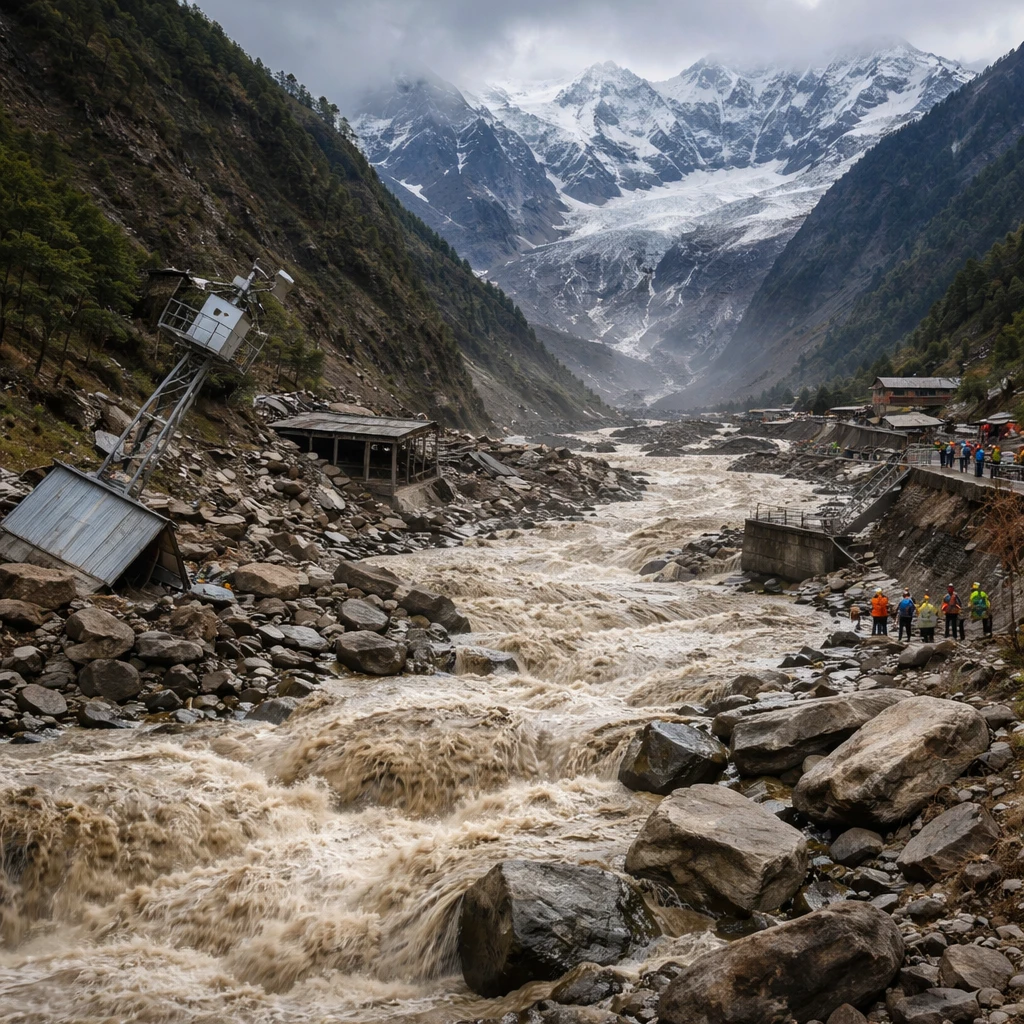
Parajuli's team discovered that a border monitoring station had ceased transmitting data after 8:40 a.m., and attempts to reach downstream stations found them similarly silent. Teams suspected that the devices had been washed away by the fast-moving flow. After verifying the situation with local authorities, Nepali officials issued a public alert to mobile users at 9:13 a.m.
Preliminary Nepali government assessments indicate the deluge carried approximately 57.4 million cubic metres of water - about 2 billion cubic feet - down the valley, a volume more than half again as much as typical flows. The torrent traveled 168 km downstream from the Nepal-China border, destroying at least four monitoring stations in its path.
Physical and human toll
The surge of floodwaters dislodged enormous boulders, swept away buildings and damaged critical infrastructure across a broad swath of the watershed. Nepali authorities and external analysts reported damage to 19 bridges and roughly 40 km of highway. The disaster also knocked out more than 10 percent of Nepal's electricity generation capacity according to the Stimson Center.
Survivors described the flow not as water but as a "huge gush of mud" that struck with high velocity. Keshav Prasad Baral, from Tupche village about 25 km downstream of the border, said he lost his wife to the mudslide as the mass of debris ripped through the village. Such accounts underscore the human devastation that accompanied the loss of life and infrastructure.
Preliminary Nepali assessments suggest the glacier fragment that failed carried about 5 million cubic metres of ice and rock, and when it crashed to the valley floor hundreds of metres below, it produced high-speed flash floods. The current confirmed toll from the event stands at nearly 800 dead across both sides of the border with more than 3,000 people listed as missing, according to the latest counts cited by officials.
Broader geophysical context
The Hindu Kush Himalayas extend across a broad region from Afghanistan to Myanmar and contain the largest volume of ice outside polar areas. The mountainous zone holds more than 63,700 glaciers, which cover nearly 56,000 square kilometres and together store up to 5,700 cubic kilometres of ice. These figures highlight the vast ice reserves that influence river systems and downstream livelihoods across South Asia.
Glacier melt in the region is accelerating, driven by changing climate patterns: declining snow cover and more erratic snowfall are among the trends identified in scientific assessments cited by Nepali institutions. Those shifts increase the likelihood of floods and landslides and exacerbate related hazards such as sedimentation and erosion.
Mountain communities that rely on rivers originating in Tibet and adjacent highlands face heightened exposure because many major South Asian river systems originate there and then flow through highly seismically active, flood-prone landscapes.
Next steps and demands for data-sharing
In the aftermath of the disaster, Nepali authorities said they will intensify efforts to collaborate with China on research and the construction of monitoring systems to detect avalanches and sudden releases of water from glacial lakes - threats that loom large for communities on both sides of the border.
Parajuli said his department plans to propose a formal data-sharing agreement with China patterned on an existing arrangement Nepal has with neighbouring India. The aim is to secure more frequent updates on precipitation and river levels, moving beyond occasional high-precipitation forecasts to a continuous stream of operational data.
Specifically, Nepali officials said they will request data at 10-minute intervals so that they can issue warnings quickly and, they hope, reduce future loss of life. "Our main target is we shouldn't miss any future disaster," Parajuli said.
Officials also stressed that while cross-border data exchange is not a panacea, improving the density and timeliness of monitoring networks and the resilience of data transmission systems could materially improve early-warning lead times for communities downstream.
At present, the degree and frequency of data sharing, the technical modalities for real-time exchange, and the institutional arrangements required for such cooperation remain matters for further negotiation between Kathmandu and Beijing.
Wider economic implications
The disaster's immediate impacts are both human and economic. Nepali estimates that recovery will cost roughly a tenth of the country's annual economic output, a sum that will strain national resources and test the resilience of infrastructure and public finance. Damage to bridges, roads and power facilities will impede logistics and recovery operations, and the loss of electricity generation capacity may affect industrial activity and households.
Beyond reconstruction costs, the event underscores vulnerabilities in sectors dependent on stable infrastructure and reliable hydrological regimes - including hydropower, transportation and local commerce - which may face longer-term disruptions as the region copes with increased glacier instability and more frequent extreme events.
Conclusion
The May meeting in Kathmandu represented a formal recognition by officials on both sides of the border that glacier and flood risks require collaborative attention. But the events of August - a fast-moving glacier collapse and a destructive flood that killed and displaced hundreds - have highlighted gaps between high-level dialogue and the operational, minute-by-minute data flows that can underpin lifesaving early warnings.
Nepal is pressing for more systematic, frequent data exchanges and for agreements that will allow Nepali agencies to receive near-real-time precipitation and water-level information. Whether Beijing and Kathmandu can translate concern into robust, interoperable systems for shared monitoring remains a central question for preventing similar tragedies in future.