
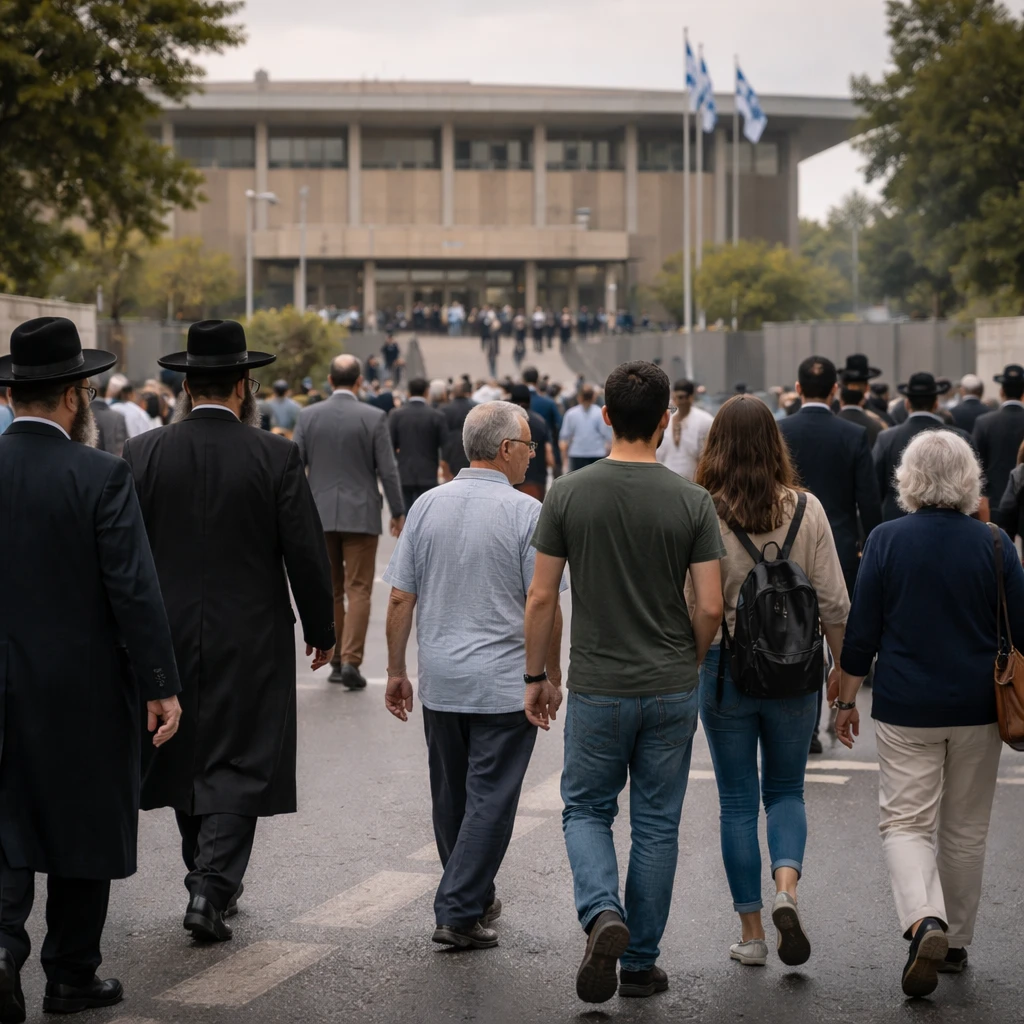
Israelis are scheduled to cast ballots on October 27 in a national election that will be the first since the October 7, 2023 Hamas attack that upended security perceptions and triggered fighting involving Gaza, Lebanon and Iran. The vote arrives amid public scrutiny of leadership and governance at a time when war and national security have dominated public life.
Where the polls stand
Multiple surveys in recent months have pointed toward what many pollsters describe as a likely defeat for Prime Minister Benjamin Netanyahu. The October 7 attacks have, according to these polls, heavily damaged his reputation on security matters, an area that had been central to his political profile. While public backing for Israel’s military campaigns against Hamas, Hezbollah and Iran has remained substantial, confidence specifically in Netanyahu’s leadership has declined.
Beyond security concerns, a range of his government’s domestic policies on religion and the state have drawn disapproval from significant segments of the electorate. Despite those trends, Netanyahu is a long-tenured politician known for his ability to navigate turbulent political waters. Polls to date do not display a clear, consolidated path to power for any single rival, leaving room for fluid developments ahead of the election.
Main challengers
- Gadi Eisenkot - The former military chief, who lost a son in Gaza, has seen a rise in polling support. Eisenkot presents himself as an outsider to the political establishment, emphasizing his military background and security credentials. His image of modest origins and family sacrifice is frequently contrasted with Netanyahu’s long public career and ongoing legal challenges.
- Naftali Bennett and Yair Lapid - The two former prime ministers formed an unlikely joint ticket after previously occupying opposing political positions. Their alliance produced a coalition that unseated Netanyahu in 2021, assembling an eclectic mix of liberal and conservative parties and, for the first time in Israel’s history, including an Islamist Arab party. That government lasted roughly 18 months.
- Avigdor Lieberman - Once an aide and ally of Netanyahu, Lieberman has positioned himself to the right of his former partner and left the Netanyahu government in 2018 for being insufficiently tough on militants in Gaza. Since then, he has been one of Netanyahu’s most outspoken critics.
How Israeli elections operate
Israel uses a parliamentary system in which citizens vote for a national list to fill the 120-seat Knesset. While the law envisions four-year terms, in practice many Knessets have been short-lived. A cycle of frequent elections that began in 2019 culminated in 2022 when Netanyahu returned to power with a strong parliamentary majority, leading what was described as the most right-wing government in Israel’s history. The upcoming vote is notable because it follows a Knesset that, in that cycle, completed a full term, an uncommon occurrence.
Seats in the Knesset are distributed by proportional representation. Parties that receive at least 3.25% of the national vote - the threshold equal to four seats - qualify for allocation. Because no single party has ever won an outright majority, forming a government requires coalition-building among parties. This design gives smaller parties leverage when negotiations are tight and can result in leaders having to accommodate a range of demands to maintain a governing majority.
Coalition dynamics and political bargaining
Coalitions in Israel can be fragile. When policy disagreements surface, governments may quickly unravel. Small factions can therefore act as kingmakers, determining who will lead the country and how long a government endures. Historically, prime ministers have navigated sectarian and ideological requests to preserve their coalitions.
Netanyahu has depended politically on ultra-Orthodox Jewish parties for survival. Those parties have long requested exemptions for their communities from compulsory military service, an issue that has been especially sensitive amid wartime mobilization and national security concerns.
Who is on the ballot
Political parties must submit their candidate lists by a September deadline, meaning the roster of participants can still shift as parties join, merge or withdraw. At present, Netanyahu’s governing bloc includes his own right-wing Likud party alongside Finance Minister Bezalel Smotrich’s Religious Zionism, which supports settlement expansion, and Itamar Ben-Gvir’s far-right Jewish Power. The ultra-Orthodox parties United Torah Judaism and Shas left the government in 2024 but have continued to lend support from outside the coalition.
Opposition and challenger lists include Eisenkot’s Yashar - a name meaning "honest" or "straight" in Hebrew - the joint ticket of Bennett and Lapid called Together, Lieberman’s Israel Our Home which draws a base among Israel’s ex-Soviet immigrant community, and four parties that mainly represent the country’s roughly 20% Arab minority: Hadash, Taal, Raam and Balad. Also in the mix is the left-wing Democrats led by former general Yair Golan.
What remains uncertain
Although current surveys point toward a decline in Netanyahu’s standing, the fragmented nature of Israel’s political landscape means that the post-election configuration is hard to predict. Small parties and shifting alliances may prove decisive in the weeks after the vote. Until candidate lists are finalized in September, there is also potential for additional changes to the field that could affect voter choices and coalition possibilities.
For voters and observers, the central questions will be how parties translate poll positions into seats and how potential coalitions form when the Knesset reconvenes. In such a system, electoral arithmetic and bargaining often matter at least as much as headline polling figures.