
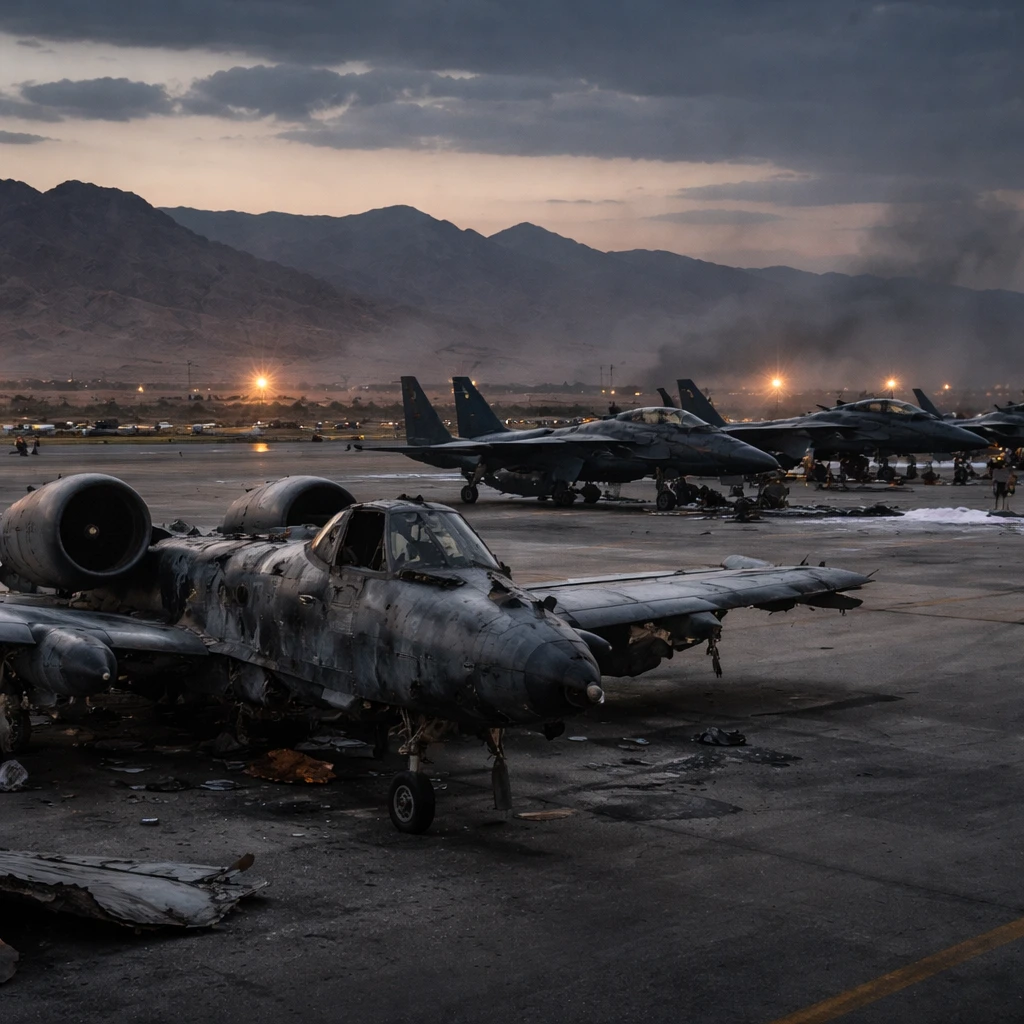
Sept 10 - Iranian strikes this week inflicted damage on a number of American military aircraft located at the Muwaffaq Salti Air Base in Jordan, a U.S. official said. The attacks added to material losses the U.S. military had already sustained earlier in the conflict.
According to the official, one A-10 Thunderbolt II - commonly referred to as the Warthog - was struck in the attack and was left with a missing wing. The same source said roughly eight F-15 fighter jets suffered only light damage and were subsequently returned to service.
Those recent hits build on a broader pattern of equipment losses. The U.S. military had already seen more than two dozen drones destroyed, fighter jets struck, and other aircraft lost to accidents prior to the Jordan attack. A May report by the Congressional Research Service noted that 42 U.S. military aircraft had been lost or damaged in the conflict up to that point.
The human toll of the conflict was also noted: since the Iran war began in February, 18 U.S. service members have been killed and more than 800 have been injured, the official account states.
The Iranian assault on the Jordan base occurred after U.S. forces said they had destroyed five Iranian crude oil carriers. U.S. authorities described those strikes as a response to actions by Iran's Islamic Revolutionary Guard Corps, which targeted a U.S. Navy warship with ballistic missiles on two separate occasions over the two days preceding the attacks.
Responding to the missiles launched at the warship, U.S. forces fired about 30 Patriot interceptors to counter the incoming threats, the U.S. official said. That expenditure has drawn attention to the size of U.S. inventories of air defense interceptors and other missiles.
While exact counts of remaining interceptors are classified, an estimate from the Center for Strategic and International Studies cited in reporting indicated that roughly 65% of U.S. Patriot interceptors were expended between February and July, leaving fewer than 850 interceptors in reserve - down from an inventory of 2,330 prior to the onset of the Iran war.
Clear summary
An Iranian strike on a Jordanian base this week damaged multiple U.S. aircraft, including heavy damage to an A-10 and light damage to several F-15s, following a sequence of U.S. strikes on Iranian-linked shipping and Iranian missile attacks. The incident compounds existing U.S. matériel losses and has highlighted concerns about air defense interceptor stockpiles.
Contextual details
- More than two dozen drones were destroyed earlier in the conflict.
- A May Congressional Research Service report recorded 42 U.S. military aircraft lost or damaged in the conflict.
- Since February, 18 U.S. service members have been killed and over 800 wounded.
Attribution and sources
The account of aircraft damage and interceptor usage was provided by a U.S. official who spoke on the condition of anonymity; other inventory estimates referenced reporting by a strategic research center.