
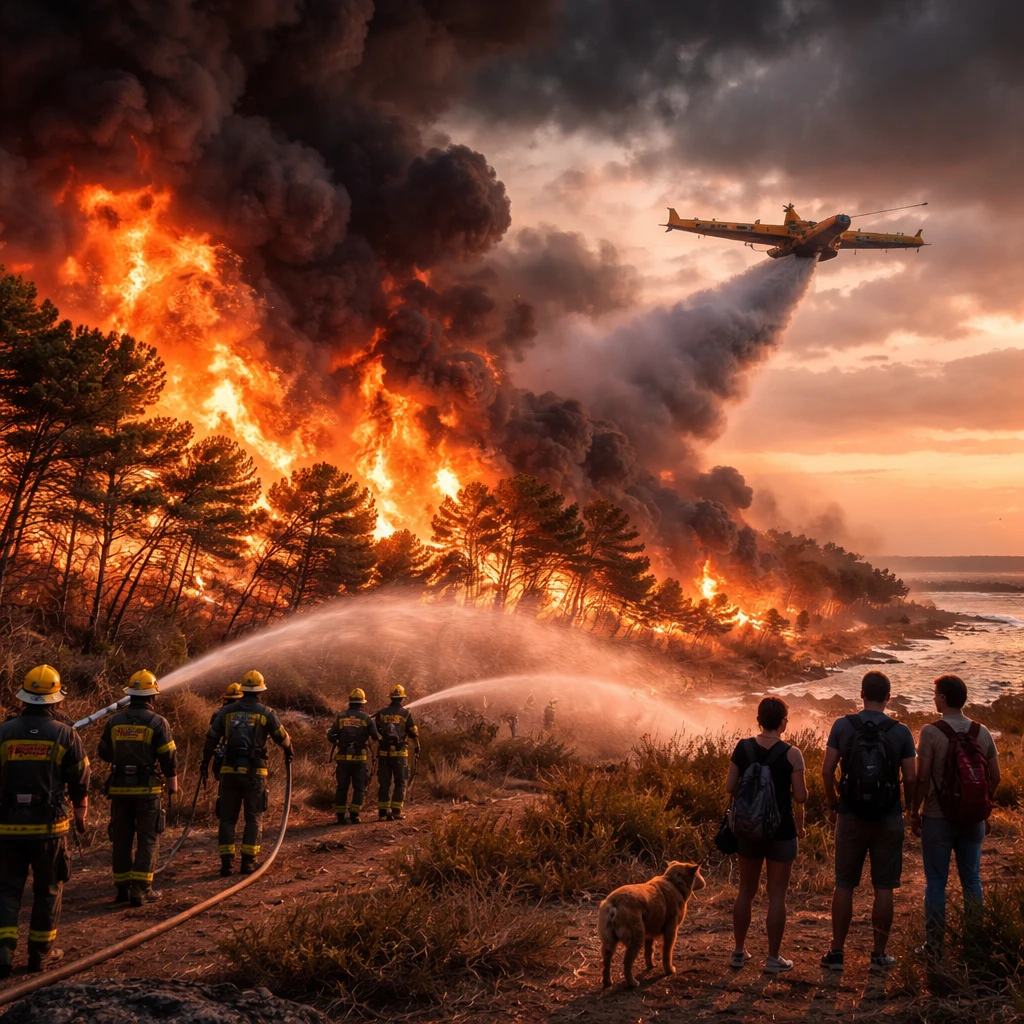
Fire crews worked through Tuesday to bring under control vast wildfires that forced unprecedented evacuations across parts of France and Spain, while meteorological services warned that a new heatwave was set to push temperatures higher from Wednesday.
In the Bordeaux area, authorities said firefighters had contained a forest blaze overnight, although some flare-ups persisted. In Spain, officials lifted a state of emergency introduced on July 23 for much of central Toledo province, allowing most residents to return to their homes. Fire activity, however, remained active in the nearby Madrid region.
Spanish Prime Minister Pedro Sanchez told reporters: "We are starting to see the end of the tunnel in the fight against these fires." The remark followed a week in which flames tore through a region already suffering from a blisteringly hot and dry summer.
In France, the situation has been particularly grim around the Cap Ferret peninsula on the Atlantic coast, a popular tourist area, and across districts surrounding Bordeaux where fires have swept through vegetation and posed major threats to communities. President Emmanuel Macron described the wildfire crisis as possibly the most severe the country has faced since World War Two.
Local authorities in Nouvelle-Aquitaine and Gironde posted on X that the fire had been contained on Tuesday after some flare-ups, but they cautioned that weather forecasts remained unfavourable. Spanish officials continued to scale back emergency measures on Tuesday, clearing the way for residents to return to 13 municipalities and other affected areas in the Madrid region and Avila province.
Health authorities reported that a woman who had been hospitalised in critical condition after suffering severe burns during a wildfire near Almeria on July 9 has died, raising the death toll from that blaze to 14.
Large wildfires can generate their own microclimates. Rising heat and smoke may form towering storm clouds that sometimes produce strong winds and lightning, which can spark new fires. That phenomenon, known as a pyrocumulonimbus, has been recorded in other countries that experience major wildfires. "We fight against a monster," said Eric Brocardi, a spokesperson for the French firefighters' association, adding that such phenomena were likely to become more frequent.
Weather forecasts amplified concerns that containment gains could be fragile. According to the Reuters Climate Monitor, temperatures in Bordeaux were expected to reach 33 degrees Celsius on Tuesday - 7.1 C higher than the daily average for 1961 to 1990 - while the Madrid region faced 37 C, 5.5 C above that historical average. Meteo France said the heat was expected to peak on Wednesday, with temperatures in Paris possibly hitting 38 C, but it added that the duration of the heatwave "will be determined in the coming days." Crews were trying to capitalise on more favourable conditions before the next wave of higher temperatures arrived.
Scientists cited by officials say human-driven climate change is intensifying the heat and drought that allow wildfires to spread more rapidly, burn longer and reach greater destructive power. Spanish Prime Minister Sanchez warned that ignoring this fact made people even more vulnerable to these changing conditions.
The blazes and the persistent heat have disrupted everyday life across multiple sectors. Authorities reported snarled road and rail travel and impeded river shipping. In Bulgaria, a passenger ship ran aground overnight on the Danube because of low water levels, a disruption linked to drought conditions cited alongside the region's heat.
International assistance arrived as other EU members and Turkey sent waterbombing aircraft to both Spain and France, while Sweden, Portugal, Switzerland and Serbia deployed ground teams. Even so, the intensity and extended duration of the fires have prompted questions about whether firefighting and emergency resources are adequate.
Avincis, Europe’s largest aerial emergency services firm, warned that the continent is not prepared for longer, more extreme wildfire seasons, noting that its firefighting aircraft were now needed almost year-round. The International Federation of Red Cross and Red Crescent Societies said emergency support services were under growing strain in Spain and France as evacuations continued. "This is the pattern we are seeing more and more across Europe: heatwaves, drought and wildfires feeding into one another, and communities bearing the consequences," said Maria Alcazar Castilla, IFRC deputy regional director for Europe, urging investment in preparedness and climate adaptation.
For residents forced from their homes, escape often meant leaving with only relatives and pets, abandoning possessions and property. Spanish evacuee Jose Miguel Encinas, 53, from La Vall d'Uixo in eastern Spain, described the departure in stark terms: "It was like in the movies where hell cracked the ground open, and you see the red hell." Many people reported scenes of sudden chaos as flames and smoke advanced.
Authorities and emergency services continued to monitor fire behaviour closely as they sought to consolidate containment lines and secure areas recently evacuated. Officials emphasised that any progress could be reversed if temperatures rose and winds shifted, noting that the coming days would be critical in establishing whether control can be maintained as heat returns.
Summary
Firefighters have achieved containment in parts of the Bordeaux region and Spain's Toledo province, enabling returns for many evacuees, but the Madrid region still faces active fires. Forecasts predict another heatwave from Wednesday that could undermine control efforts. International assistance has been deployed, yet agencies warn emergency resources are under significant strain as prolonged, intense wildfire seasons appear to be increasing.
Key points
- Containment advances: Firefighters reported overnight containment in the Bordeaux region; Spain lifted a state of emergency for much of Toledo province, allowing returns for many residents. - Impacted sectors: tourism, local services.
- Weather risk: A new heatwave is forecast to arrive from Wednesday with temperatures peaking in parts of France and Spain, raising the risk of renewed fire activity. - Impacted sectors: transport, river shipping.
- Resource strain: International aerial and ground assistance has been deployed, but agencies warn that firefighting capacity is stretched amid longer and more intense wildfire seasons. - Impacted sectors: emergency services, aviation (aerial firefighting).
Risks and uncertainties
- Renewed heat could reverse containment gains - if temperatures rise and winds shift, fires may re-ignite or spread. - Sector affected: public safety, transport.
- Fire-generated storms (pyrocumulonimbus) can produce winds and lightning that spark new blazes, complicating suppression efforts. - Sector affected: emergency services.
- Emergency and aerial firefighting resources could be insufficient for prolonged seasons, leaving regions vulnerable if multiple large fires occur simultaneously. - Sector affected: aviation and emergency response logistics.