
Summary
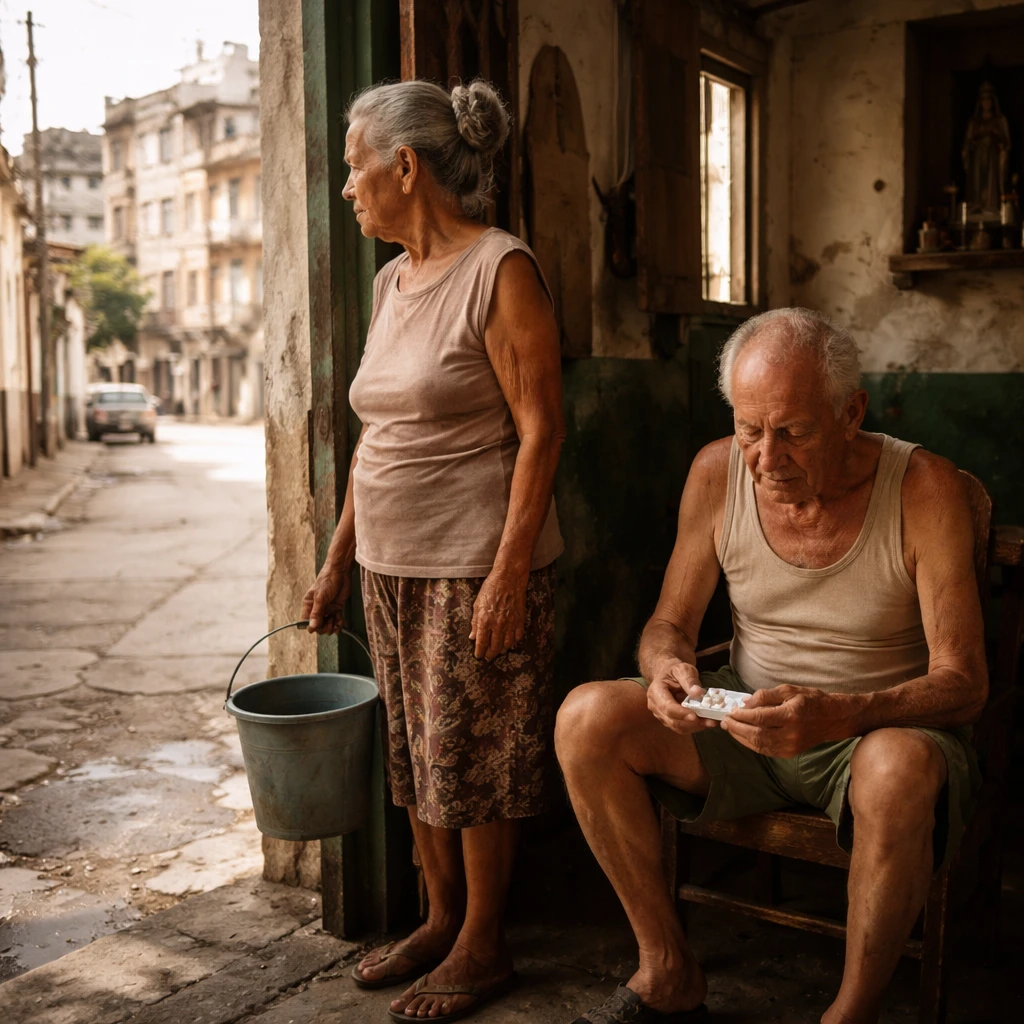
The generation that spent working lives within Cuba’s state system now confronts rapidly deteriorating living conditions. After a late-January decision that curtailed fuel access to the island, long-running shortages of food, medicine and electricity have deepened. Pensions have been sharply devalued on the black-market exchange, public transport is unreliable or absent, and health services report major gaps in personnel and essential medicines. For many elderly Cubans, the social guarantees promised decades ago are no longer delivering basic needs.
Human impact and daily struggles
Sagrado Armando Garcia, 85, a former long-term bureaucrat at the Ministry of Social Security, has experienced this downturn personally. After collapsing at home, Garcia’s son was unable to drive him to a hospital because the family lacked fuel for their car. On other days Garcia said he has felt dizzy from hunger. He described a sense of abandonment after years spent relying on a system he believed would protect him in old age: "They are leaving us to our fate," he said.
These stories are echoed across the island. Cuba’s elderly have long lived with intermittent services, power cuts and shortages. Those pressures intensified after the Trump administration’s move in late January to cut off the island’s fuel supply, according to reporting from Havana. Officials and aid workers now warn that the combination of higher prices, smaller pensions and restricted mobility has created a precarious situation for older citizens.
Official response and competing explanations
A U.S. State Department spokesperson referred to recent testimony from Secretary of State Marco Rubio, attributing Cuba’s problems to internal corruption and mismanagement rather than to U.S. sanctions. "Cuba was having blackouts well before January 3rd of this year, for two reasons: they were no longer getting free oil from Venezuela, and they did not invest a single dollar back into their plants," the spokesperson said, citing Rubio. "Cuba is a mess."
Economic pressures on fixed-income seniors
Inflation, currency instability and reduced rations have hollowed out the real value of pensions. On the black-market exchange, pensions have been estimated to be worth the equivalent of $7 per month. The peso has lost about a third of its value against the dollar since the start of the blockade.
Recognizing the strain on the most vulnerable, the Cuban government has appealed to the United Nations World Food Programme for assistance so it can continue providing two meals a day to seniors and other vulnerable groups. Etienne Labande, the WFP representative in Havana, warned that the combination of higher prices and shrinking pensions and rations had placed many older people at serious risk. "This is a very high-risk population right now, a situation that worsened starting in January," he said. "Inflation has skyrocketed, there’s no public transportation, and getting around costs a lot of money." The Ministry of Internal Commerce, which oversees public food kitchens, did not immediately respond to requests for comment.
Healthcare system under strain
Cuba’s public healthcare system, long presented as a central achievement of the revolutionary state, has been weakening after years of economic pressure. Government figures show the number of doctors fell by 30% between 2019 and 2024, the most recent year for which public data are available. Concurrently, officials report that 70% of essential medicines were either scarce or completely unavailable.
Hospitals are seeing growing backlogs. The Cuban health ministry projects that the waiting list for surgeries will reach 160,000 patients by the end of the year, a rise equivalent to a 60% increase from previous levels. Physicians interviewed in Havana said many drugs, including common blood pressure medications, are in short supply.
Uneven access and the role of remittances
On an island where average monthly income is reported to be around $15, modest remittances from abroad can be decisive. Those elderly who receive money from relatives outside Cuba often fare better than those who do not.
Regina Zaida Jorge, 74, a retired physician who does not receive external remittances, lives alone in a cramped flat that was once servants' quarters. She has no running water and must carry water from a rooftop cistern. She relies on government food rations and handouts from the Catholic Church. "The policies here were designed to guarantee the basics," she said. "But deep down they are cosmetic measures, to keep you alive. You have to forget about aspiring to have a television, a telephone; the pension isn’t enough for anything." She said she gave "everything" as a low-paid state worker to a system that cannot consistently provide essentials like a bar of soap. "I feel like I sacrificed myself in vain," she added.
By contrast, some seniors who receive remittances describe more stable circumstances. Sonia Belmonte Puebla, 73, said she gets small dollar amounts from a daughter in Florida. That support allows her and her husband to live independently and to afford occasional treats and better food. "I can treat myself now and then and eat well," Belmonte said.
Religious and community organizations also provide a partial safety net. Bryan Arbuelles, a member of the clergy at the San Juan de Letran church in Havana, said elderly parishioners are among the worst affected by the crisis. "In this crisis that Cuba has been experiencing since January, the elderly are most affected," he said. "They are people who worked for decades but whose pension is now not enough to live on." He described the outlook as "terrible."
Demographic pressures and long-term concerns
Cuba is the fastest-aging nation in Latin America and the Caribbean. Government statistics indicate more than a quarter of the population is over 60, a shift driven by a steep fall in birthrates and a large outflow of younger people. Since 2021 the population has shrunk to less than 10 million, a decline of roughly 10%.
These demographic trends amplify the social and fiscal pressure on public services. As a larger share of the population enters old age while the working-age base contracts, healthcare, pensions and food distribution systems face mounting demand even as resources become constrained.
Conclusion
For many older Cubans, the promise of state protection has been eroded by a mix of external restrictions and internal economic stresses. Diminished purchasing power, reduced medical supplies and personnel shortages, and faltering transport have combined to create a precarious environment for a population already vulnerable because of age and limited incomes. International aid requests and community-level charity provide limited relief, but officials and aid workers warn that risks to seniors remain acute and have worsened since the fuel cutoff in January.