
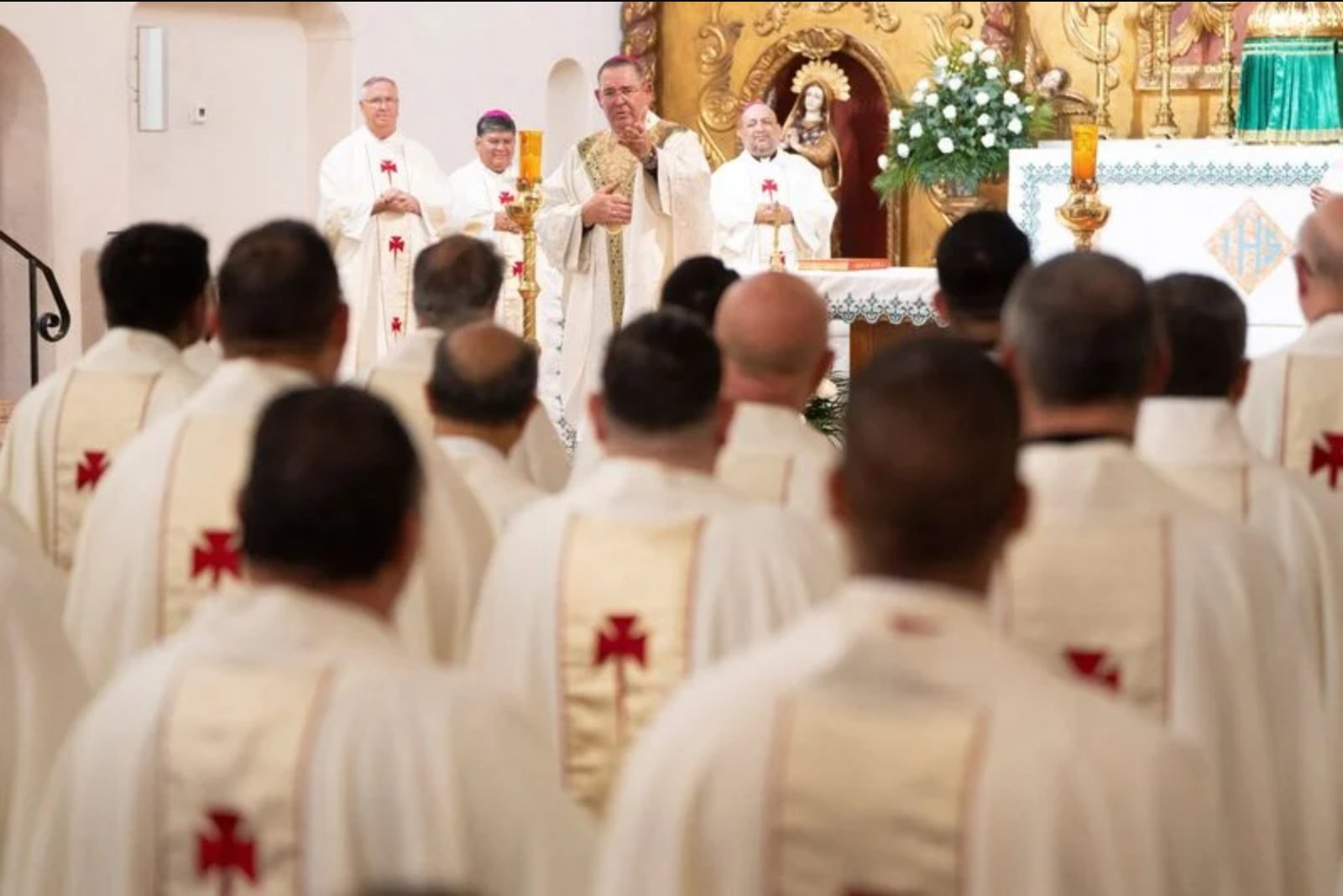
More than 100 members of the Catholic clergy and faithful gathered in Nogales, Arizona, on Friday evening for a cross-border procession demanding that migrants be treated with dignity and respect. The group - made up of bishops, nuns, priests and parishioners - walked from the Sacred Heart Church in Nogales, which overlooks the U.S.-Mexico border fence, into the Mexican sister city in Sonora as part of an event timed to coincide with commemorations of America's 250th anniversary.
At the start of the event, Tucson Bishop James Misko celebrated Mass at the Sacred Heart Church and urged unity. "We want to be well together. This is what the Church is all about," he said, as the congregation prepared to leave the church and move toward the border crossing.
When the service ended, the group began a rosary procession, walking across the border where Mexican clergy and parishioners joined them. The walk continued under intense heat: Sister Eileen McKenzie, a Franciscan nun active with migrants in Ambos Nogales, said temperatures reached about 96 degrees Fahrenheit (36 degrees Celsius) and described the conditions as extreme.
"The heat is terrible, the heat is actually deadly," Sister McKenzie said, calling the procession a distinct act of solidarity. She noted that, as they marched, the group reflected on those who are crossing deserts without respite, observing that people are traveling farther into dangerous terrain out of increasing desperation.
Catholic leaders in the United States, as well as Pope Leo, have spoken out against immigration measures implemented during the Trump administration, criticizing mass deportations, conditions inside detention centers and enforcement raids. Church officials say those actions have helped create fear and suffering among migrant communities.
The U.S. Supreme Court issued two rulings on Thursday that affect asylum and deportation protections. The decisions allow the Trump-era policy of turning away asylum seekers at the border to stand and remove deportation protections from hundreds of thousands of Haitian and Syrian immigrants, outcomes cited by religious leaders as part of the broader enforcement context.
At a November meeting, the United States Conference of Catholic Bishops expressed concern about the growing hostility toward immigrants and the state of detention facilities. The USCCB said it was saddened by what it described as "the vilification of immigrants" and worried about restricted access to pastoral care for those held in custody.
Bishop Mark Seitz of the Diocese of El Paso, Texas, said he has been tracking conditions at the Camp East Montana detention center at Fort Bliss. Seitz reported instances in which religious chaplains have been denied access to some detainees, and he described alarming health outcomes among those held there.
"Most of these people that are being detained right now, they’re not elderly people. They’re not generally sick people. And yet they’re dying. And, there are many emergency calls from there to people who are suffering mightily," Seitz said. He added that Catholic priests at the facility have been permitted to offer only a single Sunday Mass each week in a space that holds about 100 worshippers, a small fraction of the more than 1,000 people detained.
"These are people, 80% of which are probably Catholic and, and many of which, because of their circumstances, are even more needing God in their lives. It’s so unfortunate that we can’t serve them," Seitz said, emphasizing the pastoral gap inside the detention center.
A spokesperson for the U.S. Department of Homeland Security previously told Reuters that, "ICE is always looking at ways to improve (its) detention facilities," and cited a change in contract administration at Camp East Montana following three deaths there between December and January.
After crossing into Mexico, the bishops and the procession were waved through by federal officials and continued praying the rosary beneath a banner of the Virgin of Guadalupe. Observers along the route smiled as the procession headed to the Church of the Immaculate Conception, where they were welcomed by the local Nogales bishop.
Dylan Corbett, executive director of the HOPE Border Institute in El Paso and a member of the Dicastery for Promoting Integral Human Development - a Vatican group that advocates for migrant rights - said the Mass and procession at Nogales were part of a broader, sustained effort by Catholic communities worldwide to support migrants.
Corbett described church-led work in regions experiencing large outflows of people, saying, "In Central America, the exodus that we’ve seen from Venezuela, and (in) Haiti, the Church is there providing humanitarian support, standing up structures to be able to reintegrate those who have been deported, providing witness and also advocacy to advance policies that are more humane and will result in a more human and compassionate treatment of migrants."
The church action in Nogales was positioned by participants as both a pastoral ministry and a public appeal. Organizers framed the procession and shared prayers as a demonstration of solidarity with people who migrate under dangerous conditions and as a call for humane treatment from governmental authorities.
Looking ahead on the religious calendar, the article notes that on July 4 - the 250th anniversary of U.S. independence - Pope Leo will celebrate Mass in Lampedusa, an Italian island that has received large numbers of migrants over time from parts of Africa and the Middle East. Church leaders involved with migration issues said the Nogales event is one node in a wider network of pastoral and advocacy efforts by the global Catholic community.
Context note: The procession at Nogales combined liturgical observance with public protest and pastoral concern, bringing together U.S. and Mexican clergy and laypeople to press for dignity, access and policy changes related to migration and detention.