
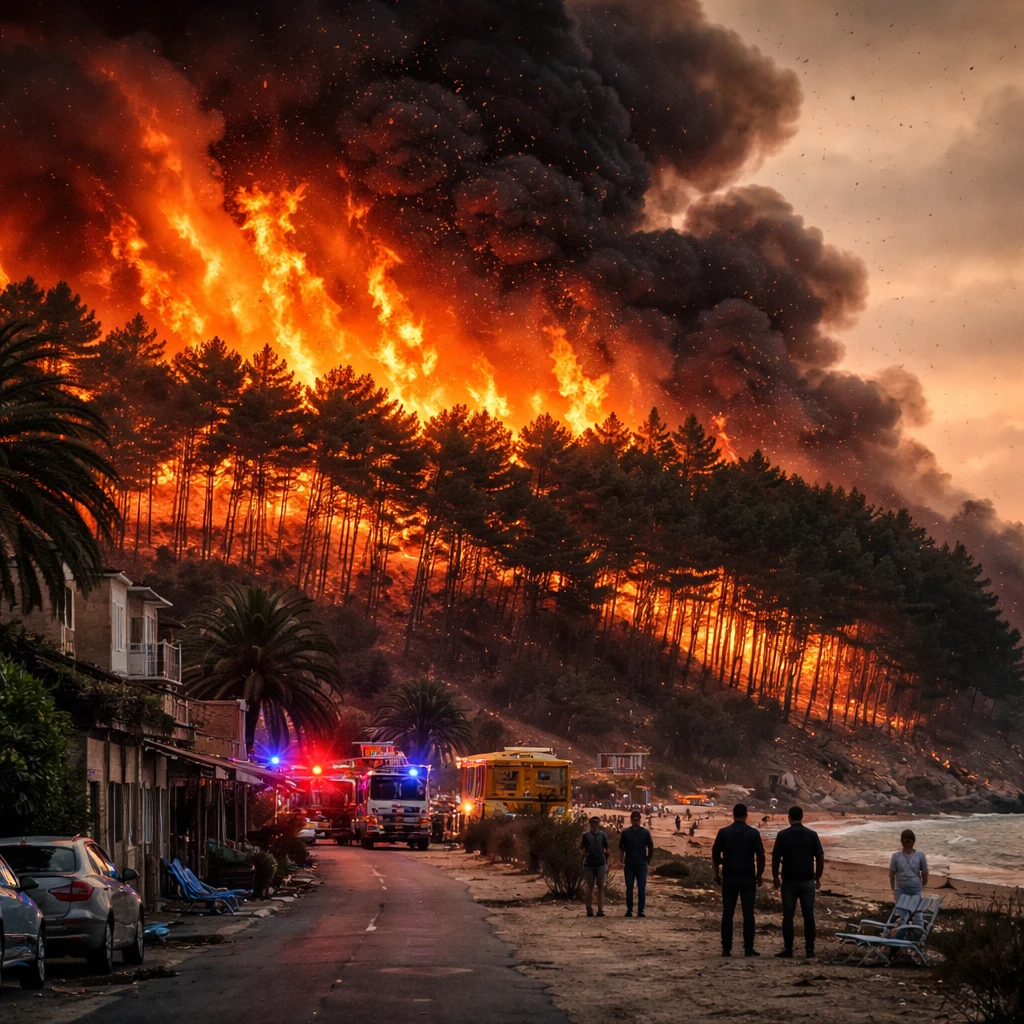
Major wildfires continued to spread across parts of western and southern Europe on Thursday as extreme heat, arid vegetation and powerful winds combined to prolong a season marked by deadly blazes and large-scale evacuations.
Near Bordeaux in southwestern France, authorities said the perimeter of the main fire had not expanded overnight, with the area consumed by flames holding at 42,000 hectares. Local officials reported two arrests on suspicion of arson in connection with fires in the region, without providing further details about the detainees.
The fires in the Bordeaux area have raced through pine forests and driven about 220,000 residents and holidaymakers from their homes and lodging. Officials said roughly 60,000 people had been given permission to return, while thousands of local businesses that briefly suspended operations began to reopen.
Weather conditions offered a possible respite around Bordeaux, with forecasts suggesting higher humidity, lower temperatures than recent peaks and the chance of thunderstorms. Nonetheless, an extreme heat warning remained in force in Gironde, the department for which Bordeaux is the main city, and authorities cautioned that the risk had not yet passed.
Meteo France said in its latest bulletin that the greatest danger for wildfires was shifting toward southeastern France and along the Mediterranean arc. Officials also indicated that the total area burned in France this season has now exceeded any year since 2006.
Across the Mediterranean, Greece wrestled with two serious fire fronts. In central Crete, two firefighters died after they became trapped while moving between fire fronts. A separate blaze in the Peloponnese region claimed the life of a third firefighter. Around the community of Krya Vrysi and neighboring villages, hundreds of residents and tourists were evacuated by sea and land after high winds sent flames toward popular coastal areas.
Local officials said firefighting aircraft could not be used in parts of Crete because of the strong winds. "The situation is desperate. The tragic part is that we lost two fellow firefighters," said Yiannis Tartarakis, mayor of Agios Vasilios, whose municipality includes several affected villages. At Agia Galini, a coastal resort on Crete's southern coast, resident Chrissa Gioukaki told reporters the wind had been "unbelievable" and described the flames as "huge" and "really scary," adding that tourists and locals found shelter overnight in an indoor gym.
Spain confronted a multi-front crisis that Prime Minister Pedro Sanchez described as "extreme." Authorities reported at least 10 active wildfires raising concern across the country, with the combination of high temperatures, low humidity and strong gusts cited as fueling the blazes.
Sanchez said from Mallorca that he had written to the president of the European Commission requesting that a new EU wildfire-fighting centre for the western Mediterranean be based on the Balearic island. In northern Spain, new blazes emerged in the provinces of Zamora and Leon during the country's fourth heatwave of the summer.
More than 1,000 people were evacuated around the Arribes del Duero natural park in Zamora, while three separate fires in the north of Leon forced over 300 people to leave their homes. In eastern Spain's Castellon province, a major blaze continued to spread after ravaging over 9,300 hectares. Fire officials said an 82-kilometre perimeter had been established around the Castellon fire but had not been secured.
Antonio Rodrigo, the head of the firefighting mission in Castellon, told reporters the overnight operation involving 400 firefighters was "critical" to determine whether the blaze could be stabilised within 48 hours. He said weather conditions ahead of Thursday's heat would be key to their efforts.
Across Europe, emergency services have faced near-constant pressure this summer as successive heatwaves and fire fronts strained response capacity. According to climate monitoring data cited by authorities, Europe continued to register temperatures furthest from historical norms, with an average high forecast of 25.3 degrees Celsius - 3.6C above the average for the 1961-1990 period.
Officials and emergency crews have warned of the way intense heat from wildfires can further destabilise local weather, sometimes producing stronger winds and other phenomena that can worsen fire behaviour and complicate suppression efforts. In several affected areas, that interaction of heat and wind limited the options available to firefighters, constrained the use of aerial resources, and heightened the urgency of ground operations.
Authorities across the affected countries continued to manage large-scale evacuations, protect threatened communities and assess damage to forests and infrastructure. The combination of widespread land burned, extensive population movements and the loss of firefighting personnel underscored the severity of the current fire season in parts of Europe.
Context and immediate developments
- France: Fire near Bordeaux holding at 42,000 hectares; two people arrested on suspicion of starting fires; around 220,000 evacuated and about 60,000 allowed to return.
- Greece: Two firefighters killed in central Crete when trapped between fire fronts; a third firefighter killed in the Peloponnese; hundreds evacuated from coastal and village areas around Krya Vrysi and nearby communities.
- Spain: At least 10 active wildfires; new fires in Zamora and Leon prompting over 1,300 evacuations collectively; Castellon blaze burned more than 9,300 hectares, with an 82-kilometre perimeter and 400 firefighters engaged in critical overnight operations.
Ongoing constraints
- Strong winds preventing the use of firefighting aircraft in some areas, notably parts of Crete.
- Forecast extreme heat and low humidity expected to hamper suppression work in affected regions.