
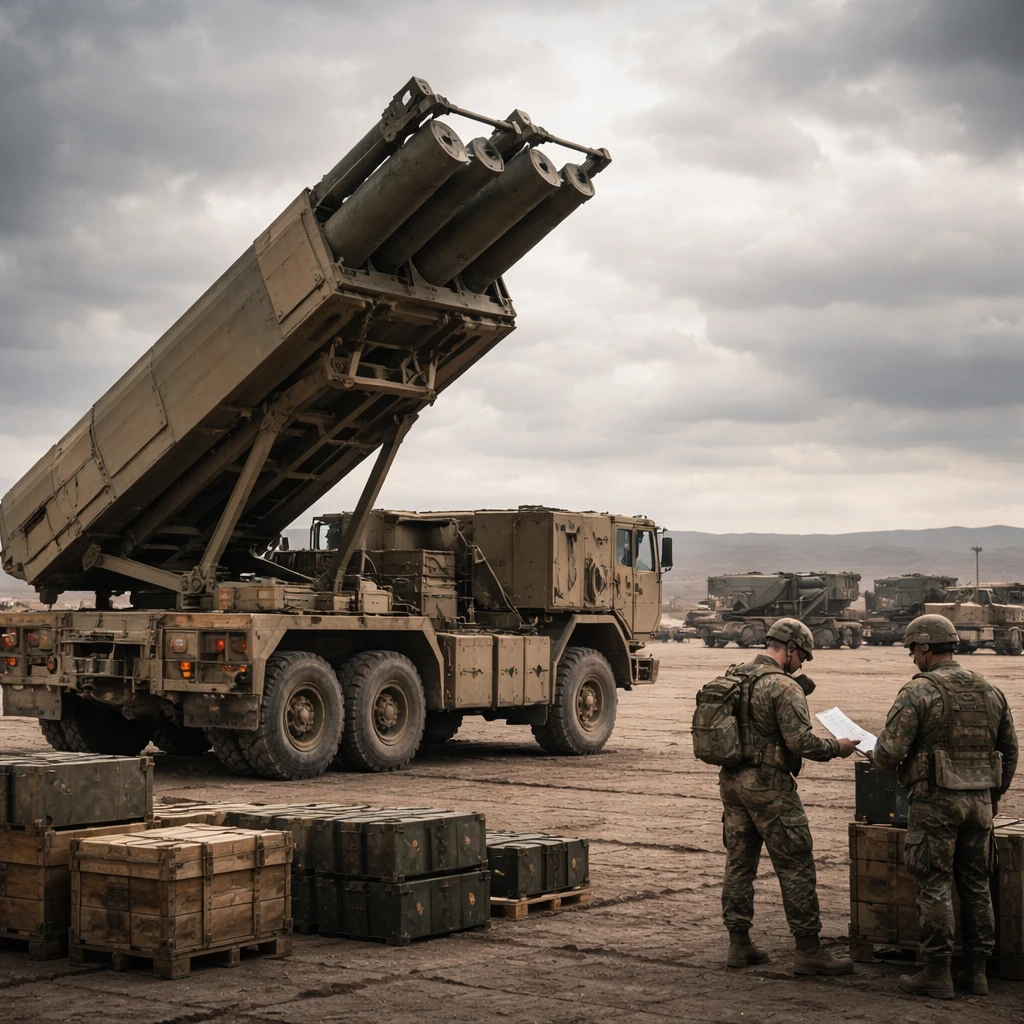
The U.S. Army has expended a large share of its inventory of accurate, long-range, surface-to-surface missiles during the five-month campaign against Iran, according to three people familiar with internal supply data. The weapons most affected are the Army Tactical Missile System (ATACMS) and the Precision Strike Missile (PrSM), with two of the sources saying the military has used "virtually all" of those munitions that were held prior to the conflict.
Those long-range munitions - each costing more than $1 million - are a core element of the U.S. precision strike capability, enabling forces to hit targets from considerable standoff distances. The ATACMS has been a workhorse in recent years, including in U.S. support to Ukraine, while the PrSM represents a newer generation designed to extend range and replace the shorter-range ATACMS over time.
Officials contacted for this report spoke on the condition of anonymity. A fourth person familiar with the logistics picture inside Central Command said that while the command overseeing U.S. forces in the Middle East has nearly exhausted the land-based missiles it held when hostilities began, it has been able to replenish some of those stocks from other U.S. military holdings around the globe.
When asked to comment on the reported stockpile levels, the White House released a statement attributed to President Donald Trump asserting that the United States possesses "far more munitions than anyone in the world" and "far more than we need." The statement added: "Our defense companies are, at this moment, making more munitions than they have ever made before, in addition to expanding their plants and equipment at record levels," the statement said.
Analysts and industry observers acknowledge that production of certain munitions - including artillery rounds and multiple missile types - is running at historically high rates, but they warn that replenishment may not keep pace with sustained high demand in a protracted conflict.
Lockheed Martin, the prime defense contractor associated with ATACMS, PrSM and the THAAD anti-ballistic missile system, did not immediately respond to queries about current supply levels or the presidential statement. Raytheon, a principal maker of Tomahawk cruise missiles and Patriot interceptors, also did not immediately provide comment.
At the Pentagon, chief spokesperson Sean Parnell said: "America's military is the most powerful in the world and has everything it needs to execute at the time and place of the President's choosing. We have executed multiple successful operations across combatant commands while ensuring the U.S. military possesses a deep arsenal of capabilities to protect our people and our interests."
Internal estimates and a separate analysis published by the Center for Strategic and International Studies (CSIS) have signaled additional strains on the U.S. defensive inventory. A CSIS report cited by several sources indicates that PrSM stocks were limited before fighting began, given that PrSM is a relatively new system, and that the military has scheduled large deliveries of those weapons for 2027.
The Army has publicly said it is transitioning away from ATACMS production toward the newer PrSM. Nonetheless, the rapid drawdown of ATACMS and PrSM in the current campaign has prompted concern inside the administration about the United States' ability to deter or, if necessary, fight other high-end adversaries without jeopardizing stockpiles.
Two of the people familiar with internal supply figures said that figures circulating inside the federal government over the last week have become a focus of intense discussion among national security officials. Those discussions have centered on how long the United States can continue offensive operations against Iran without depleting inventories to levels that would limit the military's responsiveness elsewhere.
One source specifically linked the heavy use of ATACMS and PrSM to a decision by the administration to avoid riskier strike options - for example, piloted bombing missions - which carry higher personnel risk. Because surface-to-surface, precision missiles permit attacks from safer standoff distances, military planners have relied on them to strike heavily defended targets.
Defensive weapon stocks are reported to have diminished as well. The CSIS report estimated that between February and July about 65% of U.S. Patriot interceptors had been expended and that the number of THAAD ballistic missile interceptors in U.S. stockpiles was at least 38% lower than at the start of the conflict. Two sources familiar with internal U.S. data said those figures align with what officials are seeing, although this reporting team has not viewed the raw supply figures directly.
In addition, one of the sources said the United States has used a little less than half of its global inventory of Tomahawk cruise missiles, which are typically launched from naval platforms. Reuters could not independently verify that estimate, the source cautioned.
The Tomahawk, a seafaring, long-range cruise missile fired from destroyers, cruisers and submarines, has historically enabled naval commanders to strike defended targets without exposing aircrew to direct risk. To accelerate replenishment, Raytheon, a unit of RTX, has reached a tentative multi-year agreement with the Pentagon intended to increase Tomahawk production alongside other munitions increases.
The depletion in both offensive long-range and defensive interceptor inventories has become part of broader internal debates over how to proceed militarily. Military leaders have warned senior officials for several weeks that critical defensive stocks - including Patriot interceptors that are effective against ballistic missiles - were running low, according to two of the sources.
Last week, multiple media outlets reported that President Trump ultimately decided against launching another large-scale offensive inside Iran in part because his military advisers had cautioned that U.S. stockpiles were dwindling. A separate U.S. official disputed that characterization, saying the decision not to proceed was attributable to pressure from Gulf partners. The matter of political and regional influences on operational choices remains contested inside the administration.
The conflict in the Middle East has also rekindled debate about the legal authority for hostilities. No administration request for a congressional declaration of war or for an authorization to use military force has been filed with Congress, even as strikes have continued.
Officials and defense industry leaders say the United States is expanding production capacity and increasing output to rebuild inventories. Still, analysts caution that while production rates for several classes of munitions are at record levels, existing manufacturing plans and timelines may leave demands unmet if high-intensity operations persist.
Sources who provided the supply assessments emphasized the limits of available data and declined to specify precise remaining quantities of each munition type. The lack of publicly disclosed, verifiable stockpile numbers has contributed to uncertainty about replenishment timelines and the military's margin for sustained high-tempo operations.
As the administration weighs future military options, officials will continue to factor in current inventories, production capacity and operational risk, according to the people briefed on the matter. For policymakers and markets that follow defense procurement and contractor output, the evolving balance between consumption and replenishment will remain a central metric of both strategic readiness and industrial capacity.