
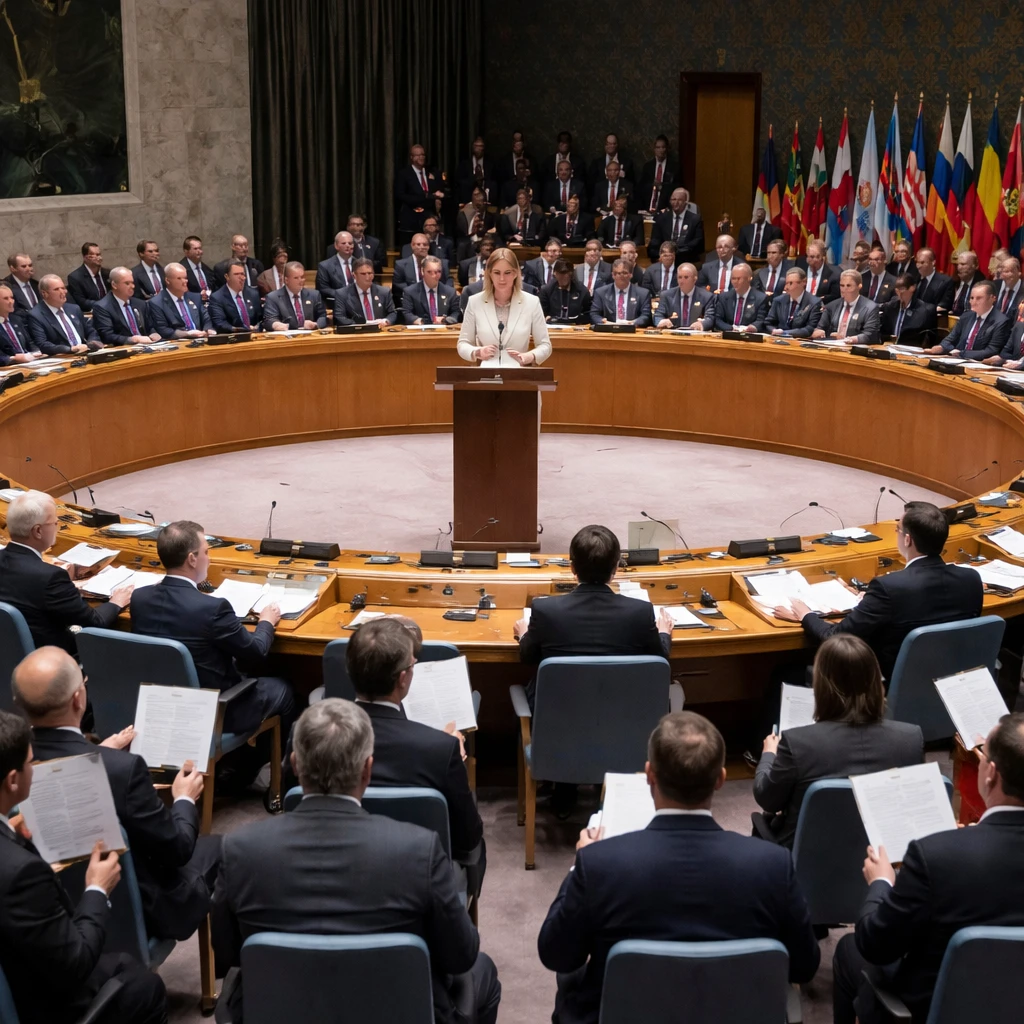
The United Nations Security Council is preparing to conduct another informal ballot on August 21 in the contest to name the next U.N. secretary-general, the council president for August said on Monday. The announcement underlines that council members do not yet see an imminent decision.
Portugal's Antonio Guterres will complete two five-year terms and step down at the end of the year. The council held an initial "straw poll" last week among its 15 members to gauge support for potential successors. That first round showed former Costa Rican vice president Rebeca Grynspan as a narrow early leader among seven declared candidates. She was followed in the tallies by former Guyanese foreign minister Carolyn Rodrigues-Birkett and Rafael Grossi, the director-general of the International Atomic Energy Agency from Argentina.
Christina Markus Lassen, Denmark's U.N. ambassador and the Security Council president for August, said her team is "aiming for and hoping to schedule" a second informal poll on August 21. She stressed, however, that council members are not at a stage where a final selection appears imminent.
The person who eventually succeeds Guterres will confront a U.N. system that many perceive to be struggling and diminished in influence, and which faces mounting calls for reform. Critics argue the organization is large, expensive, and duplicated across multiple agencies - concerns that are shaping expectations of what the next secretary-general will have to address.
A central practical constraint on the council's choice is the potential for a veto by any of the five permanent members - China, France, Russia, the United Kingdom and the United States. The five have significantly different foreign policy perspectives, making it essential for any candidate to avoid attracting a "discourage" vote from any of them if the council is to recommend a name to the General Assembly.
Custom and precedent indicate that multiple rounds of straw polling are likely to continue across coming weeks, and that the process could run into late September or early October before yielding a single candidate. The field could also expand, because other aspirants are permitted to enter the race at this stage, which could prolong proceedings if no broadly acceptable candidate appears.
Alongside Grynspan, Rodrigues-Birkett and Grossi, the current list of contenders includes former Chilean president Michelle Bachelet; former Ecuadorian foreign minister Maria Fernanda Espinosa; former Senegalese president Macky Sall; and Ugandan diplomat Olara Otunnu.
In the early straw polls, council members use identical ballots so that diplomats can observe overall levels of support and opposition without disclosing whether a permanent member has opposed a candidate. At a later phase of the process the five permanent members typically use ballots of a different color that would reveal if a candidate has received a "discourage" vote from any one of them.
Lassen said she would not assume that color-coded ballots will be employed in the next round on August 21. "That would normally happen if we are sure that the next round is close to something where we have a final candidate that we can all agree on," she said, adding that she did not believe the council had reached that point yet.
If and when the Security Council coalesces around a candidate, it will adopt a resolution recommending that person to the U.N. General Assembly. A recommendation requires at least nine affirmative votes and no veto from any permanent member. General Assembly approval of the Security Council's recommendation has, in practice, been treated as a formality.
Summary
The Security Council plans a follow-up informal poll for August 21 as the search for a successor to U.N. Secretary-General Antonio Guterres continues. The first straw poll produced a narrow lead for Rebeca Grynspan among seven candidates. Council procedures and the need to avoid a veto from any of the five permanent members mean the selection process could involve many more rounds and extend into September or October.