
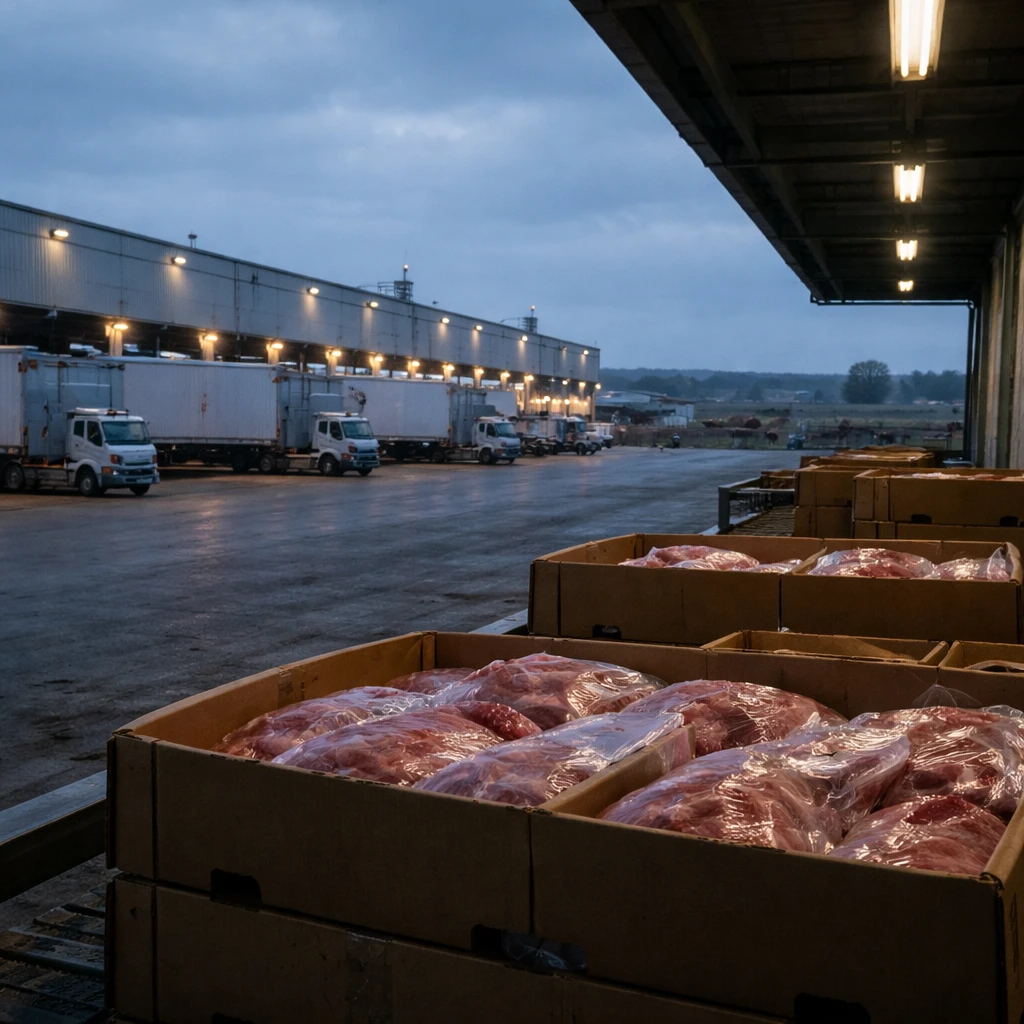
Tyson Foods saw its stock weaken sharply in early trading after the company released fiscal third-quarter results that fell short of Wall Street forecasts and prompted management to reduce its full-year profit outlook. In pre-open trading the shares declined 3.7% as investors absorbed the combination of weaker quarterly figures and a downshift in annual guidance.
For the quarter, the meat producer recorded adjusted earnings per share of $0.99, below the consensus estimate of about $1.05. Quarterly revenue came in at $13.87 billion, underperforming the roughly $14.15 billion analysts had expected.
The company’s guidance revision represented a heavier blow for the stock. Tyson trimmed its fiscal 2026 adjusted operating income forecast to a range of $2.1 billion to $2.3 billion, from a prior outlook of $2.2 billion to $2.4 billion. Management pointed to expanding losses in the beef business as the central factor behind the cut, attributing that weakness to a persistently tight domestic cattle supply.
Updated revenue growth guidance was set at 2.5% to 3.5%, a figure that disappointed relative to analyst expectations of approximately 4.3% growth. The weaker top-line trajectory and the revised profit range together created a clear near-term catalyst for the pre-market selloff.
Some of these headwinds had been signaled in recent days, with both Bernstein and Bank of America having already reduced their price targets on the stock ahead of the earnings release.
Market context added to the focus on company-specific drivers. The broader U.S. equity market was not in retreat - the S&P 500 rose 0.5% and the Dow Jones Industrial Average climbed 1.1% - indicating that the pressure on Tyson shares reflected firm-level developments rather than broad market weakness.
On a technical basis, the stock is trading near the lower half of its 52-week range, which spans from $50.56 to $69.48, underscoring the pullback that followed the earnings disappointment and guidance cut.
In sum, the mix of an earnings and revenue miss, a downward revision to full-year operating income guidance, and structural challenges tied to beef supply dynamics combined to produce an immediate negative reaction in early trading. The market response highlights investor concern that margin recovery in the company’s largest segment could take longer than previously anticipated.