
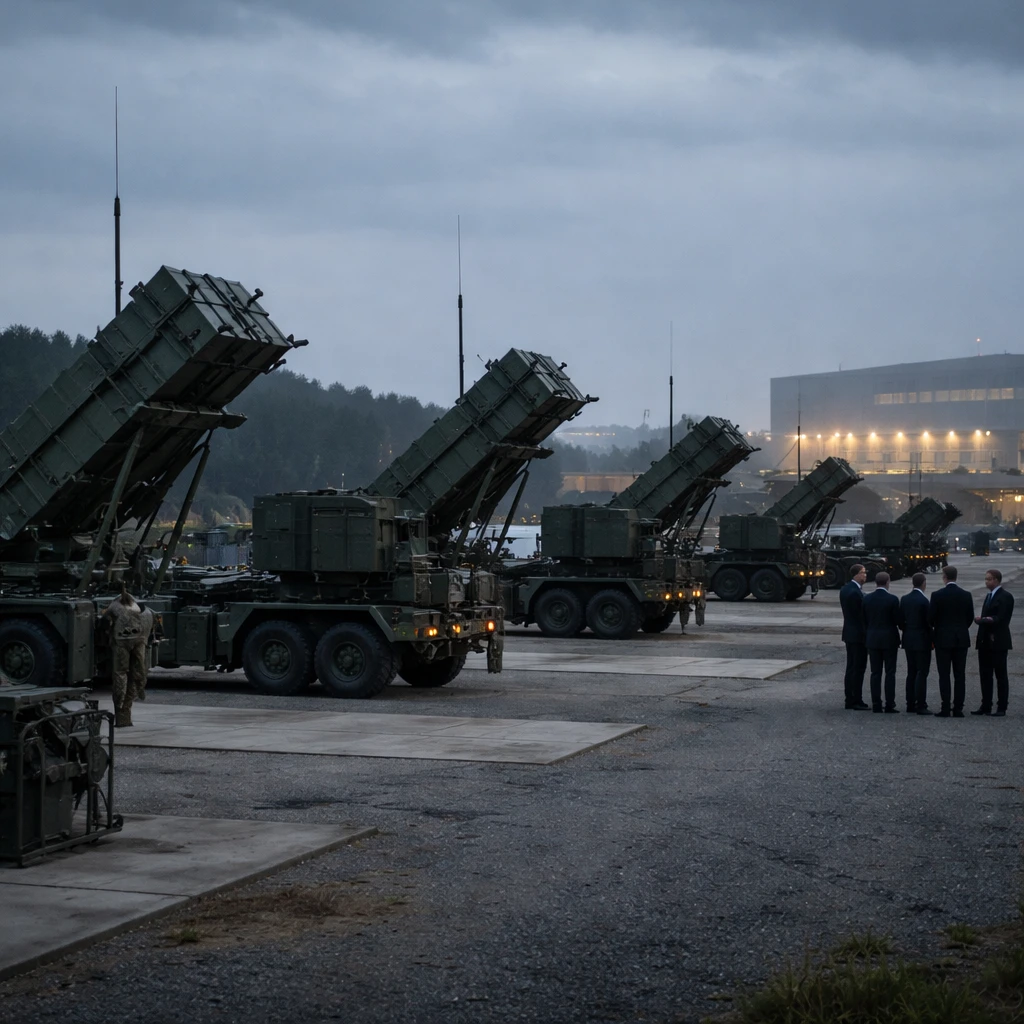
President Donald Trump told cabinet members at the Camp David retreat on Friday that the United States has not granted Ukraine permission to manufacture Patriot missile interceptors, while noting that discussions on the matter are ongoing.
Trump said the proposal to license production of Patriot interceptors - a pledge he appeared to signal during a meeting with Ukrainian President Volodymyr Zelenskiy in Turkey earlier this month - has not been finalized. The president said he raised the possibility of such a license during that foreign meeting, and that he had since hosted Zelenskiy at the White House, but has backed away from committing to the arrangement.
Speaking about the request during the cabinet meeting, Trump stressed the sensitivity of transferring advanced U.S. weaponry and related missile technology. "It’s a big step," he said, adding that while Zelenskiy wants Patriots and Tomahawk missiles - which he described as lethal, one defensive and one offensive - the U.S. must be cautious in judging whether to share such capabilities.
Trump emphasized the difficulty in allowing another country to acquire that level of technology, saying the United States has not agreed to the proposal and that the subject remains under discussion. He warned that providing advanced systems could carry long-term risks if recipients later change course.
The issue has taken on urgency as Russia has intensified air strikes and Ukraine has faced persistent shortages of Patriot systems. Patriots are identified in U.S. statements as the only tools in Ukraine’s current arsenal capable of intercepting ballistic missiles, a capability Kyiv has long sought to expand.
Ukraine has pursued a co-production arrangement for the Patriot PAC-3 interceptor with an eye toward domestic assembly. News that the U.S. might license such production surprised many and prompted follow-up meetings between Ukrainian officials, Pentagon representatives, and industry executives to explore how a formal agreement might work.
Ukrainian ambassador Olha Stefanishyna said on Thursday she remains confident in Lockheed Martin’s commitment to deepen cooperation with Ukraine. Lockheed Martin, the manufacturer of the PAC-3 missile, met with President Zelenskiy on Tuesday, and Stefanishyna said company executives plan to travel to Ukraine in the near future to continue discussions.
Context and implications
- President Trump framed the licensing question as both strategically consequential and technically sensitive, signaling that Washington views transfer of Patriot technology as a major decision that warrants caution.
- Ukraine continues to face shortages of Patriot systems even as it seeks to establish domestic production capabilities for PAC-3 interceptors.
- Lockheed Martin has engaged directly with Ukrainian leadership and is reported to be moving forward with executive-level discussions and potential site visits.
This situation leaves a complex interplay between political decision-making in Washington, defense-industry planning, and Ukraine’s immediate operational needs for missile defense.