
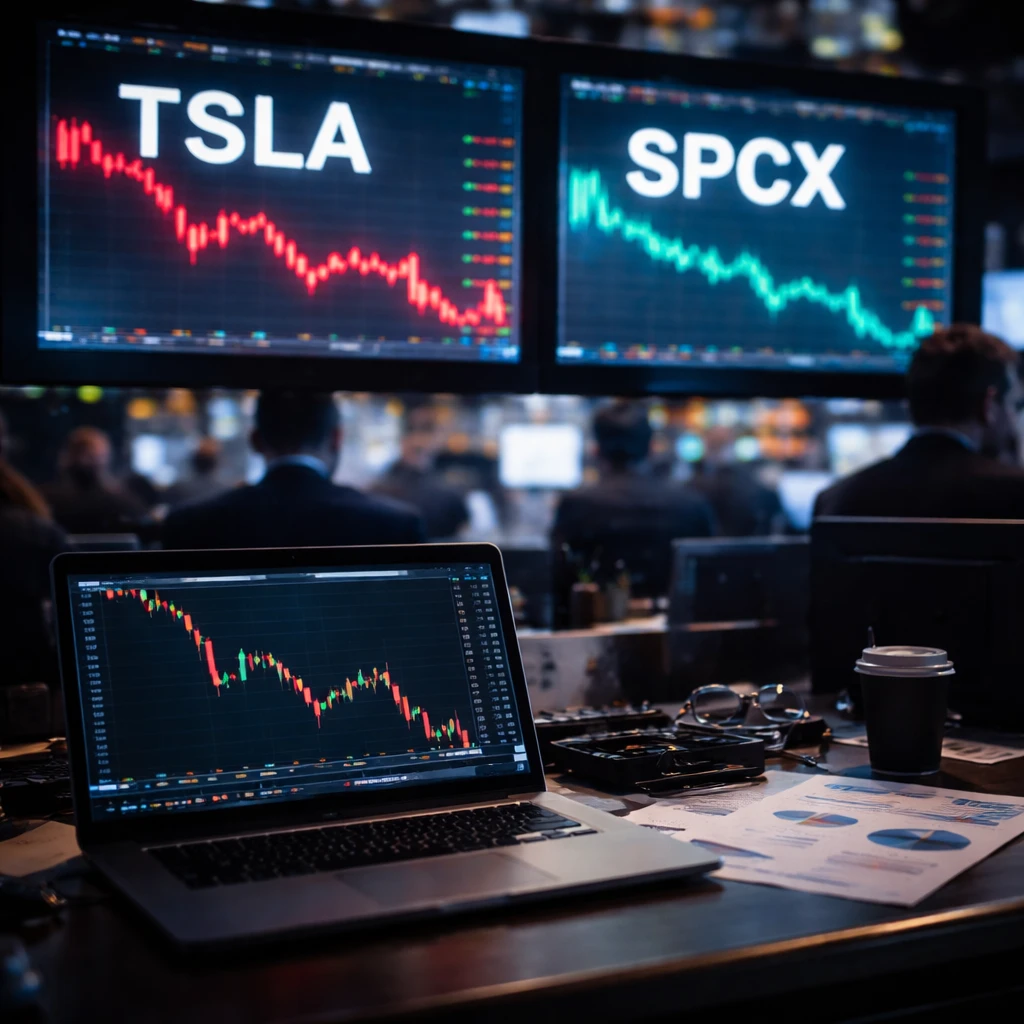
Tesla (NASDAQ: TSLA) was trading at $394.73 in pre-market activity on Monday, down $5.76, or 1.44%, from Friday's close of $400.49. The move followed a Jefferies research note that trimmed its price target to $375 and sounded a structural alarm about how Wall Street may be valuing the company going forward.
Jefferies, which currently carries a Hold rating on the stock, flagged the growing belief among market participants that a merger with SpaceX could be the next step - and that outcome risks transforming Tesla into little more than a tracker for SpaceX. The firm summed up the concern bluntly: "Consensus that a merger will be next and soon may turn TSLA into a tracker as shareholders try to minimize stake dilution."
The brokerage also criticized prevailing market assumptions, arguing that "valuation and estimates remain disconnected," a reference to the premium for AI and robotics prospects still embedded in many analysts' models for Tesla. Jefferies' note underscores that the risk is not purely theoretical, given recent developments surrounding SpaceX.
SpaceX (ticker SPCX) completed a record-setting U.S. initial public offering on June 12, raising $75 billion at $135 per share. The newly public company briefly pushed its market value above some of the largest technology firms before encountering a sharp pullback. On June 18, SPCX fell as much as 6% intraday before trimming losses to close near $189.47. The stock's weakness was attributed to valuation concerns, the $60 billion all-stock purchase of AI coding firm Anysphere (Cursor), and the looming lock-up expiration window.
A later trading session saw SPCX drop nearly 10% at intraday lows, with more than $160 billion in market value erased at the trough before some recovery. Those swings have not gone unnoticed on Wall Street and are feeding the merger-related conversation that now sits over Tesla's stock.
Sell-side responses to SPCX's post-IPO moves have been mixed and have added to the market's uncertain tone. Oppenheimer raised its SPCX target to $250, calling the Cursor deal "highly accretive," while KeyBanc Capital Markets initiated coverage at Sector Weight and judged the stock's risk/reward as balanced. Those divergent takes reinforce an environment of heightened scrutiny rather than broad consensus.
Because both companies sit under the same ownership umbrella, Jefferies says growing doubts about SpaceX's valuation are bleeding into Tesla's market reception. Rather than operating as a clear bullish trigger for TSLA, merger chatter is increasingly functioning as an anchor on the stock. Fears that an all-stock transaction would dilute existing Tesla shareholders appear to be prompting preemptive reductions in TSLA positions, separating short-term price action from the company's standalone operating performance.
Investor commentary echoed the tense backdrop. As the stock drifted lower, one market participant described Tesla as "worthless" without a merger with SpaceX, while retail activity reportedly showed rising bets on TSLA even as the share price retreated - a divergence that historically tends to amplify volatility more than it establishes a base.
Separately, Jefferies' modeling calls for below-consensus results from Tesla, forecasting that initial efforts to commercialize robotaxis and humanoid robots could act as loss centers rather than immediate earnings drivers. Consensus estimates for Tesla's second quarter put earnings per share at $0.445 on revenue near $24.3 billion. The short-term estimates picture is tilting weaker: over the last 90 days analysts have issued 14 downward revisions to estimates against eight upward revisions. Tesla's Q2 2026 earnings release is tentatively scheduled for July 22, making the print a focal point for market reassessment.
Tesla's technical backdrop further complicates the landscape. At a pre-market price of $394.73, the stock sits roughly 20% below its 52-week high of $498.83, but remains well above the 52-week low of $288.77. With a beta of about 1.76, TSLA typically magnifies broader market moves, and pre-market volume of 329,090 shares ahead of the NYSE open suggested the session could act as a near-term sentiment gauge heading into what promises to be a busy summer for both companies.
Looking ahead, the next notable catalyst is the SpaceX lock-up expiration window beginning in August 2026. That staged share-resale timetable could increase circulating supply of SPCX shares, an overhang already considered in some sell-side scenarios. Should SPCX continue to drift lower as lock-up selling pressure builds, Jefferies' caution about a tightening correlation could become more pronounced. In that circumstance, Tesla's stock might become more tightly tethered to SpaceX's price action despite Tesla's distinct operating fundamentals and independent earnings trajectory.
For investors and market watchers, the immediate questions center on how much of Tesla's near-term performance is being driven by speculative merger narratives and how much reflects underlying automotive and energy fundamentals. With earnings approaching and SpaceX's public valuation story still in flux, market participants will be balancing company-specific data against a backdrop of cross-asset valuation contagion that could persist until clearer developments emerge.
Key points
- Jefferies cut its TSLA price target to $375 and warned merger speculation could cause Tesla to trade like a proxy for SpaceX - impacting equity valuations in autos and aerospace-linked securities.
- SpaceX's large June IPO and subsequent volatility, including significant intraday drops and a $60 billion all-stock acquisition, have sown investor caution that is spilling into Tesla's trading.
- Tesla faces earnings and operational scrutiny ahead of an expected Q2 2026 report on July 22, with analysts' revisions skewing negative in recent weeks.
Risks and uncertainties
- Merger speculation risk - an all-stock deal with SpaceX could prompt shareholders to reduce TSLA exposure to limit dilution; this directly affects equity markets and the automotive sector.
- SpaceX share-pressure risk - the August 2026 lock-up expirations and staged share-resale could put downward pressure on SPCX, heightening correlation risk for TSLA and impacting aerospace and technology sectors.
- Earnings and execution risk - Jefferies cautions that initial robotaxi and humanoid initiatives could be loss-making at first, which bears on Tesla's near-term profitability outlook and investor sentiment in the EV and tech-adjacent markets.