
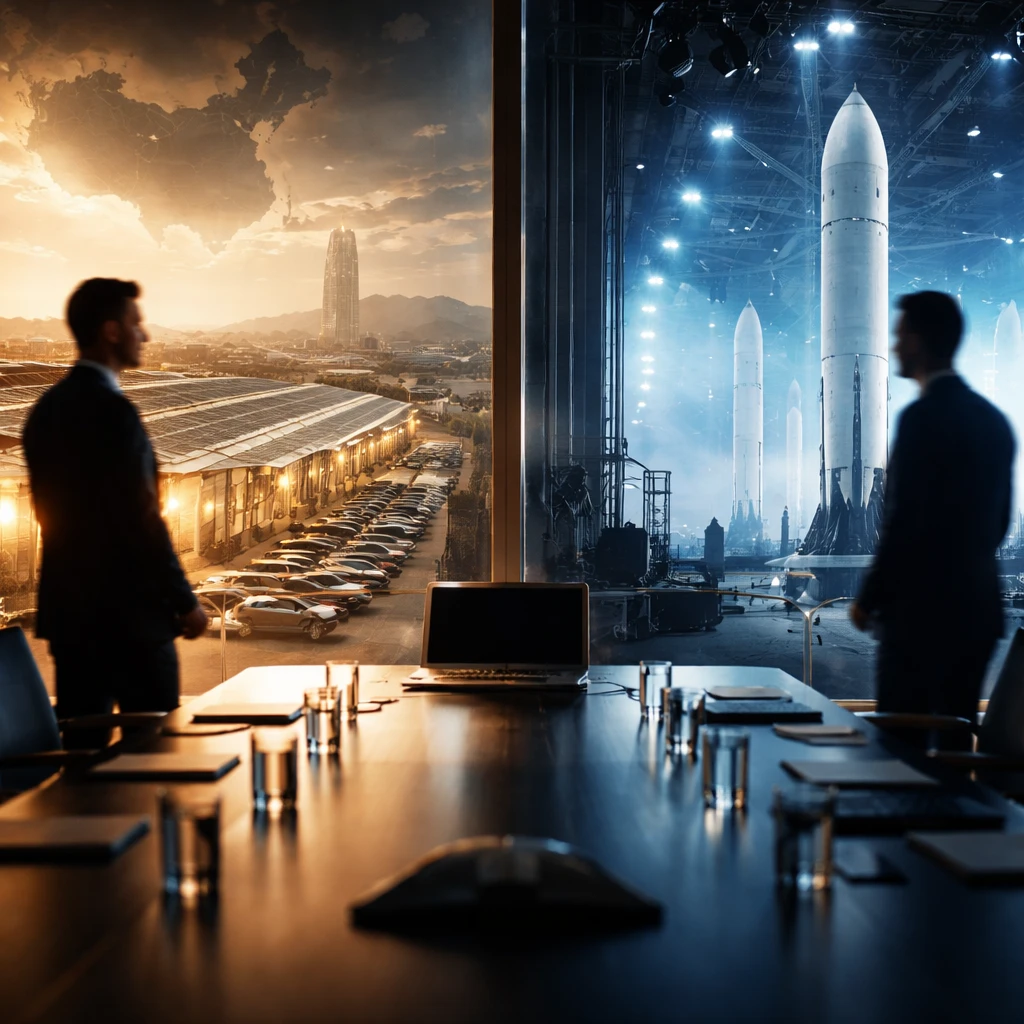
Tesla and SpaceX merger speculation has accelerated after a series of recent developments tied to regulatory hurdles and market moves. Elon Musk did not rule out a combination of the two companies during Tesla’s July 22 earnings call, citing "growing operational overlap" between the firms, and later reports on July 31 indicated Tesla is internally weighing a spinoff, sale, or closure of its China operations as a precondition for any deal.
Those two developments have altered investor assumptions. One prominent analyst increased his likelihood estimate that the companies will combine to 90% within a few years, up from 80% prior to the July 22 call. Other sell-side commentary has characterized a tie-up as something many investors now see as inevitable, with timing being the remaining open question.
The regulatory barrier in China
The July 31 reports are significant because they highlight what has been portrayed as the single largest regulatory obstacle: Tesla’s business ties to China. SpaceX maintains deep relationships with the U.S. government, and combining that company with one that has substantial operations in China is viewed as a potential national security concern. The reported internal deliberations at Tesla - considering a spinoff, sale, or closure of its China operations - are presented as a direct precondition for overcoming that hurdle.
Market response and price snapshots
The market reacted. After reports surfaced on July 31 that Tesla was considering the China precondition, Tesla stock rose +2.7% after-hours and was reported pre-market at $310.92. Other intraday snapshots in trading data showed Tesla at $308.85 with an after-market quote of $316.25; its 52-week high stands at $498.83, its one-month return is -26.57%, and its year-to-date return is -32.54%.
SpaceX has experienced a significant drawdown. The private-listed ticker cited as SPCX was quoted at $112.20 (pre-market: $112.85) with a 52-week high of $225.64. Over the past month SPCX has fallen -34.33%, leaving it roughly 5% above its 52-week low of $107.01. SPCX’s year-to-date return is -16.89%.
In merger scenarios, exchange ratios are often negotiated at a premium to prevailing market prices, which means current SPCX holders could see an uplift when terms are set. The deeper SPCX declines before any formal deal announcement, the larger the potential re-rating could be in that context.
Operational overlap and existing collaboration
The suggestion of a merger is not based purely on speculation about headline synergy. Several operational ties are already in place between the two companies, and industry analysts have noted that a formal merger would largely legalize collaborations that exist already. Specific areas of overlap cited include:
- Battery supply - Tesla reportedly supplies energy technology to SpaceX projects.
- Terafab - the companies are working together on a semiconductor fabrication facility intended for AI chips.
- Manufacturing DNA - Tesla’s gigafactory model is described as complementary to SpaceX’s needs for scaling production.
One large financial institution noted that the integration between the firms is already substantial, suggesting a formal combination may be more about corporate structure than creating new operational linkages.
Bear-case considerations and near-term headwinds
Despite the growing sense that a deal could occur, a number of material challenges remain, and several risk factors were highlighted as deserving attention:
- Governance complexity - Elon Musk reportedly has a larger voting stake in SpaceX than in Tesla, making the question of control in a combined entity complex and potentially contentious.
- China exit cost - spinning off, selling, or closing Chinese operations would crystallize the real revenue loss for Tesla given its deep manufacturing roots in the country.
- Regulatory and product headwinds - a new National Highway Traffic Safety Administration probe into suspension failures in 1.2 million Tesla vehicles adds regulatory noise at a challenging time.
- Recent financial performance - Tesla missed Q2 estimates, reporting EPS of $0.33 versus an expected $0.55, and auto margins were 16.9% compared with an expected 19.4%, which matters for how an acquirer’s balance sheet and cash flow might handle a transaction.
Valuation posture and what it means
The current pricing of SPCX around $112 is characterized in the market as a combination of merger arbitrage and a growth exposure. The 90% probability estimate from a named analyst, together with reports that Tesla is actively considering China-related structural moves, suggests the situation is more than mere rumor. That said, both companies face significant pressure: SPCX’s recent drawdown leaves it close to a 52-week low, and Tesla’s Q2 results, regulatory scrutiny, and potential revenue impact from any China divestiture all create a bumpy path to any combination.
Investors evaluating the situation see an asymmetric risk/reward profile: if a deal is consummated at negotiated exchange terms it could produce a marked re-rating for SPCX holders, but the costs and complications of executing a China exit as well as Tesla’s recent operational performance mean the route to that outcome is far from smooth.
Summary: Reports that Tesla is weighing a China spinoff, sale, or closure as a prerequisite for a potential merger with SpaceX have amplified market speculation. Analysts have raised the odds of a combination, SpaceX shares have tumbled in the past month, and Tesla faces both regulatory and operational headwinds that complicate deal prospects.