
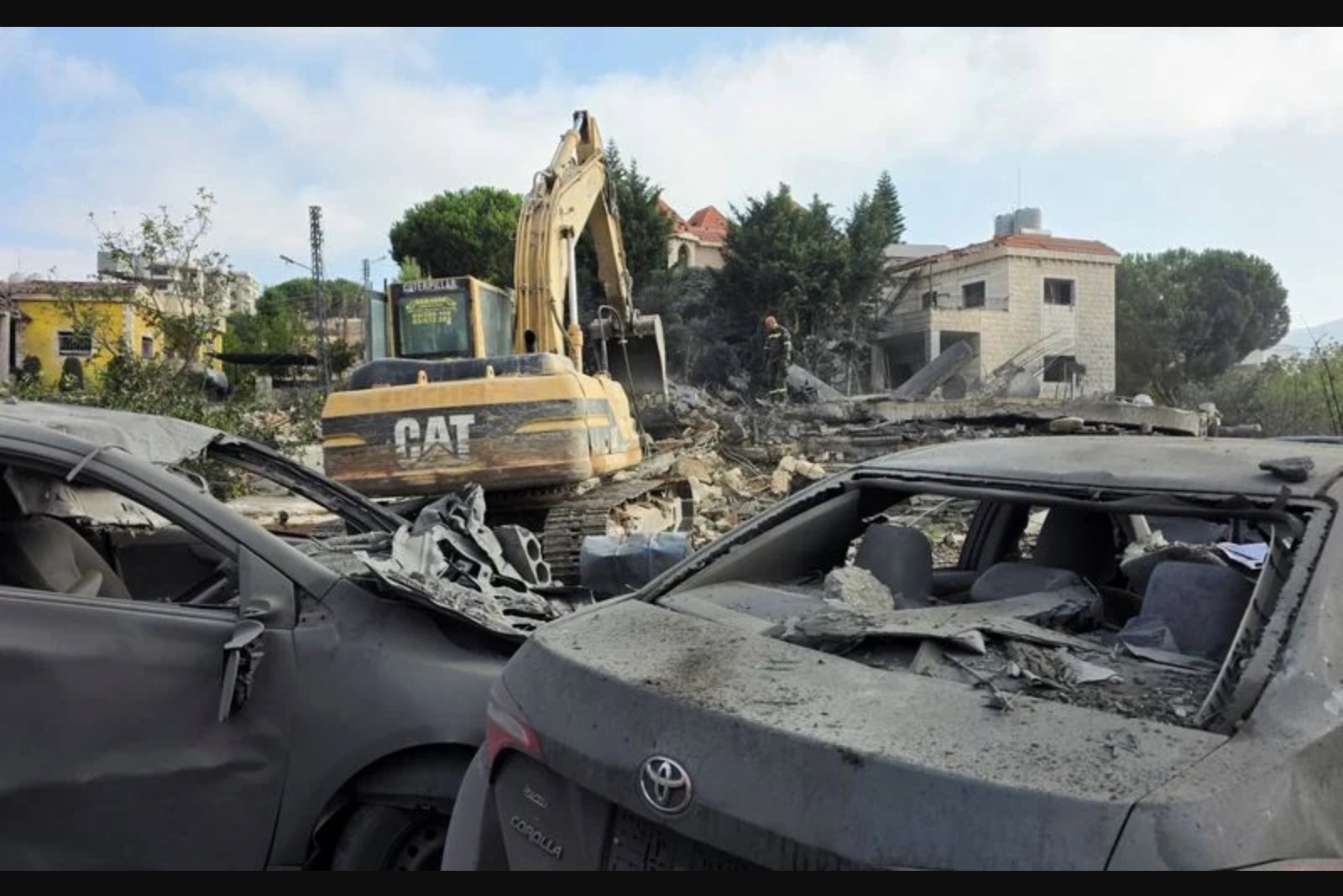
BEIRUT - An intense round of strikes on a southern Lebanese town on Monday resulted in significant civilian casualties, with Lebanon's health ministry reporting at least 13 people killed, including six children. The attacks on Kfar Rumman were described by witnesses as hitting residential areas as children were preparing for school, and rescue teams worked through the morning to recover bodies from a collapsed building.
At the scene, journalists observed children’s schoolbooks scattered among the concrete rubble where a building had once stood. Heavy machinery was used by rescue crews to extract victims from beneath the debris. Local accounts name an eight-year-old boy, Mustafa Farhat, who lost his mother and grandparents in the strike. According to locals, rescuers were still searching for his father's body as the boy received treatment in hospital for injuries sustained in the attack.
A woman who said she was related to at least three of the victims said the strike struck a residential building just before school time. She questioned the rationale for targeting what she described as civilian homes, saying at the hospital: "What did they target? What is the goal they are targeting? Do they want us to leave our land? They are mistaken."
Casualty reports and separate strikes
Lebanon's health ministry subsequently posted an updated toll on its website, reporting that 12 people, including six children and three women, were killed in that attack on the residential building. State media earlier reported the blast occurred after midnight. The ministry also reported a separate Israeli drone strike on a civilian vehicle in Kfar Rumman that killed one medic and wounded two others.
The strikes on Kfar Rumman were carried out without an online evacuation warning from the Israeli military, according to reporting on the scene.
Israeli military statement and developments around Ali al-Taher ridge
The Israeli military said it had taken measures aimed at reducing harm to uninvolved individuals, including the use of precise munitions and aerial surveillance, and that it was reviewing reports that uninvolved civilians had been harmed. The military said Hezbollah had launched two explosive drones overnight towards Israeli troops operating near the Ali al-Taher ridge, a group of strategic hills in southeastern Lebanon where the military says Hezbollah had established an underground complex.
Israel said last week it had cleared Hezbollah fighters from the ridge. Hezbollah has not issued a comment on the military situation at Ali al-Taher, and independent confirmation of control of the ridge was not available. Lebanese security officials told reporters that, in the days since, Israel had increased strikes on towns north and west of the ridge where residents had returned after the June ceasefire.
Those officials said they anticipated further escalations in the south in the coming weeks. The recent pattern includes strikes carried out both with and without evacuation warnings.
Collateral impacts and earlier strikes
In the days before Monday's deadly strikes on Kfar Rumman, Lebanese authorities documented other lethal attacks. On Sunday, at least 11 people were killed in strikes on three towns near the ridge, according to an updated toll from the health ministry. Two women were among those killed in strikes on the town of Arab Salim, where an online evacuation warning was issued at 6:04 a.m. local time (0304 GMT). The health ministry also reported that separate strikes on Sunday had destroyed the Ghandour hospital in Nabatieh al-Fawqa.
On Friday, four more people were killed, including a woman, in strikes that reportedly occurred without evacuation warnings.
Overall toll and continued pressure
Lebanese authorities report that Israeli strikes on Lebanon have killed more than 4,300 people since Hezbollah launched rockets at Israel on March 2, an event that followed US and Israeli strikes on Iran and triggered a wider Israeli air and ground campaign. The ministry's counts include more than 250 children, nearly 400 women and more than 130 medics. The health ministry's figures do not distinguish between civilians and militants, and Hezbollah has not published a casualty figure for its fighters.
The June ceasefire led to a notable reduction in violence, but Israeli troops have continued operations in parts of southern Lebanon, where they have razed villages within a self-declared security zone. The Israeli military has also continued to conduct strikes both inside that zone and to its north, often without issuing evacuation warnings.
The sequence of attacks, casualties and the destruction of medical infrastructure underline mounting concerns in Lebanon about the potential for a renewed and wider military campaign. Lebanese officials on the ground and in security services say they expect the south to remain a focus of increased military activity in the coming weeks.
Key points
- At least 13 people, including six children, were killed in Monday strikes on Kfar Rumman, according to Lebanon's health ministry; an updated toll also reported 12 victims, including six children and three women, from an attack on a residential building.
- Separate strikes included a drone attack on a civilian vehicle that killed one medic and wounded two others; medical infrastructure has been hit, with a hospital reported destroyed in Nabatieh al-Fawqa.
- Authorities and security officials expect continued escalation in southern Lebanon after a June ceasefire, with recent strikes occurring both with and without evacuation warnings.
Risks and uncertainties
- Risk of wider military escalation in southern Lebanon - this threatens further civilian casualties and damage to critical infrastructure, notably health services.
- Uncertainty around the on-the-ground military control of strategic areas such as the Ali al-Taher ridge - independent verification of claims was not available.
- Continuing strikes without consistent evacuation warnings - this raises uncertainty about civilian protection and the ability of residents to return safely to affected towns.