
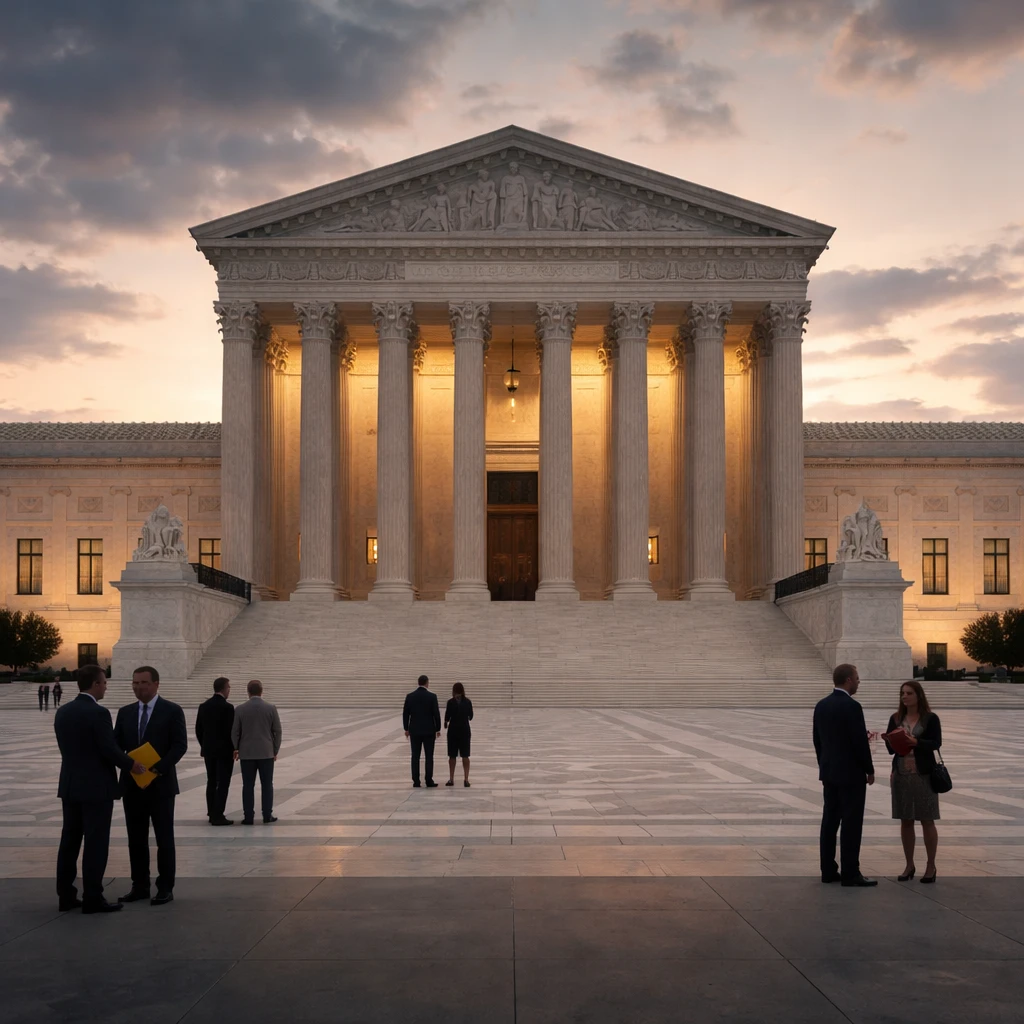
The Supreme Court's current term has been marked by a succession of cases that probe foundational constitutional questions and consequential statutory interpretations. Over the course of arguments beginning in October and proceeding through the spring, the justices addressed disputes involving voting law, presidential powers, immigration protections, the authority of federal agencies, civil liberties and corporate accountability.
The Court also has entertained emergency requests arising from administration policies, but this review focuses on the principal merits cases and issued opinions that have defined the term. Below is a methodical, case-by-case account of the major matters the justices confronted, the core legal issues posed, the lines of questioning and hints of judicial disposition given during argument, and the outcomes when the Court issued decisions.
Voting Rights Act
On April 29 the Court issued a decision that significantly altered how plaintiffs may challenge electoral maps under a central provision of the Voting Rights Act. The opinion undermined Section 2 - the statutory provision designed to prohibit districting that dilutes minority voters' electoral strength - by making it more difficult for minority communities to secure judicial relief against racially discriminatory maps. In an immediate practical consequence, the Court blocked an electoral map that had produced a second Black-majority congressional district in Louisiana.
The effect of the ruling is to weaken one of the principal tools that had served as a remedy against racial discrimination in voting. The opinion follows a 2013 decision in which the Court had already curtailed a different component of the Voting Rights Act, leaving Section 2 with heightened importance. Given typical voting patterns, the erosion of Section 2's reach could affect the composition of districts where Black and Latino voters have historically supported Democratic candidates. The April ruling also created an opening for state-level map changes in Republican-controlled Southern states that may alter majority-Black and majority-Latino districts ahead of the November midterm elections.
Birthright Citizenship
On April 1 the justices expressed considerable skepticism of a presidential directive seeking to narrow recognition of birthright citizenship. The directive instructed federal agencies not to recognize the citizenship of children born in the United States when neither parent is a U.S. citizen or a lawful permanent resident. During argument the Court questioned the administration's legal theory and practical basis for the directive.
A lower court had already enjoined the directive, finding it violated the 14th Amendment to the Constitution and a federal statute that codifies birthright citizenship. The Supreme Court took up the question and signaled uncertainty about the legality of the administration's approach. The Court is expected to issue a ruling on the matter by the end of June.
Tariffs and Executive Authority
In a February 20 opinion, the Court rejected the administration's use of an emergency economic statute to impose broad tariffs. The 6-3 decision affirmed a lower court ruling that the president had exceeded the authority granted by the International Emergency Economic Powers Act, or IEEPA, a law enacted in 1977. The majority determined that IEEPA did not supply the legal basis for the tariffs the president sought to impose and that the Constitution assigns powers to levy taxes and tariffs to Congress, not to the executive branch.
The tariffs at issue had been deployed as part of the president's broader trade policy in his second term and were central to a trade confrontation that affected international commerce and market conditions. The Court's ruling narrowed the scope of executive power under IEEPA and reaffirmed the separation of fiscal authority between Congress and the presidency.
Attempted Dismissal of a Federal Reserve Governor
Argument on January 21 drew attention to a high-stakes dispute over the president's attempt to remove a Federal Reserve governor. The president sought to dismiss Governor Lisa Cook, and the matter raised the prospect of a significant intrusion into the central bank's long-protected independence. During oral argument the justices were skeptical of the president's claim to be able to remove the governor immediately while a lower court's order that temporarily barred such dismissal remained in force.
The Federal Reserve Act - enacted by Congress when the Fed was created - contains a provision that makes governors removable by the president only "for cause." But the statute does not define "for cause" or lay out the process for such removals. The president's stated basis for the proposed dismissal was unproven mortgage fraud allegations, which the governor has denied. The governor has characterized the allegations as a pretext linked to policy divergence over interest-rate decisions, with the president pressing the Fed to reduce rates. For now the governor remains in office while the legal challenge proceeds, and the Court is expected to issue its decision by the end of June.
Temporary Protected Status
On April 29 the Court heard argument in a challenge to the administration's effort to terminate humanitarian protections for hundreds of thousands of immigrants under Temporary Protected Status, or TPS. The government appealed two federal-court rulings that had blocked its attempts to end TPS for more than 350,000 people from Haiti and about 6,100 from Syria.
During argument several conservative justices appeared receptive to the administration's contention that courts should not second-guess executive determinations to end TPS protections. Conversely, some justices probed whether the administration had complied with statutory procedures governing TPS decisions. The Court's ruling on this dispute is expected by the end of June.
Federal Trade Commission Tenure and Presidential Removal Power
Arguments held on December 8 centered on whether the president exceeded his authority in removing a member of the Federal Trade Commission before the expiration of her term. The Justice Department appealed a lower-court determination that the president had overstepped his power by dismissing Democratic Commissioner Rebecca Slaughter in March.
Conservative justices during argument signaled a willingness to uphold the president's action and to limit longstanding protections Congress had created for heads of independent agencies. If the Court ultimately sustains the administration's position, it would represent an expansion of presidential authority at the expense of a near-century-old precedent that insulated certain agency officials from at-will removal. The Court permitted the president to remove the commissioner while the appeal proceeded, and a final ruling is expected by the end of June.
Transgender Athletes and State-Level Bans
The justices considered cases brought by Idaho and West Virginia challenging lower-court decisions that had blocked state laws excluding transgender athletes from female sports teams. The January 13 arguments took place against a background of more than two dozen states having adopted similar statutes restricting transgender participation in school athletics.
During oral argument the conservative justices expressed concern about imposing a single nationwide standard in an area marked by sharp disagreement. Questions focused on scientific uncertainty regarding whether treatments such as puberty blockers or gender-affirming hormones negate male physiological advantages in competitive sports. The justices' lines of questioning suggested an inclination among conservative members to uphold state-level bans, while the Court's final resolution on this matter is expected by the end of June.
LGBT 'Conversion Therapy' Ban
On March 31 the Court struck down a Colorado statute that prohibited licensed therapists from providing so-called conversion therapy to minors - a practice aimed at changing a young person's sexual orientation or gender identity. The justices ruled 8-1 in favor of a Christian counselor who had challenged the law on First Amendment grounds, concluding the statute unlawfully restricted protected speech.
The Court rejected Colorado's argument that the law regulated professional conduct rather than speech. In reversing a lower court's ruling that had upheld the statute, the justices found that the counselor's claim that the law abridged free speech rights was meritorious under the First Amendment.
Hawaii Gun-Carrying Restrictions
On January 20 the Court heard argument in a challenge to a Hawaii statute that restricts the carrying of handguns on private property that is open to the public without the express permission of the property owner. That law requires property owners to give "express authorization" before a handgun may be brought onto such premises.
During argument conservative justices indicated skepticism of the law's constitutionality and signaled a readiness to further expand gun rights. Opponents of Hawaii's statute argued that the measure is consistent with the Second Amendment; the state's defenders contended it appropriately regulates the carrying of firearms on private property open to the public. The Court's decision in this matter is expected by the end of June.
Gun Possession by Users of Illegal Drugs
On March 2 justices heard argument in a challenge brought by the Justice Department defending a federal law that disallows gun ownership by users of illegal drugs. The statute at issue originated as part of the Gun Control Act of 1968 and has been invoked in recent prosecutions. The case involved a dual American-Pakistani citizen in Texas and the government sought to overturn a lower-court ruling that had found the law largely incompatible with the Second Amendment.
The dispute carries contemporary resonance because the restriction formed one of the bases for charges brought against former President Biden's son in 2023. The Court weighed questions about the law's scope and constitutionality, and a resolution is anticipated by the end of June.
Campaign Finance and Limits on Coordinated Party Spending
The Court heard argument on December 9 in a Republican-led challenge to federal limits on coordinated campaign spending by political parties working with candidates. The appeal, involving Vice President JD Vance among the challengers, asked the justices to reconsider whether restrictions on coordinated party expenditures violate the First Amendment's protections for political expression.
During argument some conservative justices expressed sympathy for striking down the federal limits, while the Court's three liberal members appeared inclined to preserve the restrictions. The dispute centers on whether coordinated spending caps impermissibly restrict parties' speech when they consult with the candidates the expenditures support. A ruling in the case is expected by the end of June.
Mail-In Ballots and Post-Election Grace Periods
On March 23 conservative justices signaled skepticism toward a Mississippi statute that permits certain mail-in ballots to be counted if they are postmarked by Election Day and received up to five business days later. The law provides this grace period for a limited category of absentee voters, including the elderly, the disabled and people residing away from home.
The case was brought by Republicans challenging the law, and the Trump administration urged the Court to invalidate Mississippi's practice. A lower court had ruled against the law, and the Supreme Court's decision could narrow or expand how states handle late-arriving absentee ballots in future elections. The case may have implications for voting rules beyond Mississippi, and a ruling is expected by the end of June.
Asylum 'Metering' at the Southern Border
On March 24 the Court addressed a dispute over the executive branch's authority to refuse to process asylum claims at the U.S.-Mexico border when officials deem crossings too burdensome for immigration processing. The policy at issue, known as "metering," allowed immigration officials to turn away asylum seekers and decline to process their claims, at times indefinitely.
The Trump administration defended the practice and sought to preserve authority to implement it, while the practice had been abandoned by the subsequent administration. During argument the justices appeared inclined to uphold the government's power to refuse entry or processing under certain circumstances. A final ruling is expected by the end of June.
Roundup and Weedkiller Cancer Claims
The Court heard argument on April 27 in Bayer AG's appeal seeking to block thousands of state-law lawsuits that allege the company's glyphosate-based weedkiller Roundup causes cancer. The specific case under review stemmed from a Missouri jury verdict awarding $1.25 million to a plaintiff who said he developed non-Hodgkin lymphoma after prolonged exposure to glyphosate.
Bayer argued that federal pesticide law preempts state-law claims over pesticides, a contention the lower court rejected. During argument the justices appeared divided and the outcome remained uncertain. The matter tests the boundaries of preemption and corporate liability for alleged harms linked to widely used products. A decision is expected by the end of June.
Alien Tort Statute and Allegations of Human Rights Abuses Abroad
On April 28 the Court heard argument in a long-running case brought by members of the Falun Gong movement who allege that Cisco Systems assisted the Chinese government in persecuting their members by developing technology used to surveil and target them. The suit, first filed in 2011, had been revived by a 2023 decision that allowed certain claims to proceed under the Alien Tort Statute, an 18th-century statute that lets non-U.S. citizens pursue civil claims in American courts for certain international-law violations.
Cisco urged the justices to curtail the statute's scope, arguing that U.S. courts should not entertain such claims against corporations for conduct tied to foreign government actions. The Court's ruling on the reach of the Alien Tort Statute could have broad implications for human rights litigation in U.S. courts. A decision is expected by the end of June.
SEC Disgorgement Authority
On June 4 the Court resolved a challenge to the Securities and Exchange Commission's authority to obtain disgorgement - a financial remedy designed to deprive defendants of illegally obtained profits. The justices rejected the challenge and upheld a lower court's endorsement of a broad view of the SEC's disgorgement power.
The case involved a defendant who had been ordered by a California court, at the SEC's request, to repay more than $3 million in ill-gotten gains and interest arising from an alleged fraud. The Court's decision affirmed the SEC's ability to pursue disgorgement as a tool for recovering unlawful profits and represented a significant endorsement of the agency's enforcement toolkit.
FCC Forfeiture System and Wireless Carriers
The Court on June 4 also sided with the Federal Communications Commission in a dispute over the agency's in-house system for assessing fines, known as forfeiture orders. The justices rejected challenges brought by major wireless carriers including AT&T and Verizon, upholding the FCC's administrative process for levying penalties.
The carriers had argued that the agency's internal proceedings deprived them of the right to a jury trial under the Constitution. The Court's decision preserves the FCC's current enforcement mechanism for imposing monetary penalties on regulated carriers and related entities.
Geofence Warrants and Cellphone Location Data
On April 27 the Court heard argument in a case testing whether law enforcement's use of so-called geofence warrants violates the Fourth Amendment's prohibition on unreasonable searches. Geofence warrants require third-party companies to search comprehensive location data to identify devices that were in a particular area during a specified time surrounding a crime.
The dispute involves a defendant who conditionally pleaded guilty to an armed robbery while reserving the right to challenge the admissibility of evidence drawn from a geofence warrant. The legal question is whether compelled searches of vast troves of location data to find potential suspects constitute an unreasonable search under the Constitution. A ruling is expected by the end of June.
Crisis Pregnancy Centers and State Investigation
On April 29 the Court revived a federal lawsuit brought by First Choice Women’s Resource Centers, Christian faith-based facilities that provide counseling intended to discourage abortion. The suit challenges a 2023 subpoena from the New Jersey attorney general seeking records about the centers' donors and physicians as part of an investigation into potential deceptive practices.
A lower court had tossed the federal lawsuit, but the Supreme Court's decision allowed the centers to proceed with their federal claim. The ruling effectively blocked the state's investigatory subpoena as the litigation progresses.
Rastafarian Inmate's Religious Rights
The Court heard argument on November 10 in a case brought by Damon Landor, a Rastafarian inmate in Louisiana whose religion requires him to let his hair grow. Prison guards shaved him bald, and he sued state officials alleging violations of his religious rights. A lower court dismissed his suit on the ground that the statute invoked did not permit suits for monetary damages against individual officials.
During argument conservative justices appeared inclined to reject the inmate's effort to proceed against the officials for damages. The case hinges on whether the federal statute in question allows an individual prisoner to pursue monetary relief against individual correctional officers for alleged religious discrimination. A decision is expected by the end of June.
Death-Row Inmate with Intellectual-Disability Finding
On May 21 the Court declined to overturn a judicial finding that a man condemned in Alabama is intellectually disabled and therefore ineligible for the death penalty. The justices upheld a lower-court's approach that weighed multiple IQ test results together with expert testimony to reach a determination about the inmate's intellectual capacity in the context of a 1997 murder conviction.
The Court's action preserved the finding that the inmate, Joseph Clifton Smith, is exempt from execution under a 2002 Supreme Court precedent establishing that the Eighth Amendment prohibits capital punishment for intellectually disabled persons.
Jury Composition and Racial Discrimination
On May 28 the justices ruled in favor of a Black death-row inmate from Mississippi who alleged prosecutors engaged in racial discrimination by excluding Black potential jurors from his 2006 trial. The Court concluded that state courts in Mississippi had failed to properly assess the defendant's Batson claim, referencing the landmark 1986 precedent that bars excluding jurors on the basis of race.
The decision found the state's judicial review of the prosecutor's conduct insufficient and sent the matter back for further consideration under the correct legal framework.
Sentence Reductions under the First Step Act
The Court on May 28 held that judges do not have the authority to order early release for prisoners on the ground that they would have received shorter sentences under the First Step Act of 2018 had it been in effect at the time of their sentencing. The rulings rejected compassionate-release motions brought by two Pennsylvania men convicted of armed robberies and affirmed lower-court determinations against them.
The decisions clarified the scope of relief available to individuals who seek retroactive application of sentencing reforms enacted after their convictions and sentences were imposed.
Securities Litigation: Investment Funds and Voting Restrictions
On June 11 the Court ruled for a group of investment funds affiliated with BlackRock and other asset managers, reversing a lower-court decision that had allowed a hedge fund to pursue claims under the Investment Company Act of 1940 challenging bylaws that limited activist shareholders' voting power. The appellate reversal protected the funds from certain private plaintiff suits that sought to nullify fund governance rules.
The suit had been brought by Saba Capital Master Fund and the case involved funds including those tied to BlackRock, FS Credit Opportunities and other investment vehicles such as Adams Diversified Equity Fund, Adams Natural Resources Fund and Royce Global Trust. The administration supported the funds in the litigation. The ruling shields fund bylaws that restrict coordinated action by activist investors from this particular form of challenge under the 1940 Act.
Cox Communications and Music-Label Copyright Suits
In a unanimous March 25 decision the Court held that Cox Communications could not be held liable for contributory copyright infringement arising from its subscribers' alleged piracy of songs owned by major record labels including Sony Music, Warner Music Group and Universal Music Group. The 9-0 ruling overturned a lower-court order that had called for a new trial to determine damages potentially owed by the internet service provider.
Cox had warned that a retrial could have resulted in a verdict of up to $1.5 billion. The Court's opinion ended the record labels' billion-dollar-plus lawsuit against the Atlanta-based ISP, concluding that under the applicable legal framework Cox was not appropriately held responsible for the alleged acts of its customers in the manner the lower court had found.
Pharmaceutical 'Skinny Labels' and Patent Infringement
On June 4 the Court decided a patent dispute between generic drugmaker Hikma and Amarin, the maker of a proprietary cardiovascular medication marketed as Vascepa. The justices held that Hikma's generic version did not infringe Amarin's patents, overturning a lower-court decision that had sided with Amarin.
That ruling may reduce the risk that generic manufacturers face patent-infringement suits when they produce versions of brand-name medicines with so-called "skinny labels" - formulations that are marketed for limited, non-infringing uses. Generic manufacturers argued that a contrary outcome would have chilled efforts to bring lower-cost alternatives to market and raised U.S. drug prices by discouraging competition.
Overview of Outcomes and Pending Decisions
Across the term the Court issued several high-impact decisions while also reserving judgment in numerous other matters. Final rulings have been handed down in cases addressing the scope of presidential authority to impose tariffs, the reach of the SEC's disgorgement power, the liability of internet service providers for subscriber piracy and the permissibility of state-conduct restrictions in the context of professional speech. Other disputes remain pending, with several decisions anticipated by the end of June.
What unites many of these cases is that they test competing visions of the balance between individual rights, state and federal powers, and the boundaries of administrative and presidential authority. The outcomes will inform legal doctrines in areas as diverse as electoral rights, immigration policy, criminal procedure, administrative law and commercial liability.
Implications Across Sectors
The Court's decisions and pending rulings touch on multiple sectors of the economy and policy domains. Voting-rights outcomes influence political representation and can affect the legislative agenda. Rulings that curtail or expand executive authority have immediate effects on how administrations implement immigration, trade and regulatory policies. Decisions about agency enforcement powers are material to regulated industries, including finance, telecommunications and health care. Corporate defendants and plaintiff industries alike - from pesticide makers to record labels to prescription drug manufacturers - will be watching the Court's reasoning for signals about liability exposure and the viability of statutory defenses.
Conclusion
The term has proven consequential across many fronts. The Court's docket has addressed the architecture of democracy, the allocation of power among branches of government, civil liberties, and the contours of corporate responsibility. Several landmark rulings have already reshaped legal precedent, and additional decisions expected by the end of June will further clarify the reach of federal statutes and constitutional protections. Stakeholders across politics, commerce and civil society should expect the legal landscape to adjust to the Court's evolving interpretations in the months ahead.