
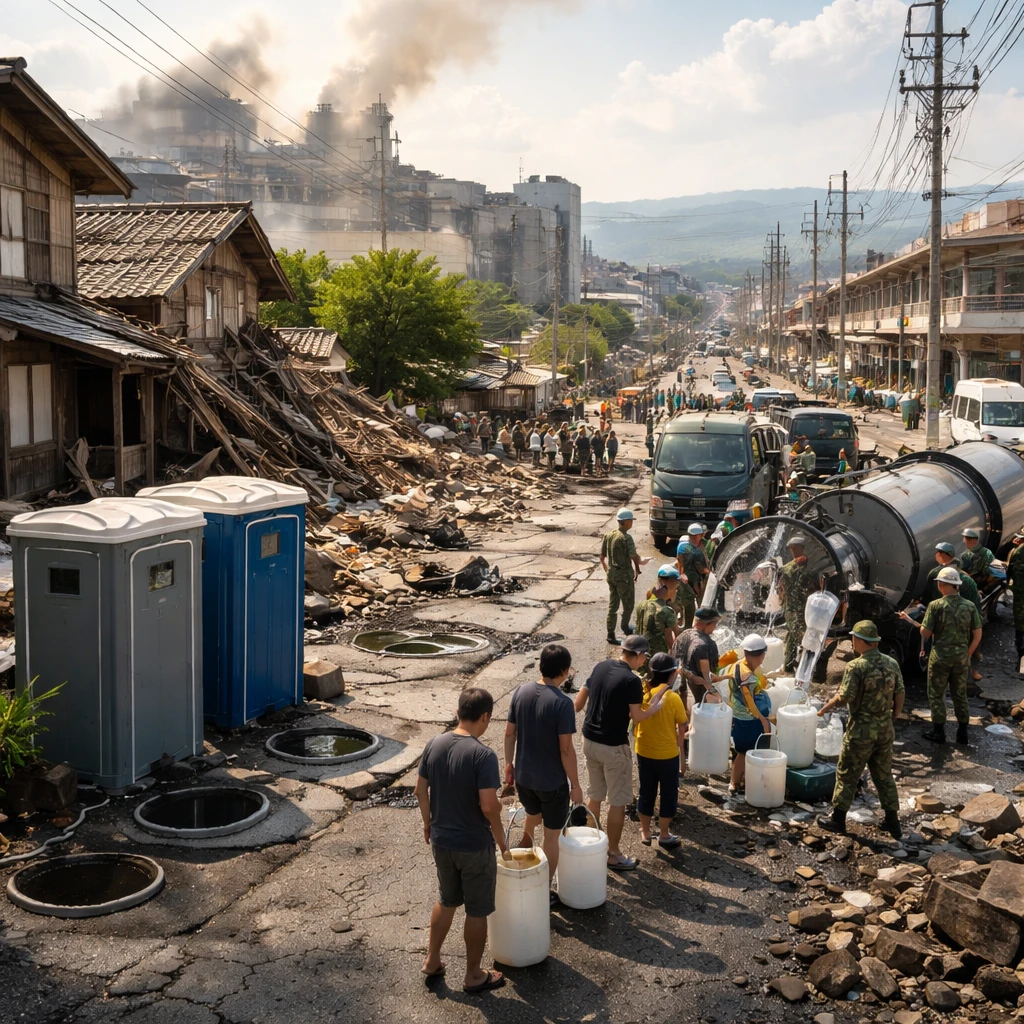
The 7.1-magnitude earthquake that struck southern Japan has not only toppled houses and split streets in Yatsushiro, it has precipitated a growing humanitarian challenge centered on water and power shortages amid intense summer heat.
Many households in the port city - home to roughly 58,000 households - remained without running water or electricity two days after the quake hit Kumamoto prefecture, which officials say has killed at least 17 people. Town official Akio Matsushita, who is coordinating relief in Yatsushiro, said the condition of the city’s water mains is severe and that officials do not know whether repairs will require days, weeks or months.
"Because of the summer heat, the lack of water is especially difficult," Matsushita said at city hall. He added that toilets inside the municipal building were out of order, and that emergency toilets had been set up over sewer manholes outside as temperatures approached about 35 degrees Celsius with high humidity.
"It will require painstaking work, and there is currently no timetable," he said, underlining the uncertain duration of critical infrastructure repairs.
Humanitarian response and immediate constraints
Japan’s Self-Defense Force (SDF) has mobilised to relieve immediate needs. SDF trucks delivered water tanks to community centres and schools in Yatsushiro, returning to city hall to refill from emergency tanks beneath the building. The military has also begun installing about 300 air-conditioning units in evacuation centres and other key locations across Kumamoto to reduce heat-related health risks.
Authorities limited residents to 3 litres (34 fl oz) of water each from the emergency supplies. Some residents relied on military water bowsers after taps ran dry.
Among those affected, Masahiro Miyamoto described clearing rubble from a toppled temple gate and returning to find his home standing while a neighbour’s house had collapsed. With no running water, he said he had to depend on SDF-delivered water. He described crowded shops and long queues at petrol stations as people searched for supplies.
"It would be better if disasters did not happen, but this is Japan, so perhaps it is something we simply have to live with," Miyamoto said.
Casualties and damage sites
The Kumamoto prefectural government said the death toll from the earthquake was 17, with the majority of fatalities occurring at two locations: Nippon Paper Industries’ paper mill, which suffered major structural damage, and an Aeon shopping mall, where authorities reported a possible gas explosion. Another six people were reported in cardiopulmonary arrest.
Japan’s top government spokesperson said that when including deaths still being investigated for a possible link to the quake, the toll stood at 28.
Economic disruptions - automotive and chip production
Beyond the immediate humanitarian needs, the quake has affected production in a region that is increasingly important to automobile and semiconductor manufacturing. The tremor forced companies including Toyota, Honda, Nissan, Aisin and Sony to halt some production. Taiwan’s TSMC evacuated workers and briefly suspended operations to inspect for any damage.
The interruptions underline how localized infrastructure damage can ripple through supply chains when manufacturing clusters are concentrated in the affected region.
Local memory of past quakes and the nature of this event
Residents of Yatsushiro and nearby Kumamoto city have previously endured powerful earthquakes. Two major quakes in April 2016 killed more than 260 people and destroyed thousands of homes. Several people recalled that Tuesday’s tremor felt worse locally than the shaking they experienced a decade ago.
Describing his experience during the quake, Miyamoto said, "I had never experienced the world moving like that before. It felt as though my body became weightless and was thrown through the air." The shaking toppled shelves and hurled computers to the floor in local buildings, he said.
Rescue and relief operations remain active. Officials have warned that forecast temperatures approaching close to 40 C over the coming weekend heighten the risk of heatstroke for those in evacuation centres and affected neighbourhoods. With uncertain timelines for restoring water and power, municipal and prefectural authorities face the twin tasks of maintaining lifesaving services and supporting economic recovery in the weeks ahead.