
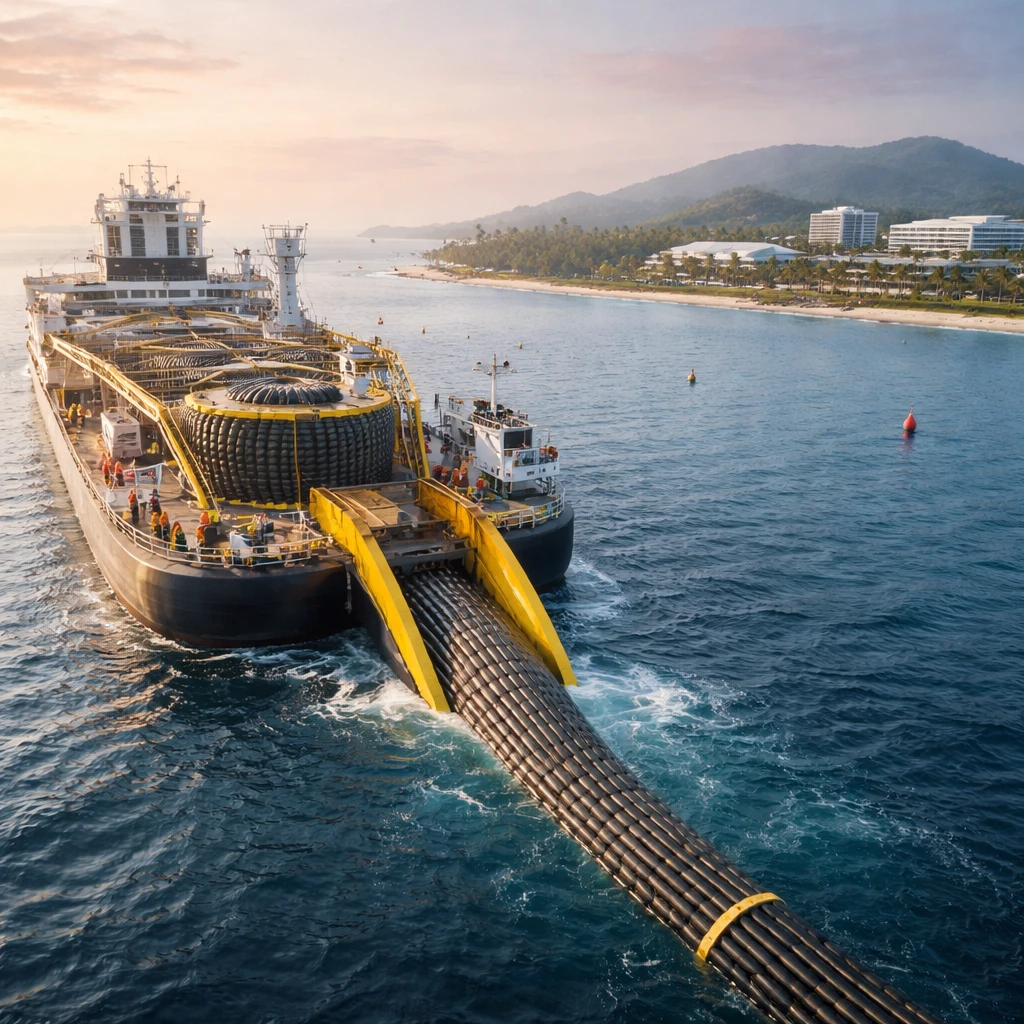
Singtel and Gulf Development said on Thursday they will form a partnership to develop submarine cable infrastructure connecting Thailand and Singapore, citing rising demand for cloud computing, artificial intelligence and data-centre services in Southeast Asia.
The initial project under the arrangement is the Vietnam-Thailand-Singapore (VTS) Cable System. The partners said the VTS system is expected to enter service by 2030, and that capital expenditure will be distributed across multiple years.
Market reaction was modest: Singtel shares were reported down 0.7% at S$4.53 in late Singapore trading, broadly aligned with the wider market where the Straits Times Index fell 0.4%.
The partnership combines Gulf’s infrastructure and digital business capabilities with Singtel’s experience in subsea cable operations. Singtel Singapore and Gulf’s Thai telecom associate, Advanced Info Service (AIS), will leverage their connectivity platforms and customer bases to aid development and commercialisation of the VTS system.
Singtel’s Digital InfraCo group includes its submarine cable network, regional data-centre arm Nxera and RE:AI, its GPU-as-a-service business. The company has said growing AI and cloud workloads are pushing demand for high-capacity connectivity in parallel with data-centre infrastructure.
The companies highlighted that AI and cloud workloads require large volumes of data to move reliably among data centres, enterprises and hyperscalers. Singtel’s annual report describes its submarine network as a backbone for global data flows, connecting Singapore to more than 100 countries.
Some financial specifics remain unspecified. The immediate financial contribution to Singtel from the partnership is unclear because the companies did not disclose the size of their investments, ownership structure or expected returns.
The announcement also follows an earlier transaction between the firms: Singtel sold a 2.8% stake in Gulf for about S$1 billion in June as part of an asset-recycling programme. Beyond that prior stake sale, further capital commitments and the division of economic interests related to the new cable venture were not detailed in the announcement.
As described by the partners, the VTS project is intended to shore up capacity for data flows serving cloud, AI and data-centre customers in the region, while commercialising connectivity through the combined reach of Singtel, Gulf and AIS.
Sectors affected
- Telecommunications
- Data-centre infrastructure
- Cloud and AI services