
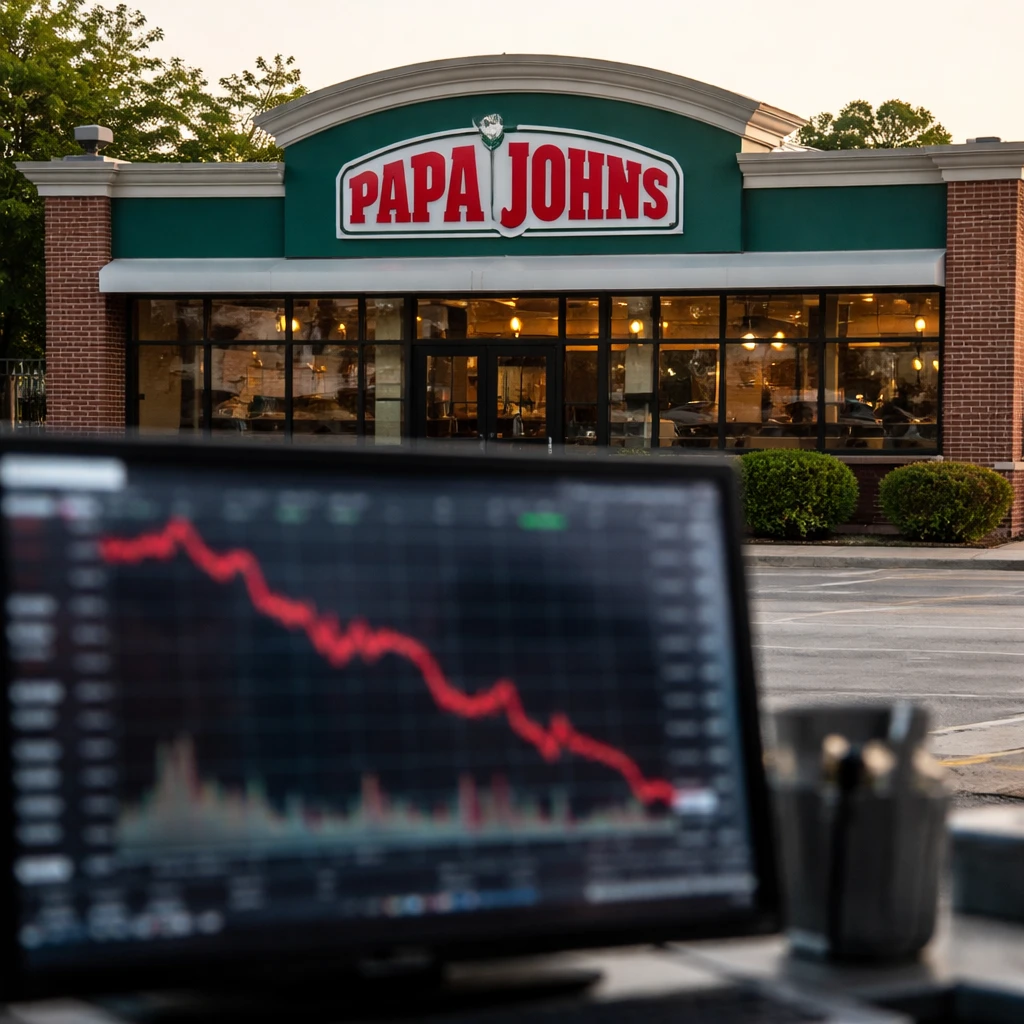
Papa John’s shares moved lower in pre-market action, falling 1.9% following a downgrade from BofA Securities to Underperform - the firm’s first explicitly bearish rating on the company. BofA also reduced its price target to $34 from $42, a level that sits only slightly above the stock’s current trading price and offers minimal implied upside for investors.
The analyst move represents a notable shift in the sell-side consensus. Prior to the call, the stock had carried no sell-equivalent ratings, making today’s change notable for investors who track analyst alignment and target dispersion.
Company-specific developments have compounded the market reaction. In late June, Papa John’s announced that Chief Financial Officer Ravi Thanawala would leave immediately to join another public company. Christopher Collins was named interim CFO while the company conducts a search for a permanent replacement. That abrupt leadership change comes on top of recent operating and financial weaknesses.
In its first quarter of fiscal 2026, Papa John’s reported adjusted earnings per share of $0.32, missing the consensus estimate of $0.37. The quarter also showed a 6.4% decline in North American comparable sales. Those results have kept sentiment muted as the company approaches the next earnings report, scheduled for late July.
Market context suggests the move is driven by Papa John’s fundamentals rather than a broad market downturn. At the same time the stock weakened, the S&P 500 was trading about 0.4% higher and the Nasdaq was up roughly 0.3% in pre-market indications. Key peers in the quick-service pizza and restaurant space, including Domino’s Pizza and Yum! Brands, did not report material negative developments that would indicate a sector-wide selloff.
Taken together, the BofA downgrade and recent corporate developments crystallize a near-term narrative investors are weighing: slower domestic traffic, an active refranchising and store-closure program, and a sudden finance leadership transition that together create a challenging operational backdrop. The shares are trading well under their 52-week high of $55.74, and with the new sell-side price target only marginally above current levels, pre-market selling appears to reflect a reassessment of risk ahead of the next earnings catalyst.
Context for investors:
- Analyst sentiment shifted to a first-ever outright bearish rating from BofA, with a lowered price target of $34.
- Management disruption - the immediate departure of CFO Ravi Thanawala and appointment of interim CFO Christopher Collins - adds uncertainty before a permanent hire is announced.
- Operational results showed pressure in Q1 2026 with adjusted EPS below estimates and a 6.4% drop in North American comparable sales.