
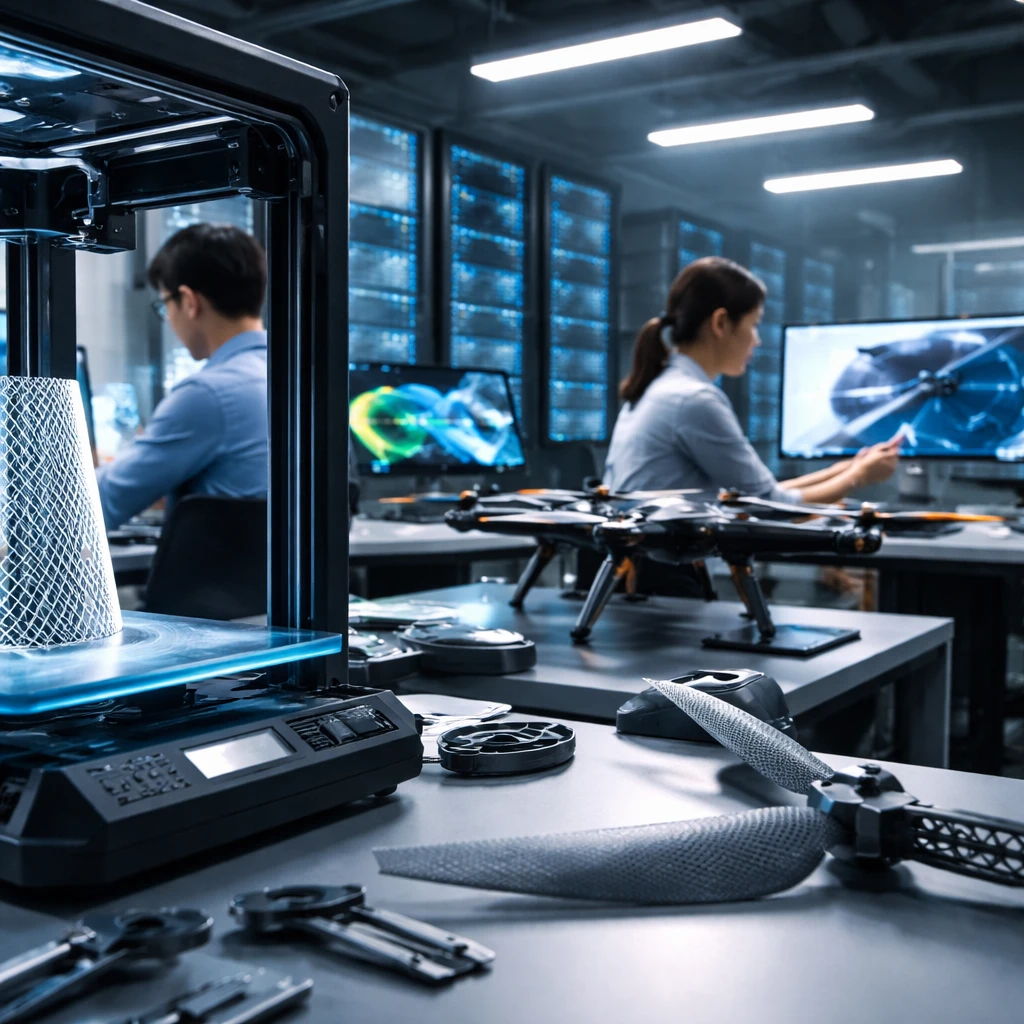
BQP, a developer of quantum-accelerated simulation software, and drone maker Modovolo have completed a commercial deployment that compressed the design cycle for Modovolo's next-generation unmanned aerial systems. The integration of BQP's flagship platform, BQPhy, into Modovolo's engineering pipeline specifically targets optimization of a patent-pending series of 3D-printed propellers.
According to details seen by the reporter, BQPhy's computations are powered by the QuantumNOW solver engine. That engine applies quantum-inspired algorithms on top of existing high-performance computing and GPU infrastructure, enabling engineering teams to run tens of thousands of design simulations within the compute footprint normally required for only a small fraction of that workload.
Conventional computational fluid dynamics and structural optimization tools typically restrict engineers to testing a handful of design variations. That limited exploration can produce hardware that functions correctly but is not fully optimized. Modovolo had previously relied on internally developed genetic algorithms for propeller optimization. Those traditional approaches were time-intensive - local server runs could take days to produce a single design iteration, and many such iterations were ultimately discarded.
With BQPhy integrated into its workflow, Modovolo now has the computational capacity to examine a substantially larger number of design variables concurrently. The deployment therefore expands the company's ability to iterate on complex geometric and structural trade-offs in its propellers without proportionally expanding compute resources.
The deployment takes place amid sizeable investment flows into quantum and advanced computational technologies. McKinsey's 2026 Quantum Technology Monitor put global investment in quantum tech startups at $12.6 billion, while Deloitte projects U.S. aerospace and defense spending on advanced computational tools and AI will reach $5.8 billion by 2029. Both companies are portfolio holdings of NY Ventures.
Modovolo's use of a quantum-inspired solver on standard HPC and GPU systems illustrates a product-first approach to engineering tooling - applying advanced solvers to give teams practical, higher-throughput experimentation without requiring entirely new hardware stacks. The commercial rollout is positioned as a direct replacement for slower, locally constrained optimization runs, allowing the manufacturer to explore broader design spaces for its next-generation unmanned aerial systems.