
What happened
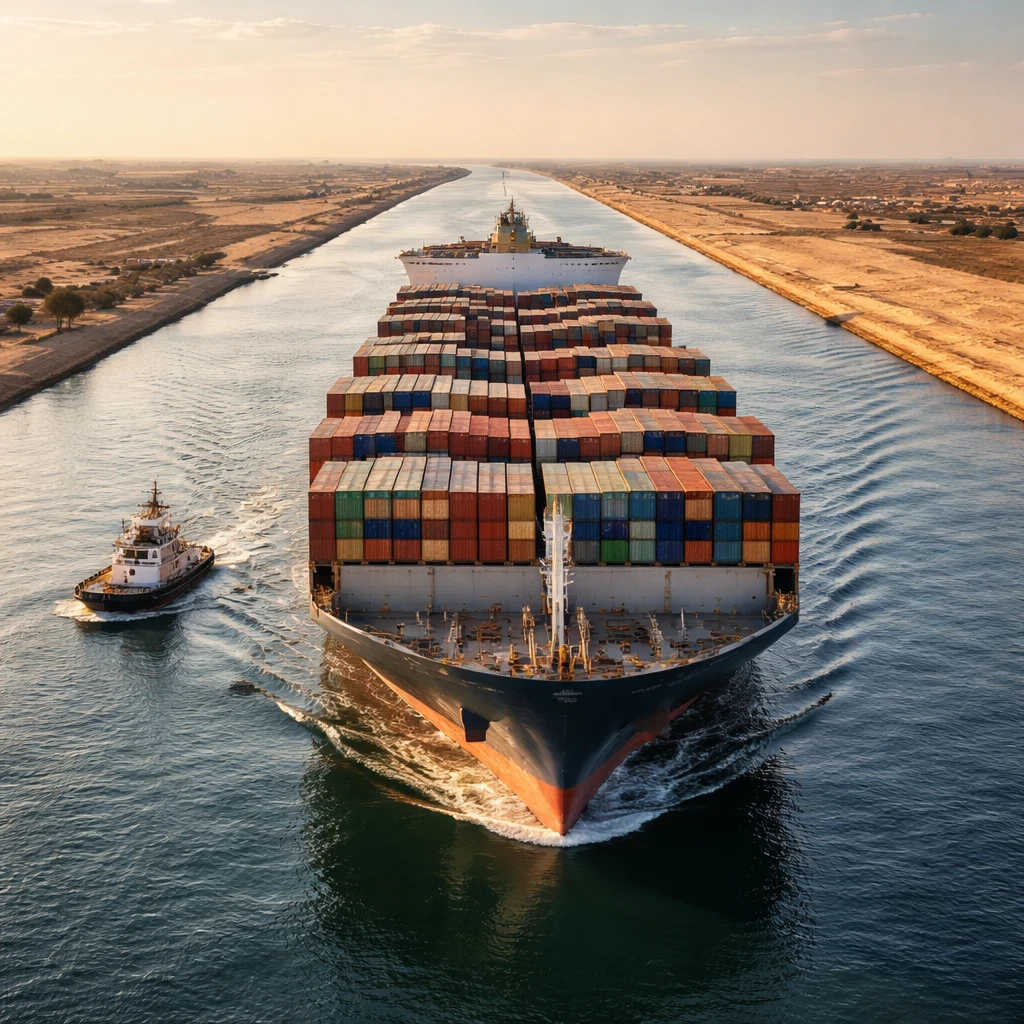
Danish shipping company Maersk announced that a Gemini network service operated in partnership with Germany's Hapag-Lloyd will resume transiting the Suez Canal instead of continuing the longer passage around the Cape of Good Hope. Maersk characterized the decision as joint and based on thorough assessments of conditions in the Red Sea area, and said it represents a move toward a gradual return to the trans-Suez corridor.
Market reaction
Following the announcement, Maersk shares fell by more than 5% in Copenhagen trading as of 10:56 GMT. Hapag-Lloyd shares also moved lower, down about 3% on the news.
Context on routing and rates
The change in routing signals that container carriers may be beginning to revert to the Asia-Europe trade lane after a period in which many vessels were forced to detour around the southern tip of Africa. Those diversions were prompted by attacks on commercial ships traversing the Red Sea, attacks that Yemeni Houthi rebels have said were carried out in solidarity with Palestinians.
Since late 2023, the redirection of traffic around the Cape of Good Hope added roughly 10 to 14 days to voyages and materially increased fuel costs per sailing. The reduction in effective capacity resulting from those longer journeys helped push spot freight rates sharply higher. In response to that market environment, Maersk raised its 2026 EBITDA guidance last month to a range of $8 billion to $10 billion, up from a prior range of $4.5 billion to $7 billion, while forecasting global container volume growth of around 4%.
Maersk and other carriers note that a return to the shorter Suez route would release the capacity that had been absorbed by longer voyages back into the market, putting downward pressure on spot rates.
Security developments
The announcement comes against a backdrop of continued security risk in the region. On Sunday, a cargo vessel was reported attacked by unknown assailants about 30 nautical miles southwest of Hodeida, Yemen, near the Bab al-Mandeb Strait. The U.K. Maritime Trade Operations reported the crew and vessel were safe, and no organization has claimed responsibility for the incident.
Maersk emphasized that the resumption applies only to the IMX/ME11 service for now, underscoring that the broader security environment remains uncertain.
Wider implications
If a broader industry-wide shift back to Suez routing occurs, analysts and market participants say it would materially compress spot rates across the Asia-Europe and India-Mediterranean corridors by returning previously absorbed capacity to the market. For the moment, the resumption remains limited to the specified service.
This report presents the companies' statements, recent market moves, and the security incidents described by maritime authorities. It does not introduce additional claims or projections beyond those provided by the companies and official reports.