
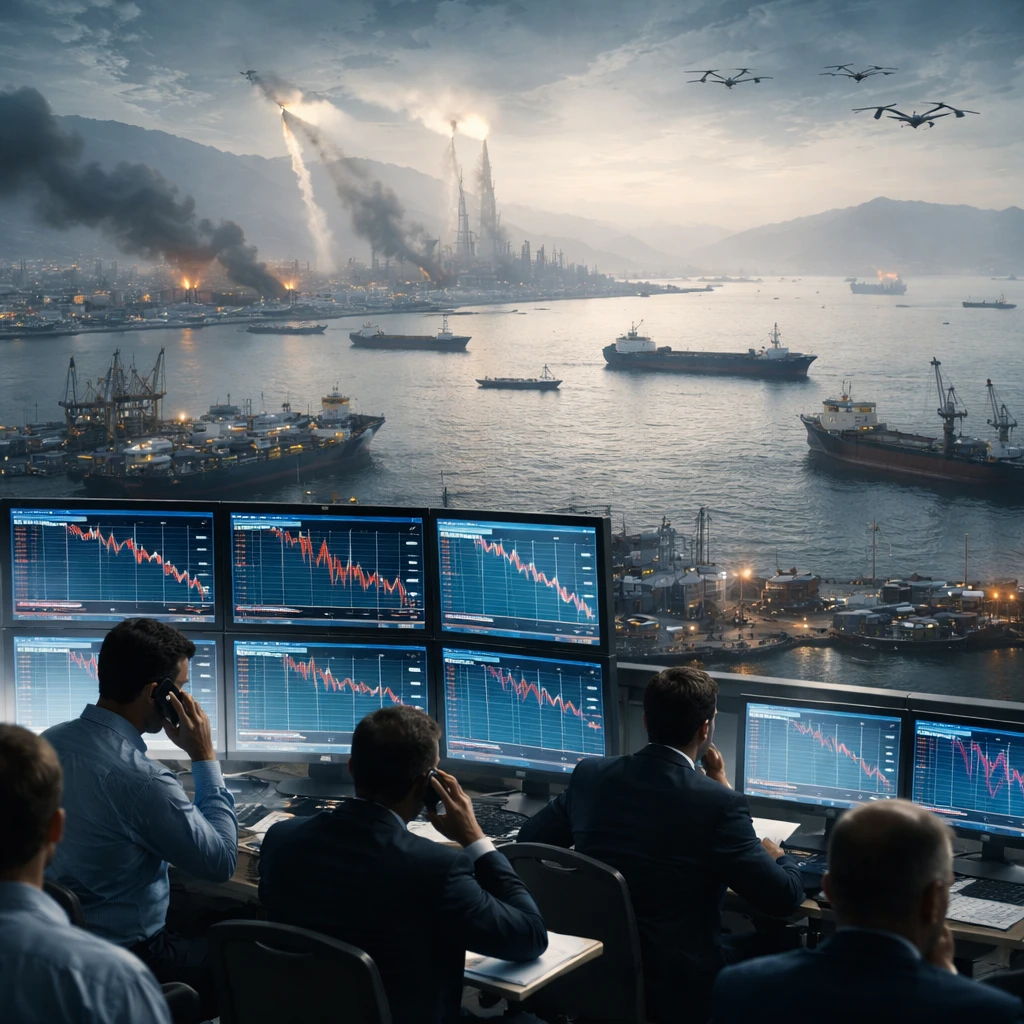
London equities fell on Thursday as escalation between Iran and the United States cast a shadow over encouraging UK growth data that outperformed forecasts.
The FTSE 100 was down 0.37% as of 03:25 ET (07:25 GMT), extending losses from the prior session. Across Europe, Germany’s DAX slipped 0.22% and France’s CAC 40 fell 0.21%. Sterling traded marginally lower, down 0.01% at $1.3535.
UK growth stronger than expected
Data from the Office for National Statistics showed the UK economy expanded 0.7% in the three months to May, beating expectations of 0.5%. Annual growth accelerated to 1.3%, the fastest pace in 13 months. On a monthly basis, GDP rose 0.1% in May, recovering from a 0.1% decline in April, with the services sector rising 0.3% and supporting the pickup.
Security tensions dominate market sentiment
Political and military developments in the Middle East dampened investor appetite. A spokesman for Iran’s military headquarters warned early Thursday that "all infrastructure in the region" would be "crushed under the steel blows" of Iran’s armed forces if the U.S. followed through on threats to attack Iran’s infrastructure. The warning followed U.S. President Donald Trump’s statement on Wednesday that Washington would "knock out all their power plants... all their bridges" unless Iran returned to talks.
U.S. forces escalated strikes early Thursday, targeting areas around Tehran and in Semnan province, which is home to Iran’s ballistic missile programme, and also firing on a vessel accused of breaching a U.S. naval blockade. Iran responded before dawn with missile and drone strikes on Bahrain, Jordan and Kuwait; the Islamic Revolutionary Guard Corps said it hit a U.S. base in Jordan in retaliation for an alleged American strike near a children’s cancer hospital in Ahvaz.
Market and commodity reactions
Jefferies strategist Mohit Kumar said traffic through the Strait of Hormuz "has slowed down significantly," and that Iran is not interested in negotiations. He judged the latest escalation to be a change from earlier rounds, which had reportedly been "meant as an objective to gain an upper hand in negotiations and to eventually de-escalate the situation." Kumar added he was doubtful Iran would "give up its claim of sovereignty over the Strait that easily" and said he was "doubtful whether there is a unified leadership in Iran that can take that decision."
Jefferies said it was "keeping risk levels low" while still expecting "eventually we will get a deal even if it’s a fudge," and anticipated the standoff could persist "for a few weeks," a scenario the firm said would keep oil under upward pressure.
Political remarks added to the uncertainty: Vice President JD Vance described the attacks as part of a "delicate diplomatic dance," while President Trump said in Pennsylvania, "We’ll find out whether or not we settle with them or we just finish it off."
In commodities trading, Brent crude was last down 0.38% at $84.63 and U.S. WTI slipped 0.08% to $79.54. Gold futures fell 0.55% to $4,029.27, while spot gold was down 0.88%.
UK corporate round up
- Crest Nicholson expects fiscal 2026 operating profit to come in at the lower end of its £5 million-£15 million guidance range amid continued weak housing demand, and has extended a covenant waiver to Sept. 30, 2026.
- Ocado said it is pursuing multiple new U.S. retail partnerships and reiterated its forecast to turn cash flow positive despite weaker underlying first-half earnings.
- TotalEnergies said higher oil and gas prices driven by the Middle East conflict are expected to boost its second-quarter profits.
- Premier Foods reported a 4% rise in first-quarter branded sales, supported by demand for sweet treats and new product launches.
- Frasers Group withheld its fiscal 2027 outlook, citing uncertainty from ongoing takeover bids involving Hugo Boss and Accent Group.
- SSE maintained its earnings guidance after reporting higher network investment and renewable generation, and appointed former National Grid CEO John Pettigrew to its board.
What investors are watching
Markets are balancing upbeat domestic growth data with geopolitical risk that could sustain higher oil prices and broader risk-off sentiment. Strategists flagged the potential for continued disruption to shipping through the Strait of Hormuz and suggested the situation could remain unresolved for several weeks, a dynamic that would likely keep energy markets on edge.
With sterling only marginally weaker and UK growth surprising to the upside, domestic economic indicators offered a counterpoint to the international developments; however, immediate market reaction was dominated by the security flashpoints in the Gulf region.
Bottom line
Stronger-than-expected UK GDP failed to fully offset concerns over a widening military confrontation between Iran and the United States. Traders and strategists are weighing the potential for prolonged disruption to maritime traffic and higher oil prices against a resilient UK services sector, leaving equities modestly lower and energy and precious metals trading with mixed moves.