
Overview
In the early morning hours on Wednesday, a school-bus-sized segment of a Falcon 9 rocket that had been adrift in space since January 2025 struck the lunar surface at high speed, astronomers confirmed. The object was the second stage of a Falcon 9 that helped launch a lunar lander from Firefly Aerospace toward the moon in January 2025. SpaceX has described the collision as unintentional.
Impact details and observations
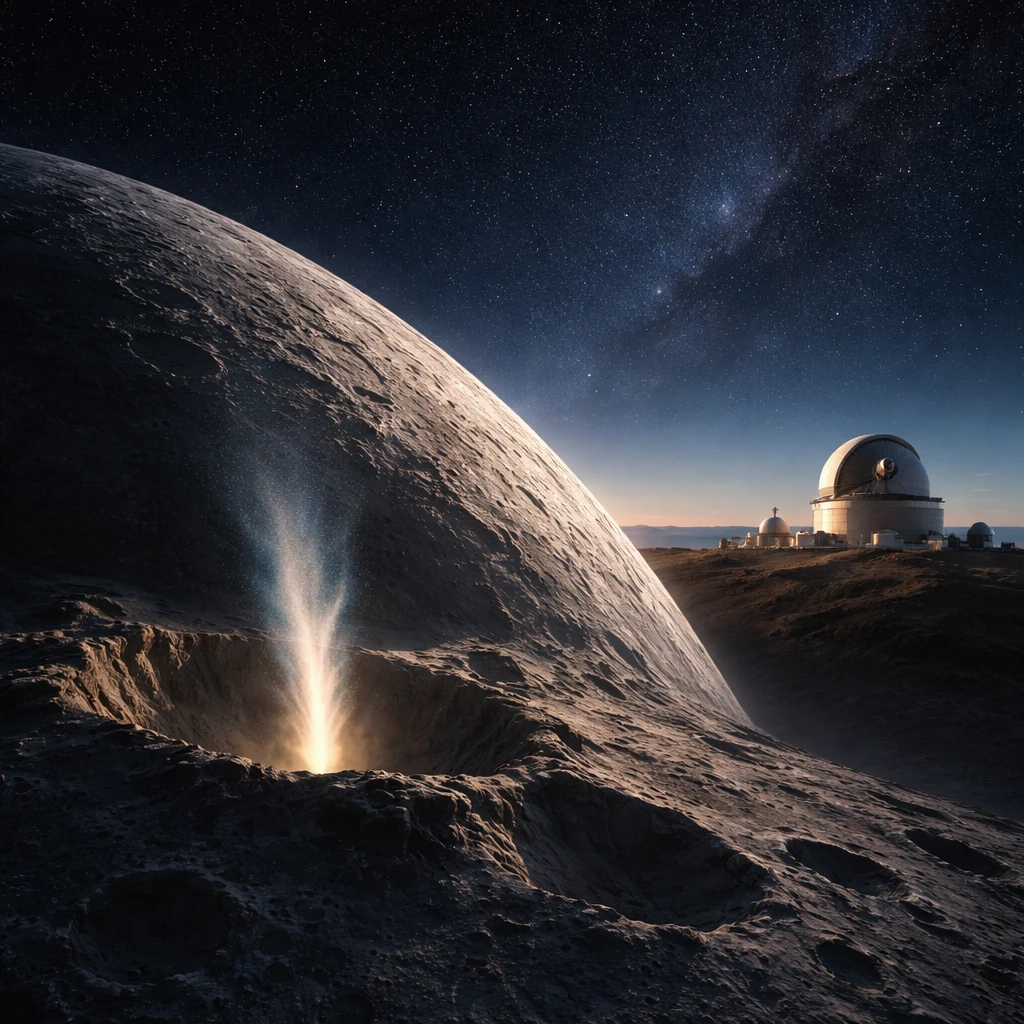
The rocket body, weighing 4 metric tons, impacted the moon at approximately 2:35 a.m. Eastern Time (0635 GMT), moving at about 5,400 miles per hour (8,690 kph). No spacecraft circling the moon were in positions suitable to capture close-up imagery of the strike. Still, the European Southern Observatory's Very Large Telescope at the Paranal Observatory in Chile registered glints of light connected with the impact.
An ESO spokesperson said the observatory detected spectral lines of sodium and lithium gas in the plume produced by the collision, with those spectral features persisting for roughly 5 to 10 minutes after impact. The impact site lay near the moon's terminator line - the boundary between the sunlit and shadowed portions of the lunar surface - and the strike was expected to occur near Einstein Crater on the moon's western limb, a region that can be hard to observe from Earth.
Carl Schmidt, the lead astronomer overseeing the observational campaign, characterized the analysis as preliminary. In an email, he said the observation did not go perfectly and called the initial analysis crude, but noted that sodium and lithium signatures were present and that more refined results could follow with further study. Schmidt added that sodium detected in the spectra is believed to have originated from the lunar regolith, while traces of lithium may have come from the rocket stage itself.
How the stage came to hit the moon
Second stages that boost payloads to near-Earth or orbital destinations commonly reenter Earth's atmosphere and break up or fall into the ocean after completing their mission. In this case, because the January lunar lander mission required more thrust than many missions closer to Earth, the Falcon 9 second stage remained in space after releasing its payload. The stage had dumped its remaining fuel and was not controllable.
Earlier this year, astronomers calculated that the stage's orbit would end at the moon. SpaceX director of NASA science and Dragon programs Julianna Scheiman told reporters that solar activity and gravitational forces combined to place the stage on a path toward the lunar surface.
Bill Gray, the developer of widely used astronomy software Project Pluto who published a prediction of the stage's impact in April, said the event may be of minor scientific interest and that it could yield some learnings. Gray recounted his own confidence in the prediction, saying that by January he believed it would hit and that by April he had enough certainty to post an announcement. He also said the incident highlights concern over how leftover space hardware is disposed of.
Plume composition and scientific context
The collision produced a plume of lunar dust briefly illuminated by sunlight, similar in behavior to prior impacts observed on the moon. How sunlight interacted with the plume helped astronomers infer components in the expelled material. Scientists believe the sodium signature came from lunar soil disturbed by the impact, while the lithium detected in the plume may be a residue originating from the rocket stage.
Although such detections are brief and can be difficult to study, they offer scientists opportunities to analyze the composition of ejecta when circumstances allow telescopes and instruments to capture the event.
Precedents and related lunar impacts
Impacts of artificial objects on the moon have occurred on several occasions. A Chinese rocket stage struck the moon in March 2022 after a lunar test mission. In 2009, NASA intentionally crashed a rocket stage into the moon to study the resultant plume of material, an experiment that contributed to the discovery of water traces in lunar soil. In the 1970s, NASA also intentionally impacted stages from the Saturn V to study seismic responses.
Several recent attempts by spacecraft to land softly on the moon have instead ended in crashes. Russia's Luna-25 mission lost control and impacted the lunar surface in 2023; its small plutonium-238 power source is believed to remain on the surface and pose no hazard. India's Chandrayaan-2 lander and Israel's Beresheet lander both crashed in 2019. The Israeli lander was carrying microscopic tardigrades among its payloads, which may still be on the surface.
Implications for future lunar activity
Officials from SpaceX and NASA have discussed ways to reduce the chance of future unintentional impacts on the moon. NASA plans to build a lunar base and resume routine astronaut missions to the lunar surface later this decade as part of its Artemis program; preventing errant pieces of space hardware from striking those assets is a stated concern.
Conclusion
The collision of an uncontrolled Falcon 9 second stage with the moon was confirmed by ground-based observatories and produced measurable, though short-lived, spectral signals. While no human or operational lunar assets were reported at risk from this particular event, observers and officials have noted the incident as an example of questions surrounding the management and disposal of spent space hardware.
Key points
- The object was the second stage of a SpaceX Falcon 9 used to launch a Firefly Aerospace lunar lander in January 2025; it weighed 4 metric tons and struck the moon at about 5,400 mph at 2:35 a.m. ET (0635 GMT).
- Ground-based observations from the Very Large Telescope at Paranal recorded a brief impact plume and detected spectral lines of sodium and lithium lasting roughly 5-10 minutes after impact.
- The incident underscores considerations for the space and aerospace sectors, including launch service providers, lunar mission planners, and organizations developing infrastructure for future crewed and uncrewed lunar activities.
Risks and uncertainties
- Uncontrolled pieces of space hardware can enter unintended trajectories and impact the moon - a risk for planned lunar infrastructure and missions, particularly as agencies and companies prepare for sustained activity on the lunar surface.
- Observational limitations meant that no lunar-orbiting spacecraft were close enough to capture detailed images of the impact, limiting immediate, high-resolution study of the event and its ejecta.
- Handling and disposal of spent rocket stages remains a challenge for the space sector, raising questions about protocols and safeguards to prevent future unintended impacts.