
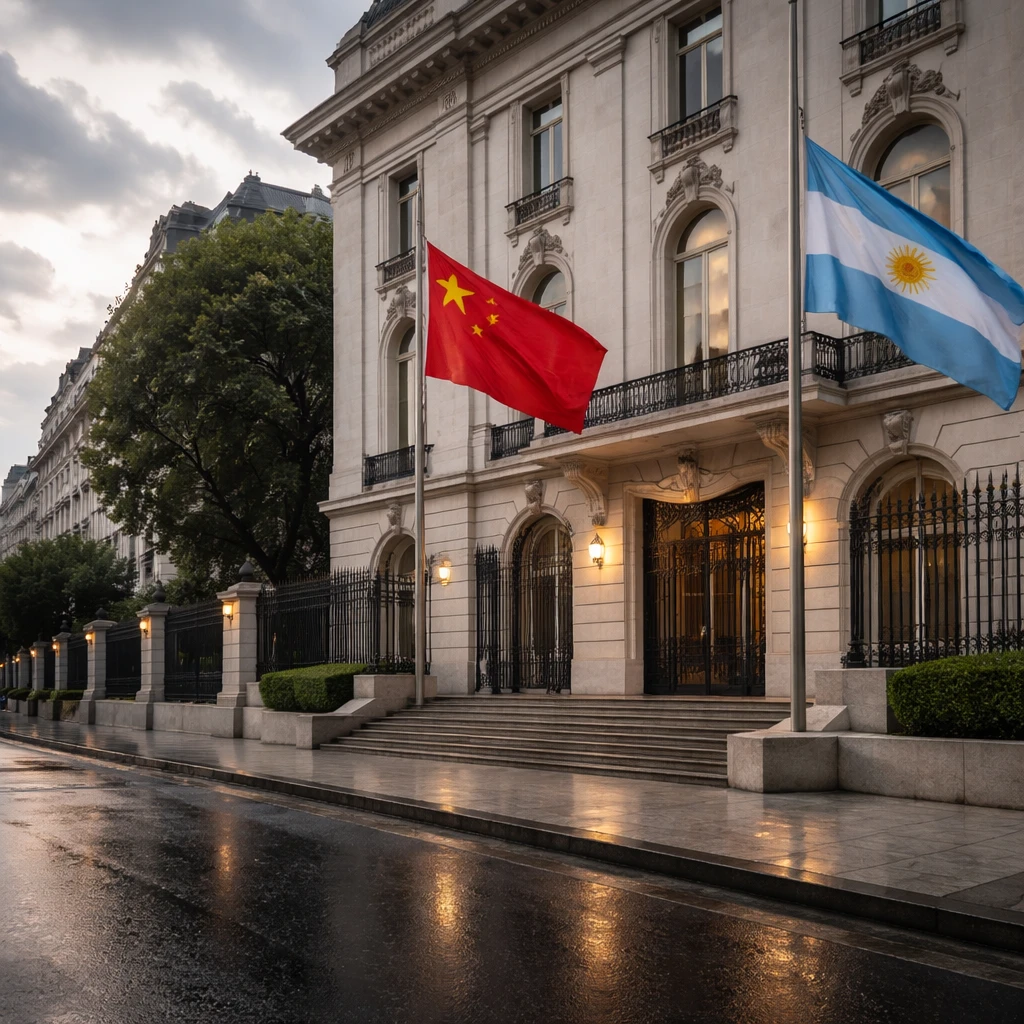
China's embassy in Argentina issued a strong public rebuke of the United States on Wednesday, alleging that U.S. visa revocations were being used to obstruct normal business cooperation between an Argentine firm and China's Huawei.
In a statement posted to social media late on Wednesday, the embassy said the U.S. embassy in Argentina "has deliberately promoted the so-called 'China threat theory,' broadened the concept of national security, and, through visa revocations, blatantly hindered normal cooperation."
"The U.S. embassy in Argentina has deliberately promoted the so-called 'China threat theory,' broadened the concept of national security, and, through visa revocations, blatantly hindered normal cooperation," the Chinese embassy said.
The U.S. embassy in Argentina did not immediately respond to requests for comment on the accusation.
The statement came amid broader diplomatic context noted by the Chinese embassy: the administration of U.S. President Donald Trump - identified in the statement as a close ally of Argentine President Javier Milei - has signaled concern about Chinese influence across Latin America, including in Argentina. The embassy emphasized Argentina's economic ties with Beijing, noting that China is Argentina's second-largest trading partner.
In parallel to the diplomatic exchange, China and Argentina's central banks this week renewed a bilateral currency swap agreement. The extension runs for five years and totals 130 billion yuan, an amount the article converts to $19.3 billion using the exchange rate listed in the original report. The piece notes the currency conversion figure and rate: ($1 = 6.7488 Chinese yuan renminbi).
The embassy statement framed the visa revocations as both a challenge to Argentina's sovereign prerogatives and a distortion of free-market cooperation, while alleging a deliberate U.S. policy choice to expand national security parameters. The article does not provide additional details on which Argentine company was involved, the number or nature of the visa revocations, or any response from U.S. officials beyond the noted lack of immediate comment from the U.S. embassy in Buenos Aires.
The article presents two concurrent developments: a public diplomatic complaint by China regarding U.S. actions tied to business cooperation with Huawei, and the renewal of a significant bilateral financial instrument between Beijing and Buenos Aires.