
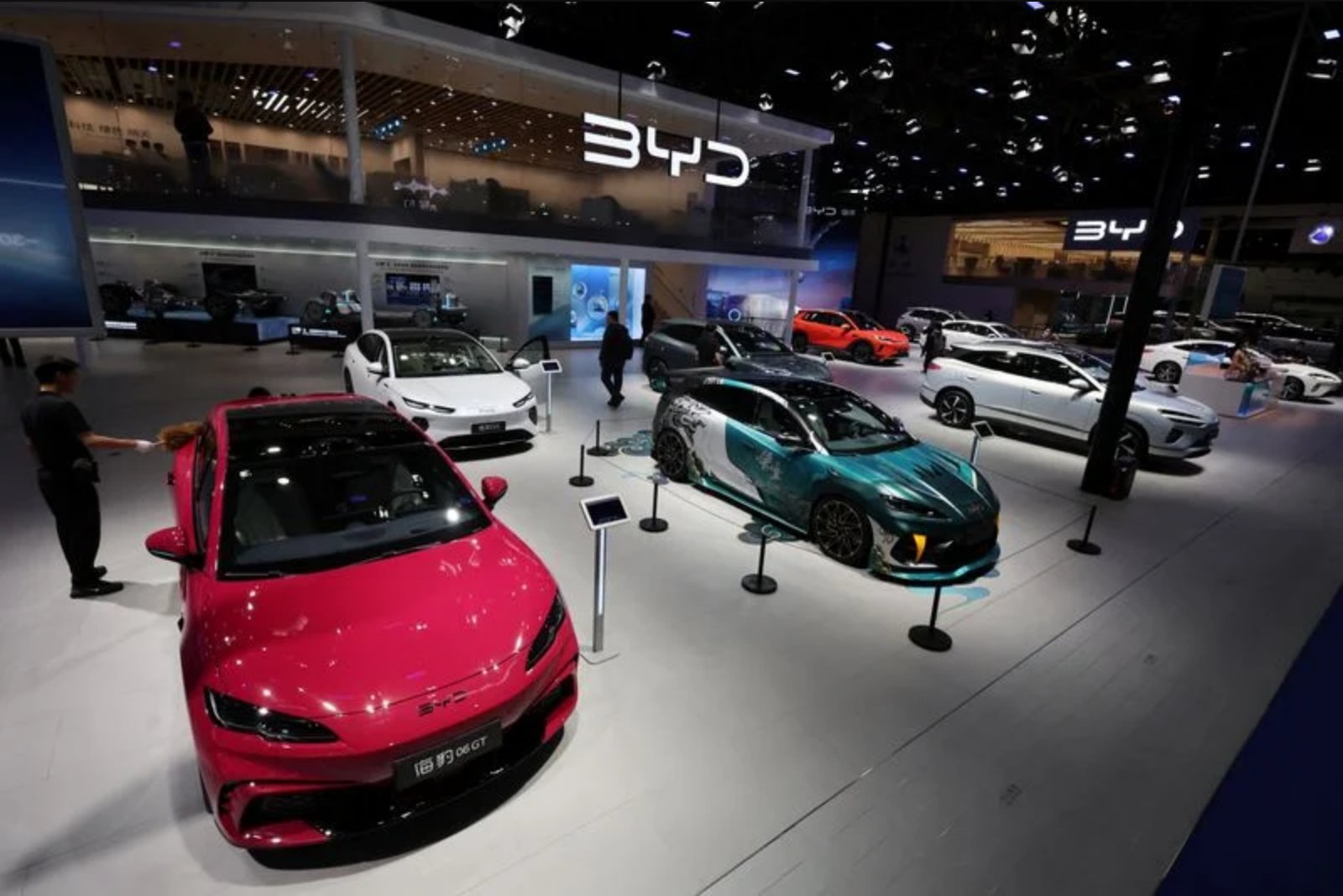
Chinese electric vehicle manufacturer BYD is weighing involvement in Formula One as it seeks to raise its profile beyond its domestic market, where it is already established. Industry observers say the company faces a difficult choice: commit tens or hundreds of millions of dollars to create a full F1 team or pursue lower-cost branding arrangements that carry different strategic trade-offs.
"Everyone wants to be involved with F1," said Ian Moore, a research analyst from Bernstein. "It’s because it’s the greatest marketing vehicle for OEMs (Original Equipment Manufacturers) that’s out there".
Formula One under Liberty Media already includes several established European and U.S. automakers - such as Ferrari, Mercedes-Benz, Ford Motor and General Motors’ Cadillac - that contribute engines or car bodies to teams. The sport’s governing body and leadership have signaled they are open to a Chinese team if it delivers commercial and sporting value, and there is technically room on the grid for a twelfth competitor.
BYD would bring a compelling commercial argument to F1: it is the world’s largest EV maker by sales, there is an existing Shanghai Grand Prix, and Formula One reports there are 221.1 million fans in China. The company has also set a target to locally produce all cars it sells in Europe by 2028, which may be relevant to a continental marketing strategy.
But the costs of entering as a full constructor are substantial and multi-faceted. Felipe Munoz, an independent analyst who runs the Car Industry Analysis platform, cautioned that "From a financial point of view it might not sound like a wise move to spend so much money on a field they barely know." He highlighted the scale of infrastructure spending and technical investment needed, including facilities such as wind tunnels.
The example of Aston Martin’s facility in Silverstone is frequently cited in discussions of the cost of building a competitive operation: the team’s campus and wind tunnel are estimated at between a3150 million and a3200 million, yet the squad has managed only a single championship point this season. In addition, the entry dynamics of modern F1 mean a new team would likely encounter a substantial anti-dilution fee to join the sport. The article referenced a figure of more than $450 million paid by Cadillac to gain entry this year, reflecting how adding teams affects the distribution of F1 income.
Acquiring an existing stake in a team is another route, but that option can be constrained by owners unwilling to relinquish control. Alpine’s minority stakeholder Otro Capital, which holds a 24% position, has been mentioned as available by some market participants, but the majority shareholder Renault retains the right to approve any change in control. Separately, private individuals with F1 experience have been linked to potential transactions; one former team principal has had exploratory contact with BYD, though the exact commercial fit of any such approach is uncertain.
Given these barriers, several experts argue a sponsorship-first strategy would be the least disruptive and lowest-risk way for BYD to participate in F1. Nick De Marco, a sports law barrister at Blackstone Chambers, explained that "Entering F1 as a sponsor only would be the lowest risk for BYD because it avoids the FIA regulatory requirements such as demonstrating technical and governance compliance requirements." A sponsorship deal would allow BYD to tap F1’s global audience without taking on the sport-specific governance and technical obligations required of a constructor.
Sponsorship costs range widely within the grid. Top-tier title partnerships can be extremely expensive - for example, Oracle is reported to be paying $300 million over five years for naming rights with a leading team. By contrast, title-like partnerships with midfield outfits can be materially cheaper: software firm Atlassian’s title partnership with Williams has been cited in the market as worth between $40 million to $60 million a year. Those examples illustrate how brands can calibrate spend against exposure and alignment with a teams competitive profile.
Analysts at Bernstein have quantified how sponsorship value is distributed across categories: they estimate the automotive sector accounts for around 1% of annual F1 sponsorship value, compared with technology at 14% and luxury at 26%. The sport does not currently have a series-level automotive partner in the way it has had multi-brand luxury deals, such as one reportedly worth $100 million a year for a luxury conglomerate.
That position raises a strategic question for BYD. Moore noted a potential conflict: "I’m not sure if that’s an option (for BYD) given that they’re also an OEM," observing that a high-profile BYD sponsorship could create friction with existing manufacturer partners in the sport. De Marco, while highlighting the lower regulatory burden of sponsorship, added that such an approach would not enable BYD to showcase its engineering and manufacturing capabilities in the paddock. "I imagine (that) is the key benefit BYD would seek to derive from that participation" - a capability that sponsorship alone may not sufficiently demonstrate.
The choice facing BYD, therefore, involves balancing marketing reach, cost, regulatory complexity and technical demonstration. A full factory entry would position the company to prove engineering credentials in a way a branding deal would not, but it would require meaningful capital and governance commitments with uncertain near-term sporting returns. Sponsorship can deliver brand exposure with lower upfront cost and fewer compliance demands, but may limit BYDs ability to directly exhibit product and engineering leadership to skeptical external audiences.
For BYD, the decision will hinge on the relative value it places on marketing reach versus technical demonstration, and on its appetite for large, long-term capital commitments in an arena that requires specialist knowledge and infrastructure.