
Asian stock markets showed mixed and volatile moves on Monday as traders tried to reconcile optimism around artificial intelligence-driven gains with fresh signs that cost pressures may be mounting across supply chains. At the same time, a delicate ceasefire between the United States and Iran left oil prices elevated and the dollar close to a one-year high, adding a layer of geopolitical risk to market sentiment.
The MSCI EM Asia index was largely flat, lingering near two-week lows, while an index that tracks ASEAN equities rose about 0.4% after having hit a two-week trough in the previous session. Market action was uneven across countries and sectors, illustrating investor caution over how far AI-related rallies can extend if input costs begin to bite.
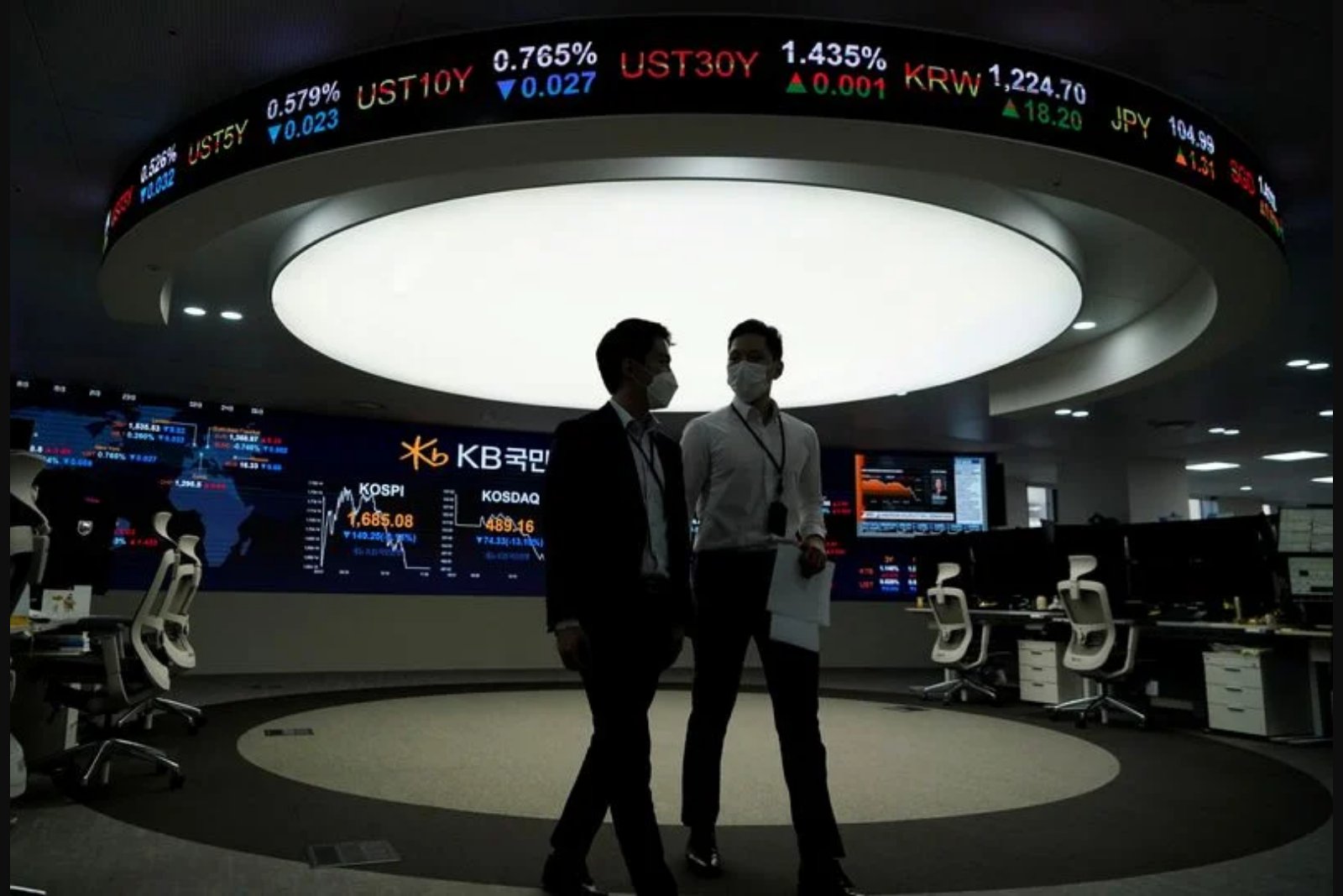
South Korea’s KOSPI, which had plunged 7% in the prior week, slid as much as 3.4% early on Monday before trimming losses to trade roughly 2% lower later in the session. By contrast, Taiwan’s stock market advanced, with gains of up to 2.1% reported. The Taiwan index has climbed 56% year-to-date, making it the second-best performing market in the region behind the KOSPI’s 97% rally so far this year.
"The narrative at the moment is focused on artificial intelligence return on investment and whether cost pressures are starting to cascade down the supply chain," said Kyle Rodda, senior financial market analyst at capital.com. "Last week’s announcement by Apple ... shows that the cost pressures caused by the demand for raw materials for the AI build-out are about to hit consumers directly."
In Southeast Asia, Thailand’s benchmark rose more than 1%, supported largely by a strong performance in electronics manufacturer Delta Electronics Thailand, which jumped around 5% on Monday and has gained roughly 84% year-to-date.
Malaysia’s equity market slipped 0.5% on the day. Jakarta’s index fell about 0.4% and was on track for its worst June showing since 2015, tracking a sixth straight month of losses and down roughly 4.5% for June. These movements underscored divergent regional dynamics as some markets continued to benefit from tech-led momentum while others faced broader downward pressure.
Global headlines also contributed to market caution. The United States and Iran exchanged fresh strikes over the weekend before agreeing to halt retaliatory attacks and to meet in Qatar on Tuesday, a development that left investors wary of how stable the ceasefire might be. The dollar index held steady near 101.4, supported by ongoing geopolitical uncertainty and by the growing likelihood of another Federal Reserve rate hike this year.
"Across EM Asia, regional currencies are broadly stable, with the lack of a sustained spike in oil prices easing pressure on net energy importers such as India, Thailand, and the Philippines," said Lukman Leong, an analyst at Doo Financial Futures. "The relatively muted market reaction also reflects expectations that any Middle East conflict will remain contained, allowing investors to refocus on domestic fundamentals."
Currency moves were mixed. The Malaysian ringgit led gains, rising more than 0.6% to 4.063 per dollar, reaching its strongest level in almost two weeks. Indonesia’s rupiah strengthened to 17,860 per dollar. The Philippine peso and the Thai baht were largely unchanged. The South Korean won weakened by about 0.6%, while the Taiwan dollar edged down 0.2%.
Outside financial markets, human tragedy and major policy shifts were also noted. In Venezuela, the death toll from last week’s twin earthquakes approached 1,500 as international rescue teams concentrated efforts in La Guaira, the state hit hardest in a country already beset by a prolonged political and economic crisis. Meanwhile, Bolivia announced on Friday that it would move to a flexible exchange rate system, ending a 15-year dollar peg and effectively devaluing its currency in a significant policy reversal aimed at stabilizing the economy.
HIGHLIGHTS
- Yield on Indonesia’s 10-year bonds at 7.182%
- China’s central bank offers 300 billion yuan in new overnight reverse repos
- South Korean president to unveil a major AI and chip investment drive
- Japan aims to more than double real growth to over 1% in its economic blueprint
- Singapore’s opposition retains Singh as party chief despite a court conviction
The session’s market and currency snapshots at 0433 GMT showed varying performances across the region, with Japan, China, India, Indonesia, Malaysia, the Philippines, South Korea, Singapore, Taiwan and Thailand reporting differing daily and year-to-date moves, reflecting the uneven interplay between technology-led gains and broader macro pressures.
Overall, the day’s activity illustrated a market grappling with competing forces: enthusiasm for AI-related capital spending and the potential return on investment, counterbalanced by the practical impact of higher input prices and geopolitical risk that keep oil and the dollar buoyed. Investors appeared to be parsing both near-term news flow and the prospect of policy responses, while regional narratives diverged depending on exposure to tech, energy import dependence, and domestic fundamentals.