
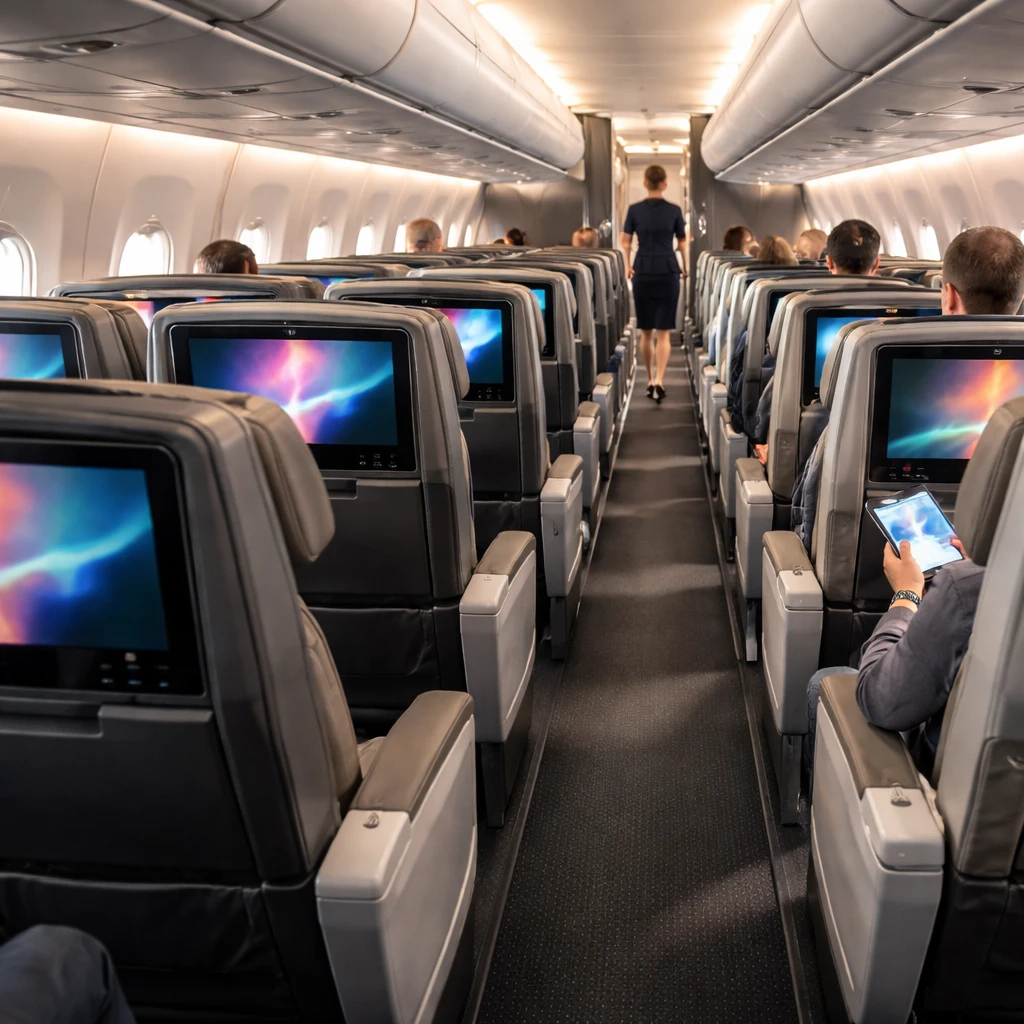
American Airlines announced plans to reconfigure its narrowbody aircraft to include a higher proportion of premium seats and to restore seatback entertainment screens, signaling a renewed focus on attracting travelers who pay more for upgraded experiences.
The carrier said premium seating will make up about 40% of seats on narrowbody departures in the coming years, up from roughly 25% at present. The change will involve adding more first class seats and offering additional main cabin seats with extra legroom as existing aircraft are reconfigured and as new jets enter the fleet.
Company data cited in the announcement show premium travelers accounted for nearly half of ticketed revenue in the second quarter while representing about 30% of seats. The move is part of a broader effort by Chief Executive Robert Isom to push premium upgrades as a way to boost earnings amid intensified competition among U.S. carriers for higher-margin customers.
Return of seatback screens
American is reversing a strategy adopted nearly a decade ago that reduced the prevalence of seatback entertainment in favor of passenger-owned devices. The airline said customer preferences have shifted, with younger flyers increasingly wanting access to larger screens alongside their personal devices. The carrier also pointed to improvements in high-speed satellite Wi-Fi, which enable a more connected and personalized onboard experience.
Ultimately, American expects more than 800 narrowbody aircraft to be equipped with seatback screens. Retrofits are scheduled to begin in 2028 and are projected to be completed in the early 2030s. In addition, new Airbus and Boeing deliveries that include seatback entertainment are slated to begin arriving in 2028. The airline already has more than 140 widebody and Airbus A321XLR aircraft fitted with seatback screens.
American declined to provide an estimate of how much it expects to spend on the seatback program.
Profitability context and leadership pressure
Despite the initiative, American continues to trail Delta Air Lines and United Airlines in profitability, a gap Isom has acknowledged as "meaningful." The disparity has increased scrutiny on management. Earlier this year flight attendants called for a leadership change, and the pilots union questioned whether the current management team can deliver the needed improvement.
American currently expects roughly break-even results for the year, while Delta and United have forecast solid profits. Last week Isom implemented changes to senior management as part of efforts to close the performance gap.
This strategic reorientation — concentrating on premium seating and restoring seatback entertainment across a large portion of the narrowbody fleet — aims to capture more high-yield revenue, but the company has not disclosed the financial commitment required to execute the plan. The timeline extends into the early 2030s for retrofit completion, with new aircraft deliveries beginning in 2028.