
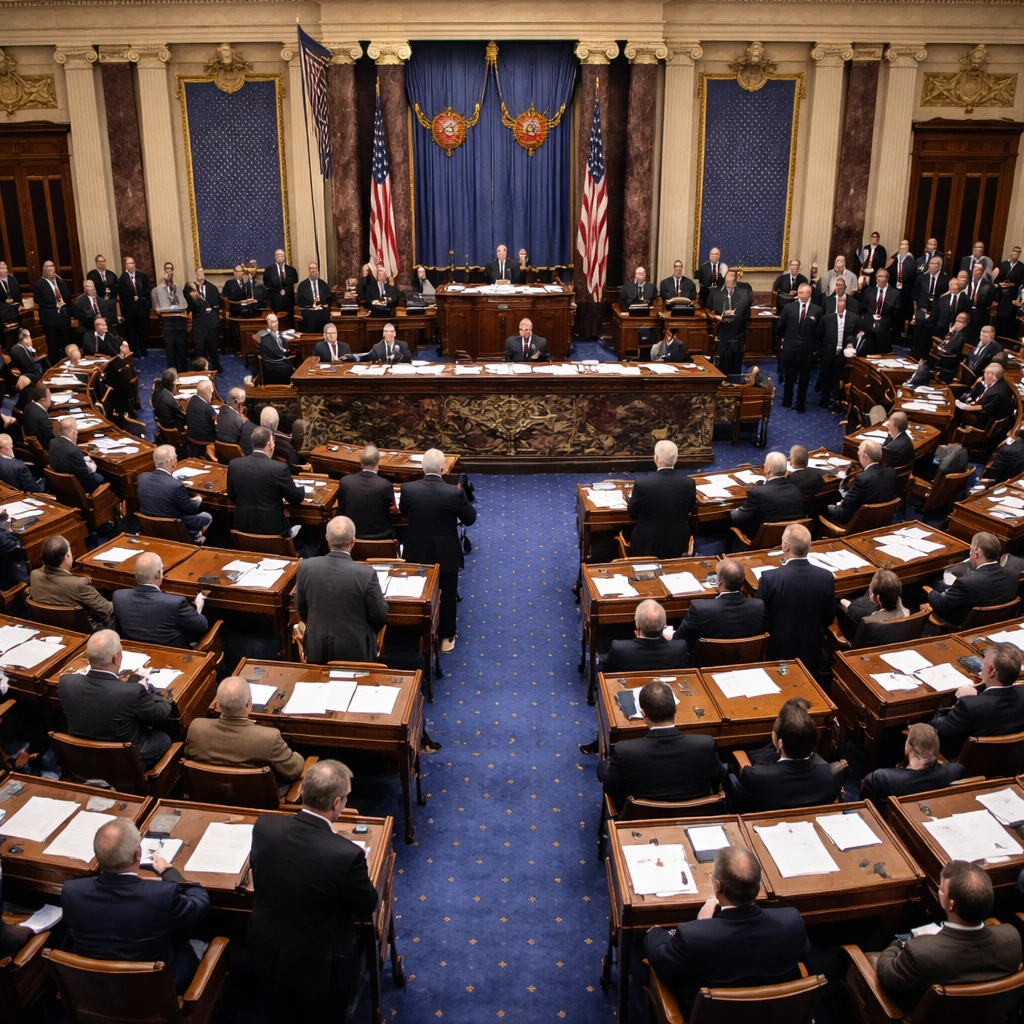
The U.S. Senate approved a concurrent resolution on Tuesday that directs President Donald Trump to remove U.S. armed forces from hostilities against Iran, with the chamber voting 50-48 in favor. Four Republican senators crossed party lines to vote with nearly the entire Democratic caucus, underscoring bipartisan unease with the conflict that began at the end of February.
The measure had previously cleared the House of Representatives earlier this month. It invokes the War Powers Resolution, the 1973 law designed to define congressional authorization for the use of U.S. armed forces abroad, by directing the president to end military action against Iran.
Republican supporters of the concurrent resolution included Bill Cassidy of Louisiana, Susan Collins of Maine, Lisa Murkowski of Alaska, and Rand Paul of Kentucky. The only Democrat to vote against the resolution was John Fetterman of Pennsylvania. Senate Republican Leader Mitch McConnell and Senator Dave McCormick did not cast votes.
Despite passage in both chambers, the resolution is widely expected to have limited practical effect. Under the War Powers Resolution the measure does not get sent to the White House for the president's signature. In addition, noted analysis from the Brookings Institution earlier this month cautioned that "even if invoking the War Powers Resolution ultimately receives majority support in both chambers, the administration is unlikely to comply. (The congressional resolution is subject to a presidential veto, and there are no immediate prospects of mustering the two-thirds majority needed to override it,)" the institution said. The analysis added that the debate may nonetheless increase public awareness of the legal mechanism and underscore the constitutional principle that the president cannot take the country to war without congressional assent.
The Senate vote arrived as diplomatic momentum between the United States and Iran appeared to shift toward a more positive track. According to the report, the two sides have signed an interim memorandum of understanding that has reopened the Strait of Hormuz and set the stage for further negotiations toward a final agreement.
Public sentiment has reflected concern over the conflict's costs. A Reuters/Ipsos poll that closed on Monday showed that only one in five Americans believed President Trump's war with Iran was worth its costs, and that a majority of respondents doubted a truce with Tehran would endure.
Analysis
The Senate action highlights the political friction around executive-led military engagements and the limited tools Congress can deploy under current practice. While the resolution signals congressional disapproval and raises public attention, procedural constraints and the administration's likely resistance limit near-term prospects for compelling a change in military posture.
Context limitations - The reporting here reflects the developments and commentary described in the Senate vote, the War Powers framework, the Brookings Institution assessment, the reported interim diplomatic steps, and the Reuters/Ipsos polling results. Where details are limited in those sources, this account does not add further claims or outcomes beyond what was reported.