
COMMERCE CITY, Colorado, June 25 - Latino voters in and around Denver’s Commerce City describe a mix of frustration with the national political climate and skepticism about the promises they have been offered. For some, that has meant moving away from the president who won their votes in 2024; for others, it has meant remaining uncommitted and unwilling to switch to the Democratic Party without clearer plans to ease everyday costs.
Gerardo Verdugo, 24, who runs a Mexican candy shop in Commerce City, said he backed Donald Trump in 2024 hoping for an economic revival. Instead, he said, tariffs increased the price of the imported sweets he sells. Encounters he has witnessed with masked immigration agents targeting fellow Latinos have also deepened his disappointment. Yet Verdugo stopped short of embracing Democrats, saying he felt stuck "in the middle" and undecided about his vote.
Colorado’s 8th Congressional District is a clear example of how mutable Latino allegiances have become. Forty percent of the district’s population identifies as Latino. The seat has swung between parties in recent cycles: a Democrat won in 2022, Republican Gabe Evans captured it in 2024, and it is again competitive heading into 2026. In the coming November midterms, Evans will face whoever prevails in the Democratic primary contest between Manny Rutinel, a Dominican-American state legislator, and Shannon Bird, a former state legislator.
Polling and conversations with voters, organizers and strategists suggest Latinos are among the most changeable blocs in the electorate, often shifting their support in response to economic conditions. They were a substantial part of the coalition that helped elect the president in the last election and are widely seen as central to efforts to flip the House of Representatives in the next cycle.
Recent surveys show shifting attitudes. A Pew survey in April found the president’s approval among Latinos who supported him in 2024 has fallen by more than a quarter. A separate Reuters/Ipsos poll this month found overall approval among Latino voters at 27%, down from 36% at the start of the president’s second term. Yet that decline has not automatically translated into stronger Democratic backing.
A bipartisan poll conducted in May by BSP Research and Shaw & Company on behalf of UnidosUS sampled 3,000 Latino voters and found one in five remained undecided heading into the midterms. The poll also suggested both parties are underperforming relative to their 2024 support levels among Latino voters. Economic concerns dominated respondents’ priorities: the top four issues named were all tied to the economy, according to BSP pollster Gabriel Sanchez, who described the prevailing sentiment as an openness to proposals that ease the cost of living.
Those priorities came through repeatedly in more than 50 interviews and field conversations across the 8th District. Many residents express fatigue with the president and his policies, but an equal or greater weariness with the perceived stagnation of political options generally. Voters say they are still waiting for candidates to make concrete commitments that would materially improve their day-to-day finances and well-being.
Analysts and organizers on both sides outline distinct challenges for their parties. Republicans are tethered to a president whose approval among Latino voters has weakened, and they have yet to replicate the intense grassroots momentum that aided the president’s gains with Latino voters in the previous cycle. Democrats, in turn, have invested heavily in outreach and appear to have an early advantage in engagement, but critics argue they are not persuading voters that they can deliver on cost-of-living concerns.
Republican strategists regard Colorado’s 8th as one of more than a dozen House races nationwide where Latino voters could be decisive. Party operatives say Republican outreach will emphasize the president’s signature tax cut for tipped workers - referred to internally as the "Big Beautiful Bill" - while giving local candidates leeway to distance themselves from the president on immigration matters.
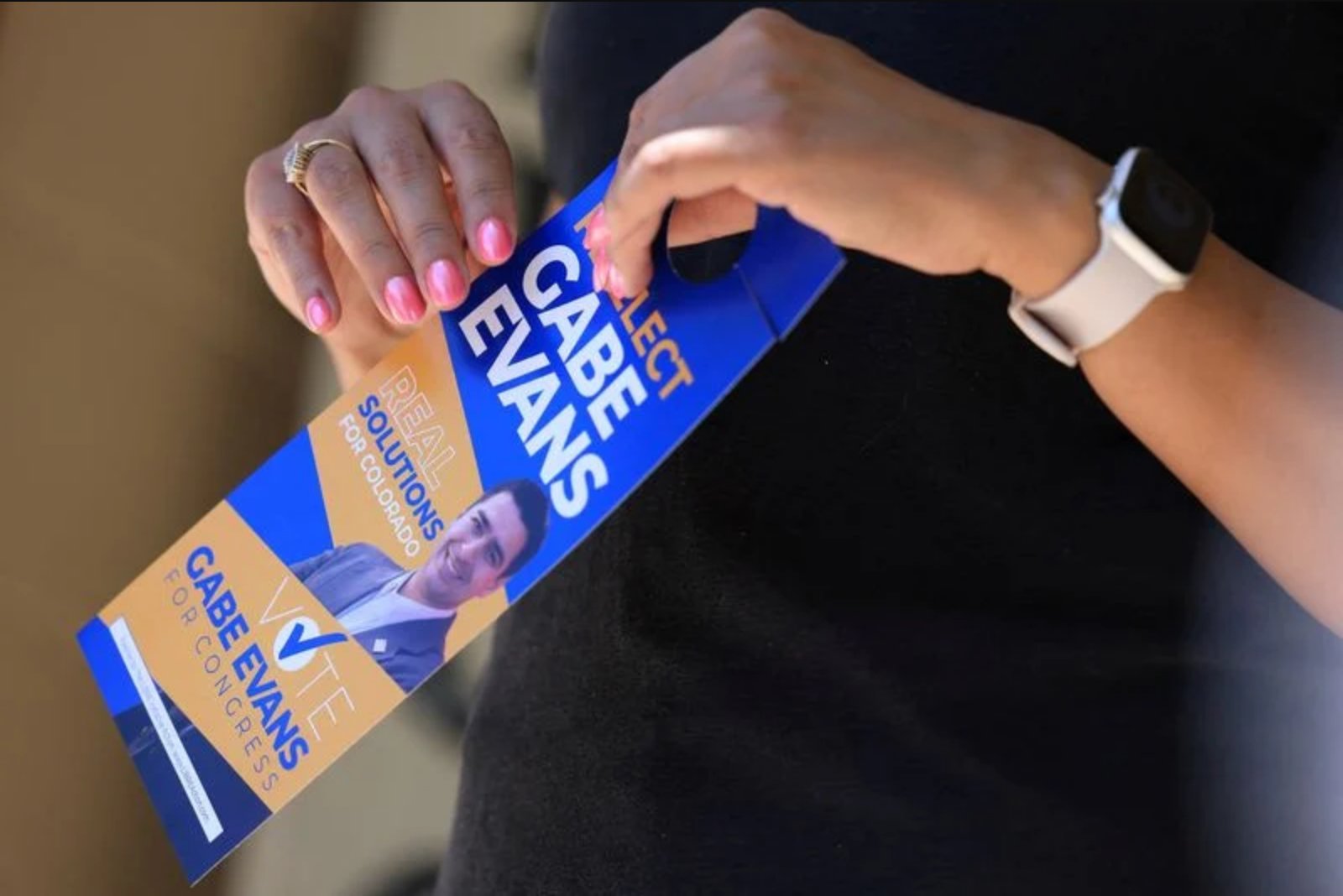
Evans, who is the grandson of a Mexican immigrant, has co-sponsored the DIGNIDAD Act, a bipartisan proposal that pairs increased border security with a pathway to legal status for some immigrants living in the country illegally. He is also leaning on working-class themes to connect with Latinos who say they are feeling economic strain.
But enthusiasm that propelled Trump among Latino voters in 2024 has not necessarily carried into the midterm cycle, according to Denise Galvez Turros, co-founder of Latinas for Trump. The group played a significant role in mobilizing Latina voters for the president last cycle, she said, but the political energy that existed in 2024 has not simply translated into support for other Republican candidates. Galvez Turros suggested many of the Latina voters her group mobilized were focused specifically on electing Trump and may not be motivated to turn out for Republicans more broadly in November.
On-the-ground outreach in the district has been led in part by conservative organizations. The LIBRE Initiative has knocked on thousands of doors in the 8th since January to generate support for Evans. Angel Merlos, LIBRE’s strategic director for Colorado, said the people his canvassers encounter have significant reservations about the president and are often undecided. Merlos said Republican campaigns should emphasize tax relief and a willingness to work across party lines in Washington.
Democrats see the district as a highly winnable opportunity but acknowledge weaknesses in their message. Stacy Suniga, founder of the nonpartisan Latino Coalition of Weld County, said Democrats could retake the seat but criticized the party for not offering bolder, more progressive economic proposals. She urged candidates to deliver policies that break with business-as-usual approaches.
At a recent debate, both Democratic primary contenders, Rutinel and Bird, centered their remarks on affordability and criticized the president’s cuts to Medicaid, aligning with national Democratic themes. The Democratic Congressional Campaign Committee has moved early this cycle, launching an eight-figure nationwide advertising campaign focused on Latino and rural voters beginning in November, months earlier than is typical. The ads fault Republicans for the president’s tariffs, reductions in food assistance and rising gasoline prices.
Democratic-aligned civic groups are intensifying field operations as well. Mi Familia Vota has been active knocking on doors in Fort Lupton, north of Commerce City. Voto Latino is testing affordability messages across 20 battleground states and is coordinating a registration push in August with Latino organizations at the University of Northern Colorado. Beatriz Lopez, Voto Latino’s executive director, described the effort as an "immense opportunity to flip that district."
Voters like Olivia Dominguez, 61, a Fort Lupton salon owner, personify the dilemmas facing both parties. Dominguez said her salon’s rent recently rose by 50% and the cost of nearly every beauty product she uses has increased. Yet she and others point out that the Biden administration has presided over years of high gasoline prices and persistent inflation, leaving them cautious about promises that Democratic policies alone will ease their burdens.
Dominguez said she will vote for the candidate who presents the most credible economic plan, describing her decision in practical terms: "whoever has some kind of sense in their brain about the economy." Such pragmatic calculus underscores why both parties are intensifying efforts to demonstrate tangible benefits to voters facing higher prices and other economic pressures.
The 8th District’s large Latino population, ongoing local and national outreach by both parties, the presence of vigorous civic groups on the ground, and the unsettled nature of voter preferences suggest the seat will remain hotly contested. Voters in the district appear to want specific, actionable policy proposals that address the cost of living, even as immigration enforcement and tariff effects continue to shape political attitudes. With one in five Latino voters still undecided according to recent polling, the race in November is likely to turn on which party convinces the most persuadable voters that it can deliver economic relief.