
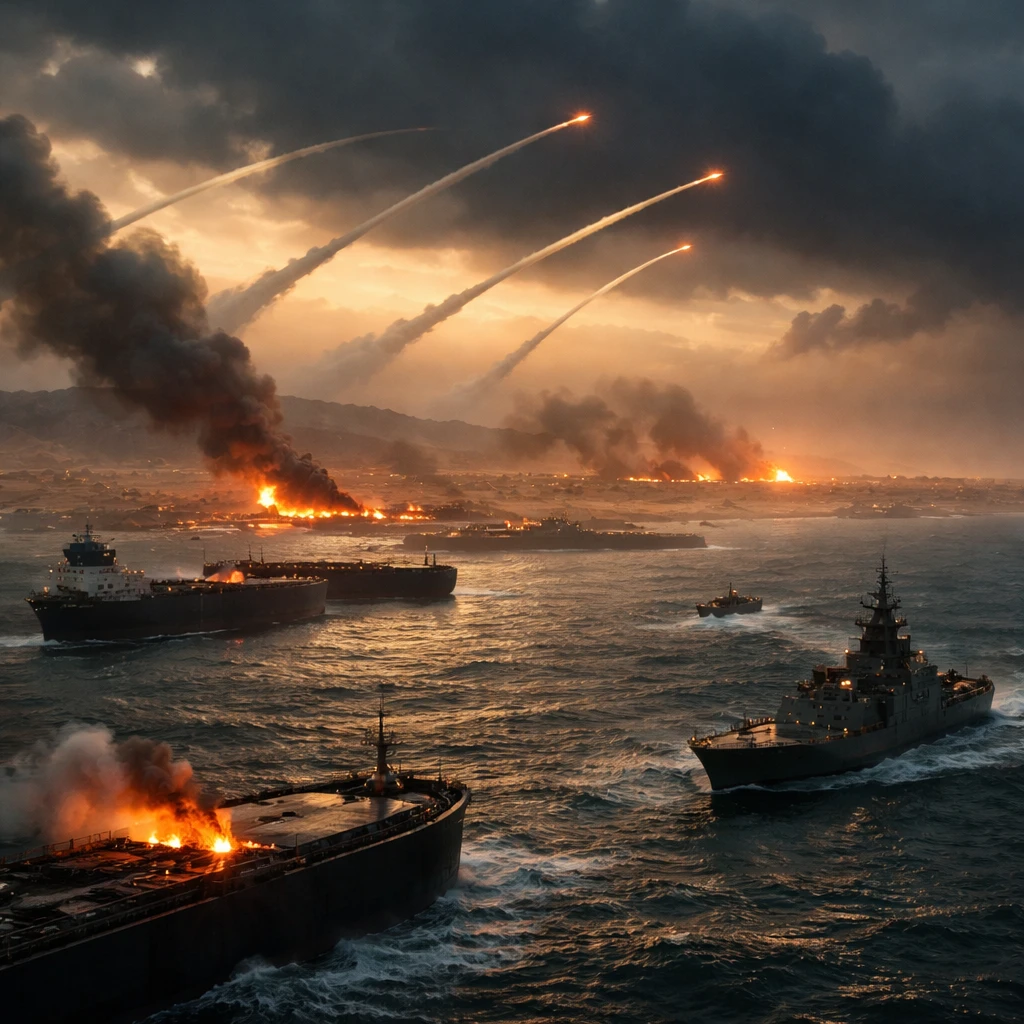
Iran escalated its confrontation with U.S. forces on Wednesday, the country's Islamic Revolutionary Guard Corps (IRGC) said, describing a missile strike on a U.S. military base near Al Azraq in eastern Jordan as "fierce." The move came after the U.S. military reported it had destroyed five Iranian oil tankers.
Jordan's armed forces reported that their air defences intercepted 18 of 20 ballistic missiles fired toward the country, saying the two missiles that were not intercepted fell in unpopulated areas. Authorities reported no casualties.
In addition to the strike on the Jordan base, the IRGC said it attacked 10 vessels in and around the Strait of Hormuz, identifying the targets as two U.S. ships and eight oil tankers. The statement expanded on a series of incidents in the region that have involved both military and commercial vessels.
U.S. Central Command said crews on the five oil tankers were ordered to abandon the vessels before they were struck and rendered inoperable. The command also said a U.S. Navy warship successfully evaded two attempted ballistic missile strikes, remained on patrol in regional waters, and that no American personnel had been harmed.
The Iranian strikes followed an American announcement that the United States had destroyed five Iranian oil tankers after Iran's Revolutionary Guards twice attempted to strike a U.S. Navy warship with ballistic missiles. U.S. Secretary of State Marco Rubio warned Tehran earlier that Washington would continue to strike Iranian oil tankers in retaliation for attempted attacks on U.S. warships.
The latest exchange of strikes and counterstrikes came amid additional regional violence. Iran-backed Houthi forces carried out attacks on Saudi Arabia on Tuesday that struck energy and economic facilities in several southern cities and injured more than 70 people, according to reporting on those incidents.
Market reactions were swift: the confrontation has heightened concerns that the six-month-old conflict could further disrupt shipping through the Strait of Hormuz, a vital channel for global oil supplies. Oil prices rose toward $100 a barrel on Wednesday as investors weighed the possibility of additional supply interruptions.
The sequence of events - missile strikes, ship attacks and retaliatory destruction of tankers - has broadened the geographic scope of the confrontation and underscored vulnerabilities in both maritime traffic and energy infrastructure. At present, official statements indicate no U.S. personnel casualties and no reported injuries from the missile impacts inside Jordan, while damage to targeted vessels has left them inoperable according to U.S. military officials.