
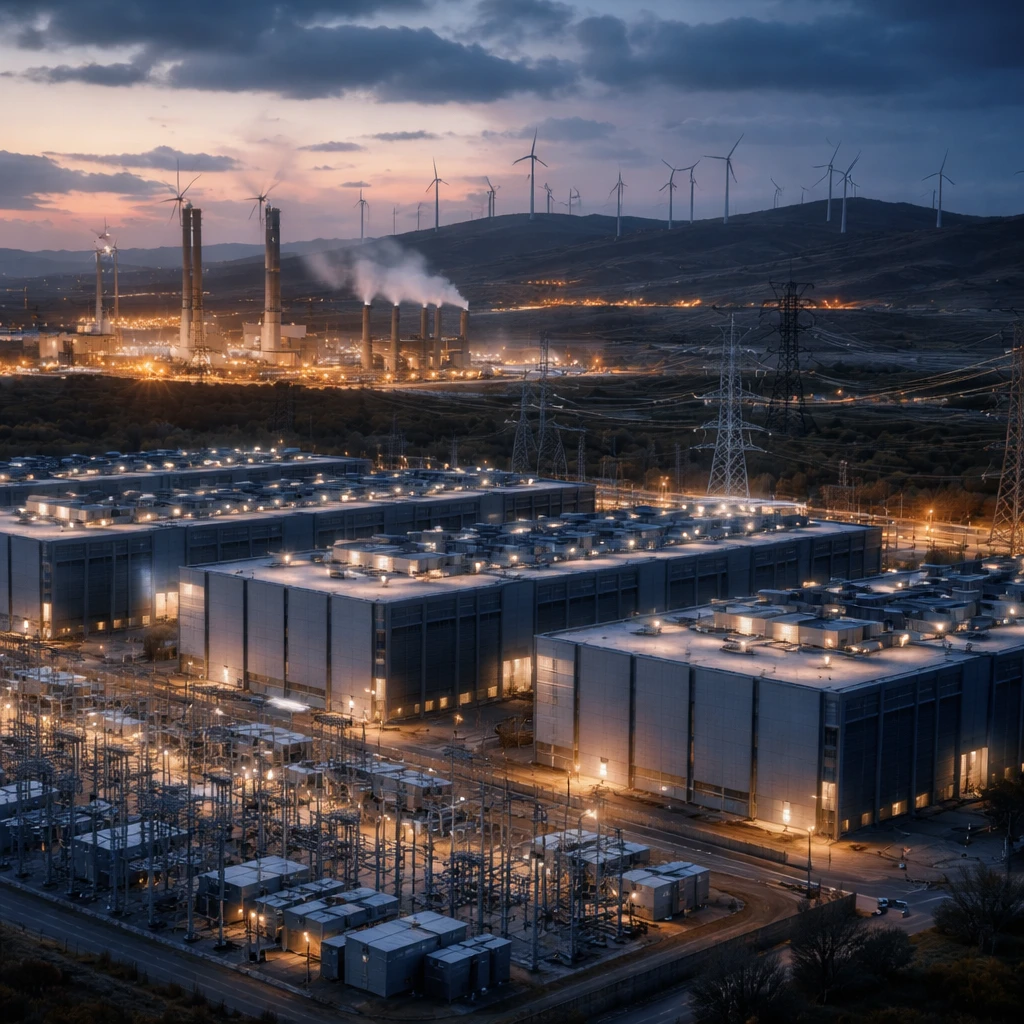
The U.S. Energy Information Administration (EIA) on Tuesday projected that national electricity consumption will continue to rise after reaching what the agency expects to be a record annual total in 2025. The EIA attributed the climb to expansion of data centers serving artificial intelligence and cryptocurrency operations, in addition to wider electrification.
Under the agency's outlook, total U.S. power demand is forecast to reach 4,269 billion kilowatt-hours in 2026 and 4,399 billion kWh in 2027, following an estimated 4,195 billion kWh in 2025.
Demand by customer class
The EIA expects a notable shift among end-use sectors in 2026. For the first time on record, commercial-sector electricity sales are projected to exceed residential sales. Commercial power sales are forecast at 1,550 billion kWh in 2026, while residential sales are expected to drop to 1,508 billion kWh. Industrial-sector sales are forecast at 1,065 billion kWh.
By comparison, the agency reports that in 2025 residential sales were 1,515 billion kWh and commercial sales were 1,493 billion kWh.
Generation mix outlook
The EIA's projections also outline changes in the composition of electricity generation. Coal's share is expected to fall from 17% in 2025 to 15% in both 2026 and 2027. Natural gas is projected to maintain a 40% share through 2027, unchanged from its 2025 share. Renewables are forecast to increase from 24% of generation in 2025 to 25% in 2026 and 27% in 2027. Nuclear generation is projected to remain steady at 18% in both 2026 and 2027.
Natural gas flows
On the fuel-consumption side, the EIA expects natural gas deliveries for power generation to reach 36.6 billion cubic feet per day (bcfd) in 2026, which would remain below the record 36.8 bcfd set in 2024. Industrial natural gas consumption is forecast to rise to 24.0 bcfd, surpassing the previous high of 23.8 bcfd recorded in 1973.
These projections reflect the EIA's assessment of demand-side drivers such as data center activity and broader electrification, as well as anticipated shifts in the fuel mix used to generate electricity through 2027. The agency's outlook provides a baseline for how consumption and generation shares could evolve over the next two years under current assumptions.