
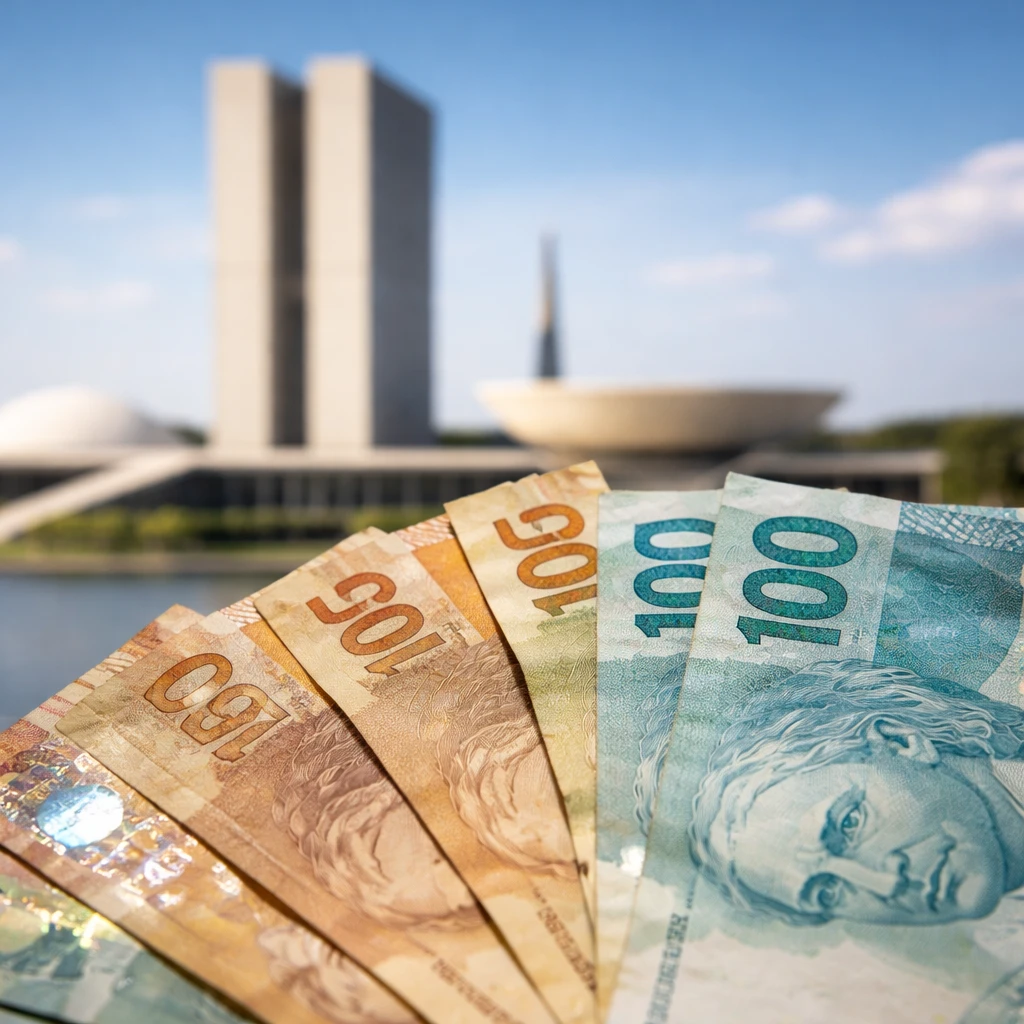
Brazil’s upcoming October presidential ballot frames a sharp political contrast between a leftist incumbent and a challenger aligned with the country’s recent far-right leadership. Still, market participants and economists increasingly treat the contest as one that will yield broadly similar fiscal results: continued increases in public debt.
Flávio Bolsonaro, the son of former President Jair Bolsonaro, has run a campaign that highlights economic distress as he seeks to displace President Luiz Inácio Lula da Silva, who retains a slim lead in opinion polls. Despite that polar choice, investors and analysts are sizing the fiscal outlook more by institutional constraints than by differences in party labels.
Roberto Secemski, Barclays’ chief Brazil economist based in New York, said stabilizing Brazil’s debt by 2031 would demand a fiscal consolidation equivalent to at least 2.5 percentage points of gross domestic product - about 350 billion reais. He argued it is unlikely either candidate could enact the whole of that adjustment, and so early steps from the eventual winner will be watched closely as signals that more will follow.
Those signals matter because Brazil’s budgetary structure and political realities make deep cuts difficult to execute. The 2026 budget law treats 92% of primary spending as mandatory, leaving discretionary outlays at roughly 2% of GDP. That dynamic forces any durable consolidation to tackle politically sensitive items such as pensions, payrolls, social benefits and the automatic indexation of many expenditures.
Secemski emphasized the challenge: "There are virtually no 'low hanging fruits' in the fiscal effort to be pursued ahead." That constraint is compounded by the makeup of the legislature: voters will also elect all 513 members of the lower house and 54 of 81 senators, meaning the president’s capacity to pass reforms depends heavily on the Congressional result.
Independent research houses model varying outcomes under different political scenarios but still foresee rising debt profiles. TS Lombard projects that, even if President Lula pursues post-election spending reforms, those measures would leave gross government debt peaking at 94.7% of GDP in 2034. Its scenario modeling a faster adjustment under Bolsonaro - including a proposed spending rule linked to debt dynamics - still shows debt at a peak of 90% of GDP in 2032. TS Lombard also noted Bolsonaro has previously retreated from proposals to alter automatic indexation after meeting political resistance.
Asked whether Bolsonaro might be more willing to pursue tougher measures, Marcelo Kalim, CEO of Brazilian digital bank C6, said: "Maybe he'd have a greater willingness. But I think you only know once someone actually has the pen in hand." The comment underscores how intent and political feasibility can diverge when facing entrenched budgetary commitments.
Recent fiscal outcomes underscore the scale of the problem. Central bank data show Brazil’s nominal deficit averaged 8.6% of GDP from 2023 through 2025, widening to 9.99% in the 12 months through June. Gross government debt stood at 81.9% of GDP, having risen 3.3 percentage points in the first half of the year. Meanwhile, a central bank survey of market economists finds expectations of primary deficits through 2029, which contrasts with official government targets.
On the currency front, the real’s strength has helped temper investor anxiety even in the face of weak fiscal prospects. The real is 5.8% stronger against the U.S. dollar so far this year and nearly 20% stronger since the end of 2024. Observers point to a combination of a 14% benchmark policy rate, annual inflation running at 4.44%, a comparatively weak dollar, improved external accounts and favorable terms of trade as supporting factors behind the currency’s resilience.
Interest-rate differentials remain large enough to underpin carry trades. The central bank’s weekly survey of economists puts the median forecast for the benchmark rate at 13.75% by year-end and 12% in 2027. Morgan Stanley has suggested the unusually high carry on the real could blunt some election-driven price moves by shifting a portion of repricing into domestic interest rates.
Capital flows have shown signs of caution. The Institute of International Finance estimates non-residents withdrew $4.2 billion from Brazilian equity and debt portfolios between March and June, following net inflows of $18.8 billion in January and February. Richard Hall, an emerging markets portfolio manager at T. Rowe Price, said hedge funds and local investors have trimmed exposure, leaving less fuel for a sudden sell-off than earlier this year.
High interest rates are exacting domestic costs. Analysts note rising corporate bankruptcies and climbing household indebtedness. Still, several portfolio managers believe the next president may have only limited influence on the real’s trajectory. Hall warned that an external shock combined with mounting stress on indebted households and weaker firms could force a more pronounced slowdown, a weaker currency and even higher interest rates.
Pramol Dhawan, head of emerging-market portfolio management at PIMCO, stressed that the economy’s structural constraints are likely to loom larger than the elected leader’s ideological stance. He said without renewed fiscal credibility, Brazil would struggle to create the conditions for a sustained fall in interest rates, intensifying pressures on growth and public debt. "The only question," he added, "is whether that adjustment happens proactively or is ultimately imposed by market forces."
Financial-market participants will therefore track the election outcome along with the legislative elections closely, looking for credible early measures from the incoming administration and signs of Congressional cooperation. Given the size of fiscal tightening required to stabilize debt and the limited discretionary budget, observers say those early actions must be sufficiently meaningful to convince investors that a broader consolidation is feasible.
(Currency conversion used in this analysis: $1 = 5.1479 reais.)