
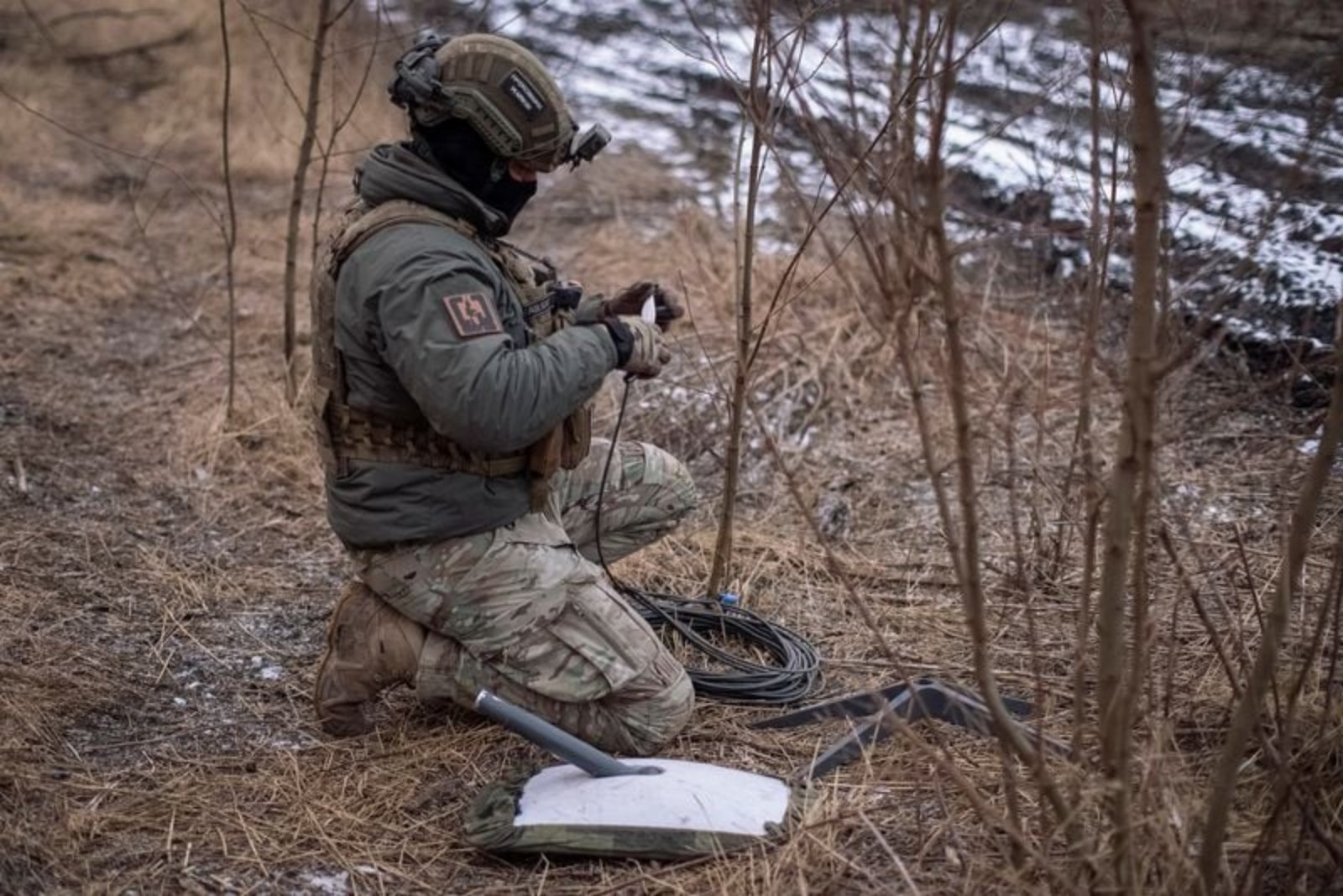
ZAPORIZHZHIA REGION, Ukraine, July 8 - Russian forces are attempting to blunt Ukraine’s so-called mid-strike drone campaign by concealing military cargoes and deploying powerful electronic jammers that can interfere with Starlink satellite internet links, Ukrainian drone commanders and pilots said during a visit to the 422nd Unmanned Systems Regiment in southern Zaporizhzhia.
Kyiv’s development of relatively low-cost drones capable of striking targets dozens of kilometres behind the front lines - many of which are controlled via Starlink - has altered the operational environment. In a series of coordinated mid-strike operations this year, Ukraine has targeted supply convoys, fuel storage sites, air-defence positions and command hubs, producing logistical disruptions for Russian forces and contributing to fuel shortages in areas of Russian-occupied Crimea, the commanders said.
Jamming and countermeasures
According to the commanders and pilots who spoke with the visiting team, Moscow has adopted a range of measures to protect fuel and other military supplies. Those measures range from disguising military cargoes in civilian vehicles to installing sophisticated electronic jamming systems intended to sever or destabilise the communications links used to operate the drones.
Several jamming units have been placed near towns and military sites, the Ukrainian personnel said, and some of these units are able to disrupt Starlink terminals. Most of Ukraine’s mid-strike missions have relied on Starlink to allow a remote pilot to command a drone - a connection previously regarded as relatively resilient to jamming.
Serhii Beskrestnov, an advisor to Ukraine’s defence ministry, identified one deployed system by name: the Volna Kupol Garant. He said it emits a signal strong enough to destabilise Starlink connections across an area of roughly 20 square kilometres (7.7 square miles). Beskrestnov added that about 10 such systems have been detected to date.
Where jammers are installed, they have become high-value targets for Ukrainian drone teams. The 422nd regiment has participated in operations to strike at least two of the jamming installations, including one attacked several hours after it was detected in a joint operation involving the SBU security service, according to Kolesnyk, a unit commander.
A video of one such strike showed a large explosion after a drone hit a site containing six large box-like structures resembling trailers. One crew commander who uses the callsign 'Dyryhent' said: "As soon as we struck that installation, our Starlink-equipped (drones) flew without problems."
SpaceX has restricted access to Starlink for Russian forces to prevent Moscow from using it in its own drone strikes, the commanders noted. SpaceX did not reply to a request for comment, and Russia’s defence ministry also did not respond to inquiries. The visiting team was not able to independently verify the full extent of the tactics Russian forces are using to avoid strikes.
Camouflage, mixed convoys and concealment
During the visit to the 422nd regiment, soldiers prepared a winged drone known as the "Zozulya" or "Cuckoo." Operating in the dark by the light of headtorches, they loaded a high-explosive warhead and launched the unmanned aircraft by catapult. The drone flew southeast toward Crimea under cover of night, on a mission targeting a base used by Russian drone pilots.
Kolesnyk and other commanders described several methods Russian forces are now using to shield vital supplies. They reported that fuel tankers have been hidden inside civilian trucks and milk tankers repainted to appear non-military, only to be found carrying diesel or gasoline. Convoys of fuel tankers are sometimes escorted by pickup trucks with mounted machine guns and use smaller roads to avoid detection.
Ukraine’s military intelligence also told the visiting team that Russian forces have begun transporting fuel, ammunition and provisions using small civilian cars, quadbikes and motorcycles. Supplies are being concealed in camouflaged dugouts, abandoned structures, agricultural buildings and even civilian petrol stations that serve as storage points for military fuel.
Operational limitations and ongoing risks
Experts and commanders acknowledge that while the mid-strike campaign has been a significant battlefield development this year, Russian forces have begun to make inroads into countering it. Rob Lee, a senior fellow at the Foreign Policy Research Institute, said that if Russia is able to scale production of jamming systems, it could complicate Ukraine’s ability to sustain the middle-strike campaign.
Even so, the mid-strike effort has not halted Russian attacks against Ukraine, and Russia still occupies about one-fifth of Ukrainian territory four years into the full-scale invasion, the commanders noted. Not every Ukrainian drone attack succeeds; during the visiting team's time with the 422nd regiment, a RAM-2X drone fired at a fuel tanker missed its target, and a surveillance drone that had been tracking the truck was later shot down by a Tor surface-to-air missile.
One of the crewmen reflected on that engagement: "At least we know it’s there now," he said, after logging the Tor system into Ukraine’s digital battlefield targeting network - effectively marking it for potential future action.
Outlook
Ukrainian commanders described a dynamic interplay between offensive drone operations and Russian countermeasures. Jamming equipment and concealment practices have emerged as key elements of Moscow’s response, while Ukrainian units continue to attempt targeted strikes on installations and supply nodes when they can be located. The situation remains fluid, and the commanders emphasized that both sides continue to adapt their tactics in response to each new development.