
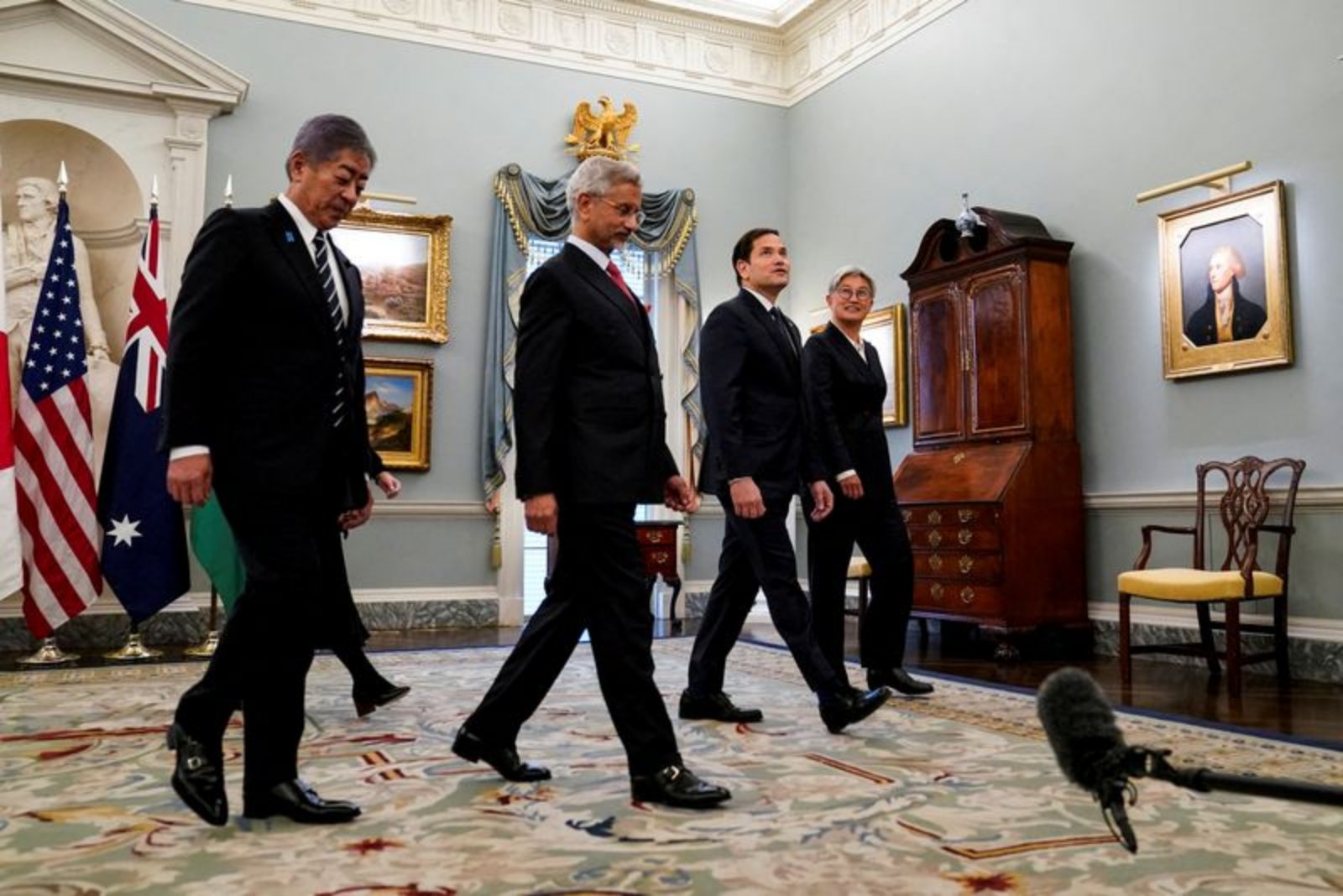
Foreign ministers from Australia, India, Japan and the United States are meeting in New Delhi as they attempt to reinvigorate the Quad, the Indo-Pacific grouping that critics say has lost some traction under the current U.S. administration. The ministers - Australia’s Penny Wong, India’s S Jaishankar, Japan’s Toshimitsu Motegi and U.S. Secretary of State Marco Rubio - will hold their third ministerial meeting since September 2024.
The four countries had anticipated a leaders’ summit in India last year, but that summit did not take place amid tensions between the U.S. president and India’s prime minister over Washington’s tariffs and other bilateral disputes. Despite those strains, officials from the Quad partners continue to emphasize shared concerns about China’s expanding influence in the region and are looking to translate diplomatic engagement into practical cooperation.
U.S. Secretary of State Rubio, who arrived in India on Saturday for a four-day visit intended to shore up ties with New Delhi, framed the grouping as more than a periodic alignment of like-minded capitals. "We don’t just want the Quad to be a semi-annual meeting of like-minded countries," Rubio said in an interview with Indian media on Sunday. "We want it to actually be a forum on which we continue to partner on things."
Rubio said the United States is seeking "concrete actions" on issues such as maritime security and critical minerals. He indicated that diplomats at the meeting would also work toward arranging a leaders’ meeting later this year. "I don’t have a date on that yet, but hopefully this year we’ll find a time for all four leaders to get together," Rubio said.
For Tokyo, diversifying supplies of critical minerals is a particular priority. According to the material presented in advance of the meeting, Japan seeks alternatives after Beijing halted shipments of certain materials used across aerospace, defence and chip-making industries during a prior diplomatic dispute. This supply sensitivity has elevated the importance of secure access to critical inputs among Quad partners.
The Quad meeting is taking place against the backdrop of developments in the Middle East. The United States and Iran have been circling a possible deal to end a three-month conflict and to reopen the Strait of Hormuz. Tehran’s closure of the strategically vital waterway has disrupted energy markets and created broader economic disturbance, issues that are expected to feature in discussions among the ministers.
Previous Quad gatherings have advanced initiatives aimed at preserving what the partners describe as "the free and open maritime order" across the Indo-Pacific. Those initiatives have included efforts to improve information gathering on maritime activity in shared waters, a continuing focus that is expected to reappear at the New Delhi meeting.
A Japanese foreign ministry official said last week that ministers would likely raise the U.S.-Israeli war on Iran, as well as rising tensions in the East China Sea and the South China Sea. The official noted that Beijing’s increased military activities in contested waters have heightened friction with Tokyo, the Philippines and other governments in the region.
Beijing has criticized the Quad as a Cold War-style construct intended to contain China’s development. India itself has outstanding territorial disputes with China, though Prime Minister Narendra Modi has signaled an openness to improving relations with Beijing even as New Delhi pressed for a visit from the U.S. president - a trip that would likely be linked to any future Quad summit.
Analysts have questioned whether the Quad’s relevance has been diminished by a lack of sustained leader-level engagement. The Japanese official emphasized that the timing of any leaders’ meeting would be decided by the host nation, India, saying, "It is quite difficult to get all four leaders together."
The broader political backdrop includes significant distractions for the U.S. president, who has been engaged in efforts related to the conflict in Iran, the unresolved war in Ukraine and global trade policies that have strained ties with Quad partners. Still, in a recent telephone appearance at a U.S. reception in New Delhi, the U.S. president praised India’s prime minister, saying, "I loved the Indian prime minister" and adding, "India can count on me, 100%."
As the ministers convene in New Delhi, the meeting will test whether the Quad can move beyond episodic summits and deliver on the concrete areas of cooperation its members have identified - notably maritime security and the supply of critical minerals - while navigating sensitive bilateral tensions and broader geopolitical frictions affecting the Indo-Pacific and global markets.
Summary
The Quad ministers meet in New Delhi for their third such gathering since September 2024. Key items include maritime security, critical minerals and the prospect of a leaders’ summit later this year. The session occurs amid regional tensions involving China and disruptions to global energy markets linked to the Iran conflict.
Key Points
- Diplomatic push: The ministers aim to convert periodic engagement into concrete cooperation on maritime security and critical minerals.
- Market implications: Discussions touch on sectors such as energy (due to Strait of Hormuz disruption) and high-tech/defence supply chains (critical minerals).
- Leader-level coordination: Officials intend to work toward arranging a leaders’ meeting later this year, though timing remains uncertain and dependent on the host.
Risks and Uncertainties
- Regional flashpoints - Tensions in the East China Sea and South China Sea, as well as the U.S.-Israeli war on Iran, could complicate cooperative efforts and increase geopolitical risk for maritime and defence sectors.
- Energy market volatility - Closure of the Strait of Hormuz by Tehran has already upended energy markets and disrupted the global economy, posing continued risks to energy and transportation sectors.
- Diplomatic friction and timing - The absence to date of a leaders’ summit and strained bilateral ties related to tariffs and trade policies may limit the Quad’s ability to act decisively, affecting investor confidence in affected sectors.